
Short answer: a 40-hour, 20-entry IOLC 2027 course outline can build the concept base for the 2027 regional sitting, but completing every lesson does not by itself produce timed, mixed-problem performance. Audit the outline by asking what evidence each lesson leaves: can you state a rule from unseen data, apply it under time, and verify it? The Hanlin course note “2027 IOLC/NACLO Linguistics Olympiad enters a new season” (9 September 2026) lists the 2027 regional test as 7 March 2027 and labels a 40-hour regional outline with 20 numbered lesson entries. A separate Hanlin IOLC overview note (16 July 2026) describes the 2026 regional paper as a 3-hour paper with 4 puzzles; use that only as a planning reference and confirm the 2027 format with the current official notice. The official IOL site states that no prior knowledge of linguistics or languages is required, which supports a concept-light start, not passive completion. This audit treats the 20-entry document as operator course material, not an official IOLC syllabus.
1. What the 40-hour outline actually contains
The Hanlin outline is broad. Grouped from the operator’s list, the 20 numbered lessons cover the nature of language and problem types; morphology and syntax basics; places and manners of articulation; vowels and suprasegmentals; writing systems; phonology; verb grammar; semantics; number systems; “other” problem types and language families; and hard-problem strategy. Midterms and a final exam also appear between numbered lessons in the same 40-hour sequence, and review and strategy lessons close it. The breadth is useful, but breadth is not the same as mixed-paper output.
| Outline segment | Lesson entries as listed by the operator | Audit question |
|---|---|---|
| Foundations | 1-2: nature of language; language as a system, morphology and syntax basics | Can you state a rule from data, not only define terms? |
| Phonetics and phonology | 3-5, 8-9: articulation, vowels, suprasegmentals, phonology, phonology with morphology | Can you test a sound rule across every matching environment? |
| Morphology and syntax | 10-12: verbs; morphology and syntax; summary and writing-system extension | Can you separate grammatical role from sentence position and write a complete rule? |
| Writing and number systems | 6, 12, 13, 16: writing systems; extended writing practice; number-systems summary; number-systems practice and strategies | Can you decode an integrated system without a pre-made chart? |
| Semantics and other types | 14-15, 17: semantics; morphosyntax practice; other types and language families | Can you choose and justify one analysis when two seem possible? |
| Review, exams and strategy | 7, 18-20: core-rules review, final review, final-exam review, hard-problem strategy. Midterms and a final exam appear between numbered lessons. | Do review sessions produce timed evidence, or only re-reading? |
Scope note: this grouping is an audit aid, not a reordering of the operator’s sequence. The outline is not an official IOLC syllabus, and lesson titles do not tell you how much independent timed practice is included.
2. What the most recent operator-described regional paper demands
The 2026 regional paper is described in Hanlin’s IOLC overview note (16 July 2026) as a 3-hour paper with 4 puzzles. For 2027 planning, that description is useful because it exposes the output the course must train: translation under unfamiliar data, explicit rule statements, justified answers, and the discipline to abandon a failing hypothesis. These are teaching judgments about task demands, not official 2027 rules. The official IOL site’s general statement that problems require logical ability, patient work and outside-the-box thinking points in the same direction, but it does not confirm the 2027 IOLC regional format.
A 40-hour outline can teach the vocabulary of phonology and morphology, but a 3-hour four-problem sitting does not ask students to recite definitions in isolation. It asks them to allocate time, choose a first hypothesis, test it, and write enough visible reasoning to earn partial credit. A lesson that ends with “students can label places of articulation” has not yet shown that students can use that label inside a larger puzzle. If the 2027 paper changes format, the same audit still applies: confirm the current format, then ask what timed output the outline produces. For a separate mock protocol before 7 March, see IOLC 2027 Level Test: Run a 3-Hour, 4-Problem Mock Before March 7.
3. Gap 1: unit exercises are not mixed timed sets
A content outline can organise material by strand. That is sensible for teaching, but it can hide a performance gap. A student may finish the phonetics unit and still lose time when a phonology rule appears inside a morphology puzzle. The audit question is not “Was lesson 8 taught?” but “What did the student produce after lesson 8, under what time limit, and with what error pattern?”
Teaching illustration, not an official problem: suppose lesson 3 asks a student to label [t] as a voiceless alveolar stop. That is a useful check. In a mixed set, the same student meets a made-up language where [t] alternates with [s] before [i], but the data also contain a vowel-deletion rule. Labeling [t] correctly does not decide whether the change happens before or after deletion. The student must order the rules and verify both directions. The unit drill tested one label; the mixed problem tested rule interaction, ordering and verification. That is the gap to add after the unit, not a reason to skip the unit.
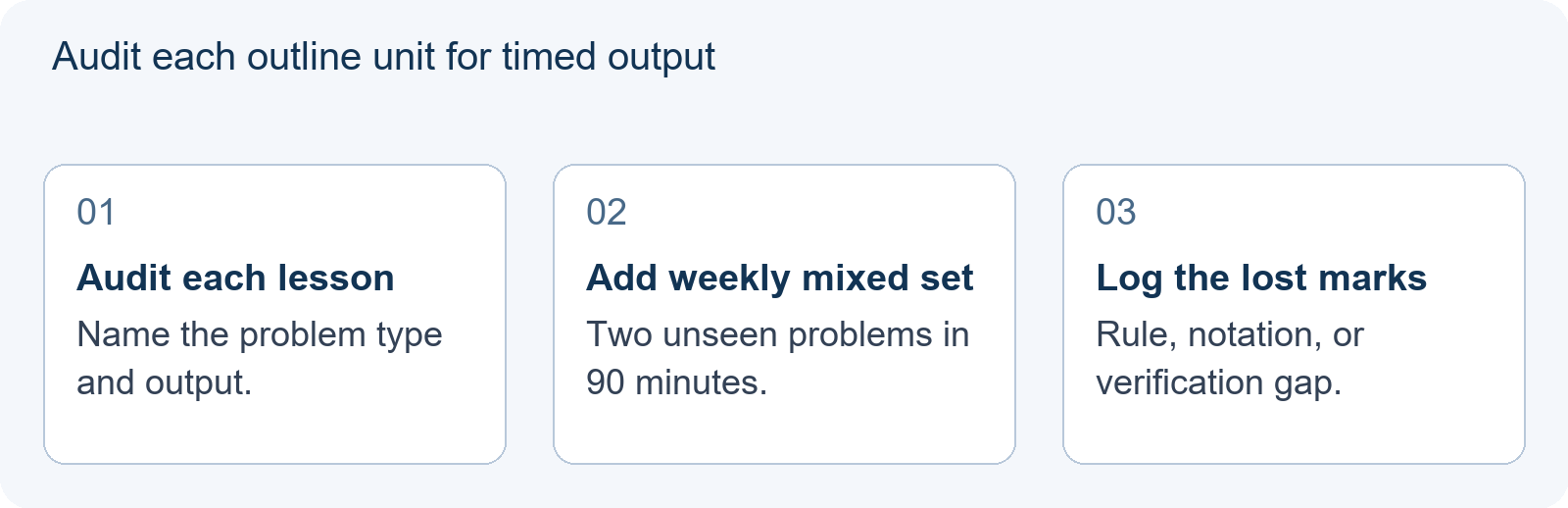
Practical add-on: once a week, run one 90-minute set of two unseen problems from different strands. Use 45 minutes per problem, then spend 20 minutes writing where time was lost. Record whether the loss came from reading, hypothesis choice, rule testing, notation or final checking. Do not count a set as “done” unless the written output could be marked by someone else.
4. Gap 2: writing systems and number systems are taught separately but tested inside larger puzzles
The outline lists writing systems and number systems as distinct lesson entries. That separation is useful for introducing notation, but a regional puzzle can combine systems. A student who has memorised a number chart may still fail when the same puzzle asks for a kinship term, a word order rule or a glyph-to-sound mapping. The audit should therefore include integrated decoding, not only isolated charts.
Teaching illustration, not an official problem: a made-up numeral system writes place values left to right in base 4, with A=1, B=2 and C=3. The string CBA means 3×16 + 2×4 + 1 = 57. A student who reads CBA as 3+2+1=6 has not made a vocabulary error; the student has missed the place-value rule. If the lesson only drills A, B and C as isolated tokens, the student may know every symbol and still fail the integrated string. The repair is to practise a full decode: identify the base, test the order, translate a small number, then a larger one, then reverse the direction. For a focused treatment of base inference, see Linguistics Olympiad Number Systems: Infer the Base Before Translating a Large Number.
After lessons 6, 12, 13 and 16, add one integrated task that mixes two systems. Keep it short: 25 minutes to decode, 10 minutes to write the rule, 5 minutes to check a reverse translation. If the student can do the chart but not the integrated task, the missing piece is application, not more vocabulary.


5. Gap 3: the outline teaches content, not error review
A course outline can sequence content without creating a review system. That is a gap because timed mixed practice produces three different kinds of loss: rule errors, notation errors and verification omissions. A single “review lesson” at the end is too late to change the next week’s practice. Build a three-column error log after every timed set, and make the log part of the course audit.
| Error type | What it sounds like in review | What to do next |
|---|---|---|
| Rule error | “I applied the sound change before the vowel deletion.” | Re-test the rule order on two new examples. |
| Notation error | “I wrote the underlying form in square brackets.” | Redo the answer sheet with one notation convention. |
| Verification omission | “I translated forward but never checked backward.” | Add a mandatory reverse check for the last two items. |
These are hypothetical log entries, not real student records. The point is to separate content gaps from process gaps. If the same rule error appears three times, the student needs targeted content repair. If notation or verification appears repeatedly, more content lessons will not fix it. The existing Linguistics Olympiad Error Log: Track Which Problem Type Costs You Marks gives a fuller tracking method.
6. A six-week audit plan after the outline
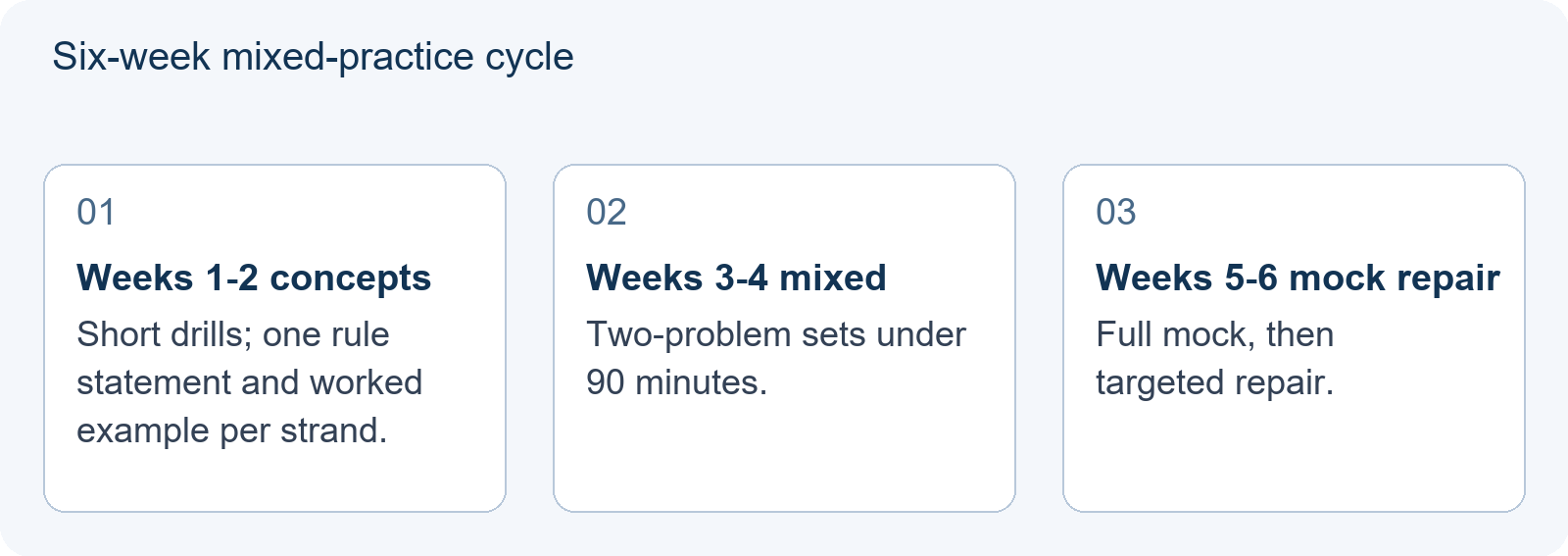
Use six weeks to turn the 20-entry outline into evidence. The plan below is a teaching suggestion, not an official timetable, and it assumes the student has already covered the relevant units. If lessons are still being taught, run the audit in parallel rather than waiting for the course to end.
| Week | Focus | Evidence to keep |
|---|---|---|
| 1-2 | Concept checks by strand: phonology, morphology, syntax, number systems | One short rule statement and one worked example per strand |
| 3-4 | Two-problem mixed sets under 90 minutes | Time log, chosen hypothesis, final written rule |
| 5 | Full timed mock in the current confirmed format | Section-by-section time and abandoned hypotheses |
| 6 | Targeted repair from the error log | Three corrected weak points, re-tested on new data |
The decision point is the end of week 5. If the student has content coverage but cannot finish two problems in 90 minutes, the next step is timed feedback, not another terminology unit. If the student finishes but cannot state why a rule works, the next step is verification practice. If both are weak, reduce the number of new topics and protect the weekly mixed set.
7. Two contrasting audit profiles
Teaching illustration, not real student cases. Profile A has completed all 20 entries and can define phonology, morphology and number-system terms. Profile A has never sat two unseen problems in 90 minutes. The audit shows strong recall but no evidence of time control. The sensible next step is not another full content course; it is a weekly mixed set with an error log and a timed mock.
Profile B has completed fewer units but has done two timed sets. The log shows that most lost time comes from checking and rewriting, not from missing concepts. Profile B does not need the whole outline repeated. The sensible next step is targeted feedback on answer structure and a short verification routine, followed by another timed set. The contrast matters because “finished the outline” and “can perform under time” are different claims. A course-fit decision should follow the evidence, not brand preference.
8. Preparing a useful course-fit or resource request
If you ask about a course or resource after this audit, bring four items: the 20-entry outline, two timed set results, the three-column error log, and the current confirmed test format. Ask whether the course includes mixed timed sets, who marks the written rules, and how feedback distinguishes rule errors from notation and verification errors. Ask for the exact contents of any practice pack and which years’ solutions are included; do not assume a broad archive or a guaranteed outcome.
The Hanlin course note also advises first-time candidates to start from past papers rather than memorising a large set of linguistics terms. That is consistent with this audit: use the outline to find concepts, then use timed mixed problems to test whether the concepts survive contact with unfamiliar data. The official IOL site lists Bangkok, Thailand, as host of the 24th IOL from 21 to 28 July 2027: International Linguistics Olympiad. That is useful context, but it does not confirm the 2027 IOLC regional paper format; keep the two levels separate.
This is an independent preparation guide, not affiliated with, endorsed by, or sponsored by the International Linguistics Olympiad.
Frequently Asked Questions
Does completing all 20 lessons in the IOLC 2027 course outline guarantee readiness for the regional paper?
No. The 40-hour outline can build concept coverage, but it does not by itself prove timed mixed-problem performance. Add weekly two-problem sets, a timed mock and an error log. Judge readiness by written output under time, not by lesson completion alone.
Is the 2027 IOLC regional paper definitely a 3-hour, 4-problem paper?
That format is described for the 2026 regional paper in Hanlin’s IOLC overview note, not confirmed for 2027 in the supplied material. The 2027 regional date is listed as 7 March 2027. Confirm the 2027 format with the current official notice before building a mock around it.
When should a student add structured support rather than continue self-study?
Use the audit evidence. If content is covered but timed sets show repeated rule, notation or verification losses, targeted feedback may help. If concepts are missing, repair content first. A course or coaching choice should follow the recorded gap, not a brand preference or a promised outcome.
IOLC Consonant Digraphs: Why bh, mb and ng Stay Single Units in Rongga-Style Data
You’re reading the earliest bulletin.
Keep reading.
IOLC Consonant Digraphs: Why bh, mb and ng Stay Single Units in Rongga-Style Data
In the 2026 IOLC Newcomer/Junior Division Rongga problem note, bh, mb and ng are recorded as consonants. Learn a data-first method for…
IOLC Team Average: How Each Participating Member Changes the Score
Understand how the IOLC team average is calculated from the individual scores of actual participating members, how adding or removing a member…
IOLC 2027 Level Test: Run a 3-Hour, 4-Problem Mock Before March 7
Prepare for the IOLC 2027 Level Test (March 7) by simulating the latest source-backed 2026 regional format: three hours, four independent puzzles….