
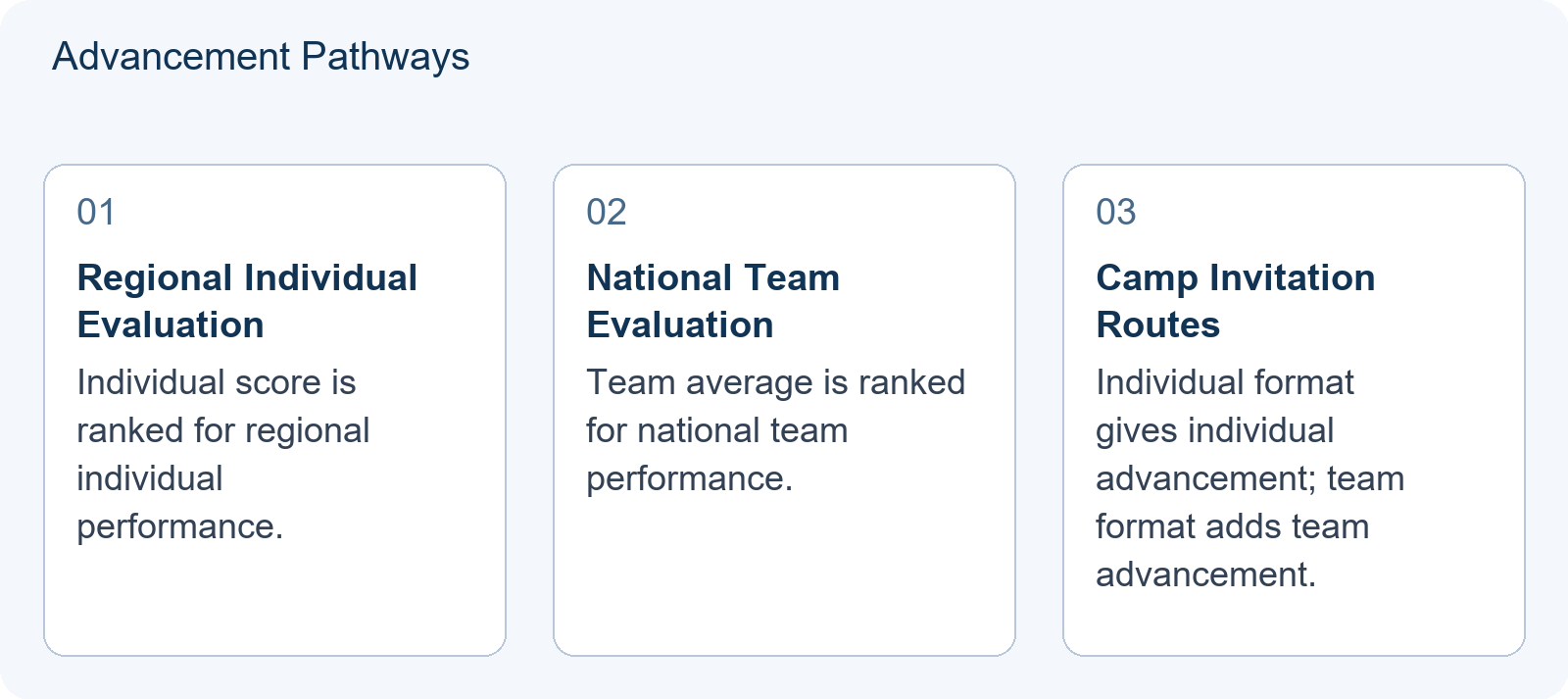
If you are searching for IOLC team average, the short answer is: in the IOLC scoring model described in the source note below, a team score is the mean of the individual scores of the members who actually participate. Regional evaluation is based on individual performance; national evaluation is based on team performance. A team entrant can have two routes to camp advancement or invitation: individual and team. Because this article follows a source note rather than a current official rulebook, verify the exact registration categories, award boundaries and invitation mechanics for the cycle you are entering.
Source basis: This article uses the source note titled [Cleaned] MIT Official Recommendation | IOLC Linguistics Olympiad Complete Guide (note_id 7497482841892192). It describes an IOLC participation and scoring model. It does not by itself prove current-cycle rules; official current announcements should be checked.
Individual Score vs Team Score: The Two Evaluations
The source note separates two evaluation layers. Every contestant answers independently on paper. An individual score is therefore generated for each student who sits the assessment. When a student is part of a 2-4 member team, the team score is derived from those individual scores. It is not a separate collaborative paper and it is not a second exam.
| Dimension | Individual format | 2-4 member team format |
|---|---|---|
| Answering method | Independent completion, paper-and-pencil | Independent completion, paper-and-pencil |
| Scoring rule | Individual score only | Individual score plus team score, where team score is the mean of actual participating members’ individual scores |
| Academic evaluation | Regional individual performance | Regional individual performance plus national team performance |
| Camp pathway | Individual advancement or invitation | Individual advancement or invitation plus team advancement or invitation |
The practical consequence is that a team entrant is not replacing the individual route. The team route is added to it. That distinction matters when families compare individual registration with 2-4 member team registration.
How the IOLC Team Average Is Calculated
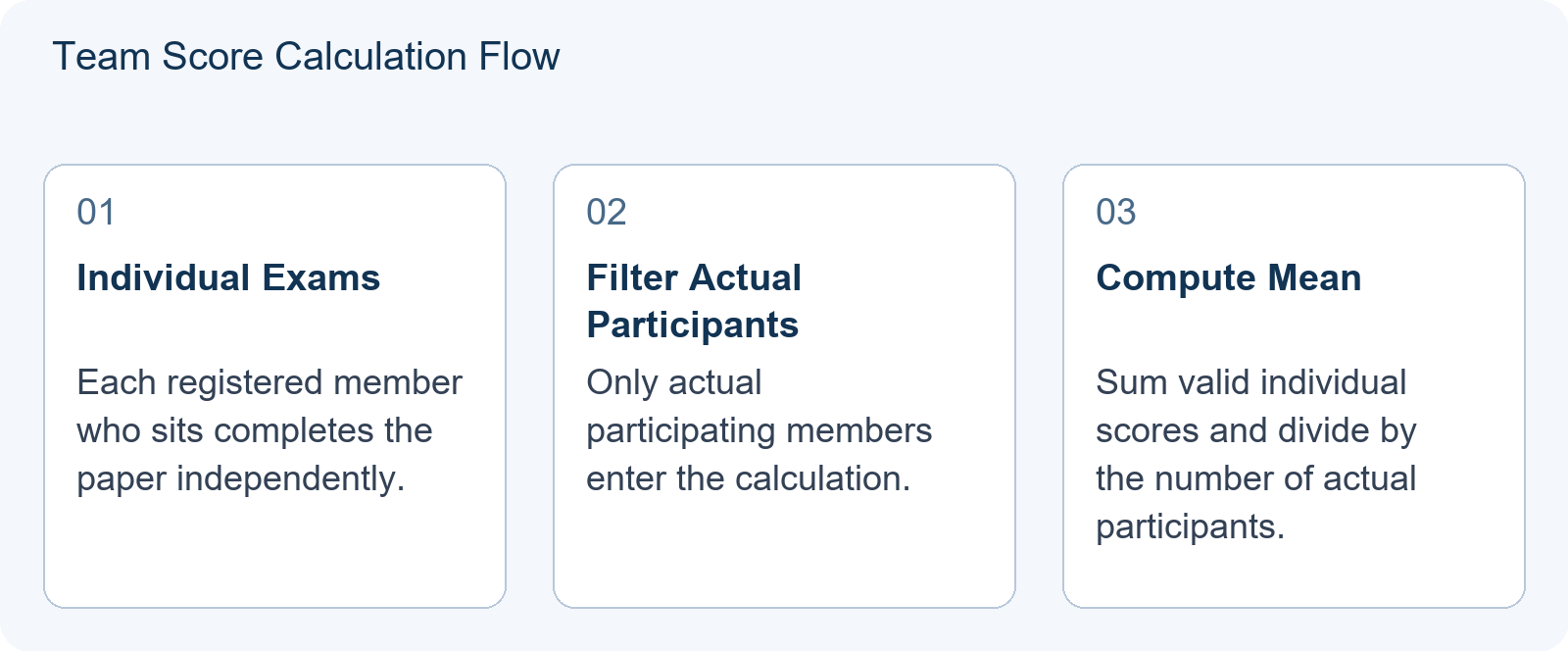
The source note defines the team score as the mean of the individual scores of the actual participating members. The word actual is doing important work. It means the calculation uses students who sat the assessment, not every name on the registration form.
Team average = (Score 1 + Score 2 + … + Score n) / n
Here, n is the number of actual participating members. If a registered member does not sit the assessment, that student does not add a score to the numerator and does not stay in the denominator. This is different from averaging all registered members, including absent members as zero.
The formula also tells you how each member changes the average:
- Adding a member: new average = (old sum + new score) / (old count + 1). The average rises if the new score is above the old average, falls if it is below, and stays the same if it equals the old average.
- Removing a member: new average = (old sum – removed score) / (old count – 1). The average rises if the removed score was below the old average, and falls if the removed score was above the old average.
This is why a single low score can pull a strong team down more than families expect, and why a single absence can change the team metric unpredictably. The missing student is not scored as zero; they are excluded. Exclusion can raise the average if the missing student would probably have scored below the team mean, or lower it if that student would probably have scored above the mean.
Teaching Illustration: Uneven Scores in a Four-Person Team
The following is a hypothetical teaching illustration, not real student data. Assume scores are on the same scale, and for simplicity imagine a 100-point scale. A four-person team has these individual scores:
- Student A: 95
- Student B: 85
- Student C: 70
- Student D: 60
The sum is 95 + 85 + 70 + 60 = 310. With four actual participants, the team average is 310 / 4 = 77.5.
Now suppose Student D does not sit the assessment. The actual participants are A, B and C. The sum becomes 95 + 85 + 70 = 250. The count becomes 3. The new team average is 250 / 3 = 83.33, rounded to two decimal places. In this illustration, removing the lowest scorer raised the average.
If Student A does not sit instead, the actual participants are B, C and D. The sum becomes 85 + 70 + 60 = 215. The count is 3. The new average is 215 / 3 = 71.67, rounded to two decimal places. Removing the highest scorer lowered the average.
This is the core arithmetic behind the title question: each participating member changes the team average according to whether that member’s score is above or below the current mean. A strong member raises the mean; a weaker member lowers it; an absent member changes both the sum and the count.
Teaching Illustration: Building a Team from Two to Four Members
Another hypothetical example shows how each added member changes the mean. Suppose a two-person team has scores of 90 and 70. The team average is (90 + 70) / 2 = 80.
If a third member joins and scores 80, the new average is (90 + 70 + 80) / 3 = 240 / 3 = 80. Because the new score equals the old average, the team average does not change.
If a fourth member joins and scores 60, the new average is (90 + 70 + 80 + 60) / 4 = 300 / 4 = 75. Because the new score is below the previous average, the team average falls.
These examples are deliberately simple. They do not predict real IOLC outcomes. They show the mathematical sensitivity that families should understand before choosing teammates or relying on a projected team band.
Regional Individual Awards vs National Team Awards
The source note also gives award bands. Regional evaluation is described under regional individual performance. National evaluation is described under national team performance and includes all participating teams. The band names are the same, but the unit being ranked is different.
| Award band | Regional individual performance | National team performance |
|---|---|---|
| High Distinction | Top 10% | Top 10% |
| Distinction | Top 10% – 30% | Top 10% – 30% |
| Merit | Top 30% – 50% | Top 30% – 50% |
| Participation | Below 50% | Below 50% |
Read this table as a description of the scoring model in the source note, not as a guarantee for the current cycle. The source text uses “Below 50%” for Participation; the exact boundary should be checked in current official rules. Also note that a regional individual award and a national team band are not the same ranking population. A student can perform well individually in the region while the team average falls into a different national band.


Individual Invitation vs Team Invitation
The source note distinguishes the camp pathways:
- Individual format: individual advancement or invitation.
- 2-4 member team format: individual advancement or invitation plus team advancement or team invitation.
This means a strong individual is not forced to rely only on the team average. According to the source note, the individual pathway remains available. At the same time, a team can provide an additional advancement route. The two pathways should not be treated as the same thing: one ranks individual performance, while the other ranks team performance.
The source note also says that individual registration defaults to a random 2-person team formed by the organising committee, unless the student forms a team or joins other invited students as described. This is important because it means an individual registrant may still generate a team score. The student may not control the composition of that team.
Strategic Implications for Registration
The scoring model creates several practical decision points. These are teaching suggestions, not official policy.
- Balance and consistency matter. Because the team score is a mean, one very low score can pull the team down sharply. A team of four strong-but-uneven students may rank differently from a team of four consistently prepared students.
- Reliability matters. Since only actual participants enter the average, last-minute absence changes the denominator. Families should plan for reliable attendance and know how the current cycle treats a registered member who does not sit.
- Individual registration may still create a team score. If the source note’s default random 2-person team rule applies in the cycle you enter, an individual registrant cannot fully control the team average. Students who want more control should confirm the current team-formation rules before registration.
- Do not infer a success probability. The team average formula shows how scores combine. It does not tell a particular student what their chance of invitation is, because quotas, populations and current rules can differ.
For the collaborative format on contest day, see IOL Team Contest Preparation: How the Four-Person Format Works and Why Most Students Ignore It Until Too Late. That article addresses team problem-solving. This article addresses the scoring arithmetic and advancement structure.
What to Verify for the Upcoming Cycle
Before using any team-average projection, check the current official rules. The source note describes a model, but competition rules can change. Verify:
- Whether individual registration still defaults to a random 2-person team.
- How the current cycle defines an actual participating member.
- Whether minimum attendance or substitution rules apply.
- Whether regional individual and national team bands still use the same percentile labels.
- Current camp invitation quotas and registration deadlines.
For registration-route context, see Linguistics Olympiad Registration, Explained: Why You Never Sign Up for the IOL Itself (2026-27 Cycle). For a quick readiness check before committing to a team plan, see Where Do You Actually Stand? A 45-Minute Linguistics Olympiad Self-Diagnostic (2026).
A useful preparation step is to estimate your individual score range honestly, then run the team-average formula with different teammate combinations. Do not treat the highest possible average as the only scenario. Test a realistic average, a low outlier and an absence case. That gives you a decision aid rather than a false guarantee.
Bottom Line
In the IOLC model described by the source note, the team average is the mean of actual participating members’ individual scores. Each member changes that mean according to whether their score is above or below the current average. Regional evaluation ranks individual performance; national evaluation ranks team performance. Team entrants may have both individual and team advancement routes. Use the formula as a planning tool, but verify the current cycle’s official rules before relying on any projected band or invitation outcome.
General event background is available at International Linguistics Olympiad background.
This is an independent preparation guide, not affiliated with, endorsed by, or sponsored by the International Linguistics Olympiad.
Frequently Asked Questions
Can a strong individual advance to camp without a strong team?
Yes, according to the source note. Individual format participants have individual advancement or invitation. Team format participants have individual advancement plus team advancement or team invitation. The individual route remains available, though current official quotas and rules should be checked.
Does registering individually prevent me from getting a team score?
No, not automatically. The source note says individual registration defaults to a random 2-person team formed by the organising committee. An individual registrant may therefore still generate a team score, but may not control the teammate.
How is the team average affected if a member misses the exam?
The team score uses actual participating members. A registered member who does not sit is excluded from the sum and the denominator. If that member would have scored below the team average, exclusion can raise the average; if above, exclusion can lower it.
Keep reading.
IOLC Consonant Digraphs: Why bh, mb and ng Stay Single Units in Rongga-Style Data
In the 2026 IOLC Newcomer/Junior Division Rongga problem note, bh, mb and ng are recorded as consonants. Learn a data-first method for…
IOLC 2027 Level Test: Run a 3-Hour, 4-Problem Mock Before March 7
Prepare for the IOLC 2027 Level Test (March 7) by simulating the latest source-backed 2026 regional format: three hours, four independent puzzles….
How to Use a Linguistics Olympiad Training Guide Without Skipping Problems
Stop reading linguistics guides passively. Learn the solve-first protocol to turn a training guide into an active gap-filling tool for IOLC preparation.