
There are two honest ways to prepare for the International Linguistics Olympiad (IOL): self-study and coaching. Both produce strong results — the difference is whether you want structure and feedback, or prefer to drive it yourself. This independent guide does not start by selling a course. It breaks IOL down to its real demands — the problem types, the solution write-up, and the national-to-IOL path — and shows what good prep looks like even if you self-study.
First, know what you are preparing for
IOL is unlike any school subject: you need no prior knowledge of any language — it is pure reasoning on data. That is exactly why prep method matters:
| Demand 1 · The problem types | Rosetta-style decipherment, phonology, morphology, number & writing systems, syntax. Each has its own attack method — learnable, but not obvious. |
| Demand 2 · The solution write-up | Marks come from showing your reasoning, not just the final answer. A right answer with no working, or messy logic, loses marks — the hardest thing to self-assess. |
| Demand 3 · The selection path | National rounds (NACLO, UKLO, OzCLO…) feed the IOL. The qualification path and timeline are easy to misjudge. |
Cracking a puzzle and writing up the reasoning clearly reward different skills. Settling whether your gap is method or write-up is the single most useful thing to do before choosing self-study or coaching.
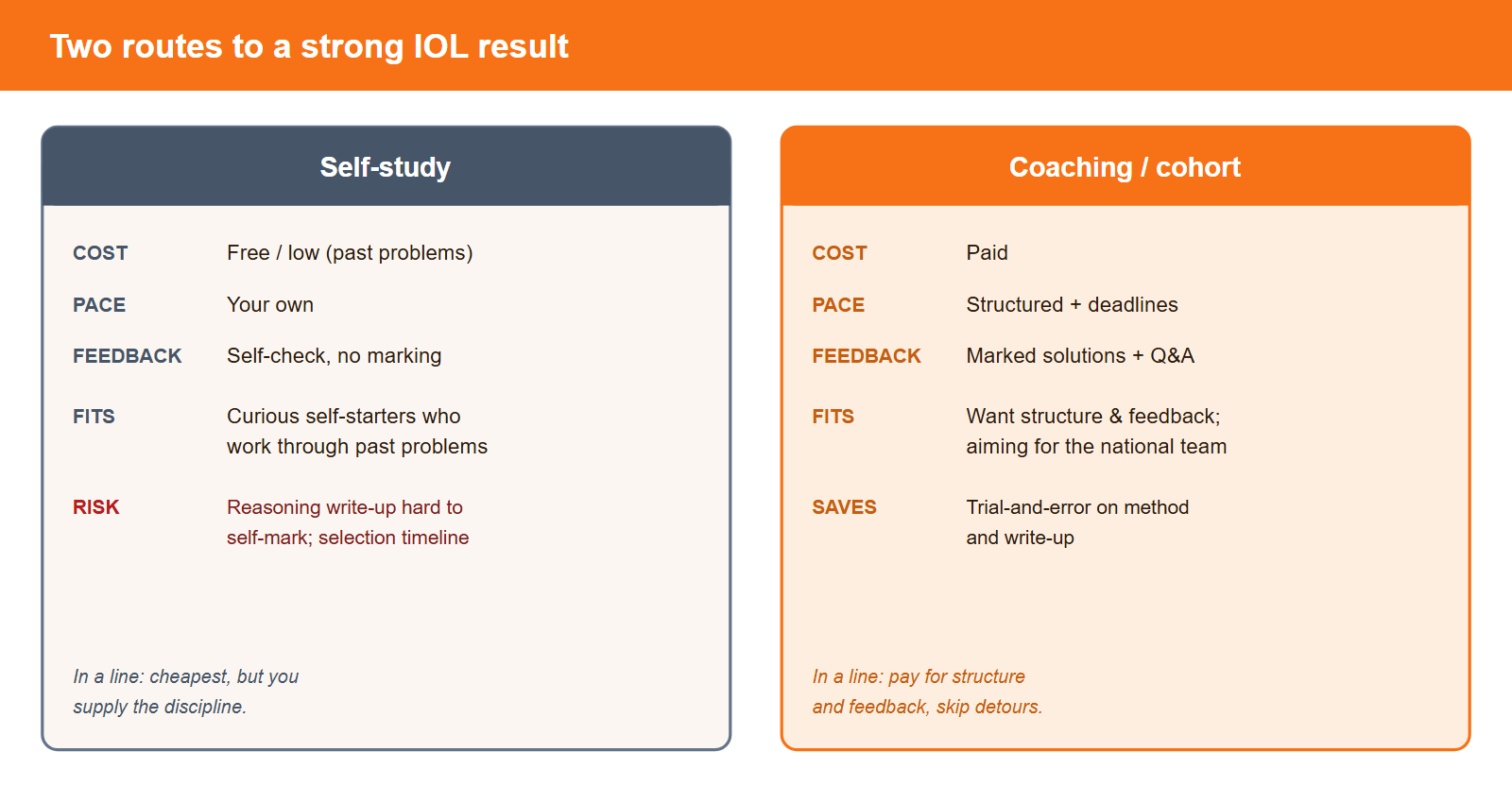
Self-study vs coaching: how to choose
An honest test: if you love puzzles, can work through the official past problems, and have someone to check your reasoning is actually clear and complete, self-study is genuinely viable — IOL rewards raw problem-solving, and many strong contestants are self-taught. If your gap is writing up the reasoning so it earns full marks — where “I solved it in my head” and “I showed why” are very different — feedback is what moves the needle. Students chasing the national team usually lose marks on incomplete write-ups, not wrong answers.
The four-phase roadmap below works for both routes: self-studiers follow it; coached students use it to check a program covers each phase.
A four-phase roadmap (~16 weeks)
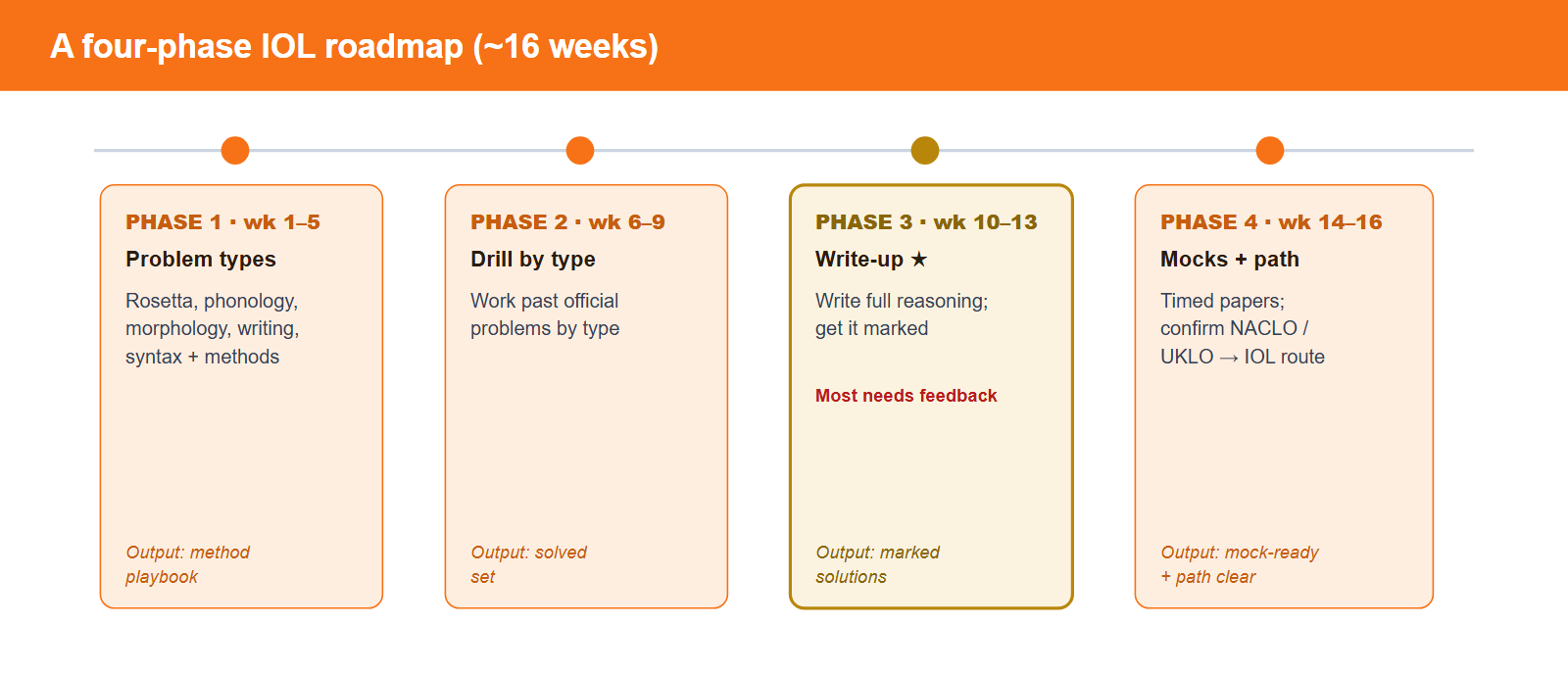
Phase 1 (Problem types) learns the attack method for each family. Phase 2 (Drill) works the official past problems by type. Phase 3 (Write-up) is the divider — writing reasoning that earns full marks, and getting it checked. Phase 4 (Mocks + path) turns preparation into a timed run up the national-to-IOL ladder.
IOL vs the national rounds (NACLO / UKLO)
The national rounds — NACLO (North America), UKLO (UK), OzCLO (Australia) — are the selection step toward the IOL, not rivals to it. They are shorter and a great way to build the same skills and qualify. The smart plan is to use a national round as both practice and a path: it sharpens your problem-solving on a real deadline and, if you place, opens the route to the international stage.


What good IOL prep looks like (a checklist you can use either way)
| ✅ 1 · Type-specific method | Does it teach the attack method for each problem type, not just “do more puzzles”? |
| ✅ 2 · Write-ups are marked | Is your reasoning actually read and marked for completeness — the thing self-study can’t give you? |
| ✅ 3 · Selection path clear | Does it walk the NACLO / UKLO → IOL route and timeline for international entrants? |
| ✅ 4 · Transparent results | Are results specific by year and award — not a vague “many winners”? |
| ✅ 5 · No guarantees | Honest coaching never promises a place — results depend on the student; it promises process. |
About our cohort (disclosure + real results)
To be transparent: this is an independent IOL Club guide, and we run an IOL preparation cohort — so this section is a disclosure of commercial interest. We coach because we have verifiable, real IOL-track results (Hanlin internal data, anonymised):
At the 2025 IOL academic camp (China), our students earned 2 Best Solution, 3 High Distinction, 2 Distinction and 5 Merit (individual), plus team High Distinctions.
These are actual IOL-track outcomes — not numbers borrowed from another competition. Our cohort turns the four-phase roadmap into a structured program, with the most effort on the step self-study can’t replicate: Phase 3 marked solution write-ups.
The mistakes that cost international students
When strong students underperform at IOL, it is rarely the puzzle-solving — it is one of four avoidable habits. Answering without working: a correct answer with no shown reasoning loses most of the marks. Ignoring problem types: attacking every problem the same way wastes time; each type has its own method. Never being marked: reasoning that feels complete but has gaps is the most common silent failure. Skipping the national round: students who jump straight at the IOL miss the selection step and the practice it provides. Fixing these four is usually worth more than another problem book.
Is an IOL result worth it for applications?
For students aiming at linguistics, computer science or cognitive science — and any program that values pure reasoning — yes, as strong evidence of analytical ability. IOL is recognised at top universities precisely because it cannot be crammed: it rewards thinking, not memorised content. It does not guarantee admission, and you should treat it as one credible signal among many. The skill itself — decoding structure from data — transfers directly to CS and linguistics, whether or not you place.
Frequently asked questions
Do I need to know languages to enter the IOL?
No. IOL requires no prior knowledge of any language — it is pure reasoning on data. What you build is the method for each problem type and the discipline of writing up your reasoning clearly.
Do I need coaching to do well?
Not always. Many strong contestants are self-taught from past problems. Coaching matters most for the solution write-up, where feedback on completeness — not the answer — decides marks.
How do I qualify for the IOL?
Through a national round such as NACLO, UKLO or OzCLO, which selects toward the IOL. Confirm the current selection path and timeline on the official IOL pages (ioling.org).
Are your IOL results real and how can I check?
Yes — actual IOL-track outcomes from our cohort (Hanlin internal data, anonymised), such as 2025 camp results of 2 Best Solution and 3 High Distinction. We do not relabel results from other competitions as IOL results.
Can coaching guarantee a place?
No. Any “guaranteed place” claim is a red flag. Results depend on the student’s own effort; honest coaching only commits to the process — type-specific method, marked write-ups and a clear selection timeline.
This is an independent IOL Club guide to the International Linguistics Olympiad, operated by Hanlin Education. We are not affiliated with the IOL Board; the official source is ioling.org. This article describes our own preparation cohort, so it is a disclosure of commercial interest. The results cited are real IOL-track outcomes from our cohort (Hanlin internal data, anonymised) — actual IOL results, not borrowed from other competitions. Confirm current dates and rules on ioling.org; confirmed errors are corrected within 7 working days.
Keep reading.
From Three Hours to Six: What Actually Changes Between a National Round Paper and an IOL Paper
A national open round gives you roughly 25 minutes a problem; the IOL gives you over an hour. Four things that change…
How to Mark Your Own Linguistics Olympiad Practice Paper When There Is No Solution Sheet
Worked solutions do not exist for every past paper. A five-band self-marking rubric, the regeneration test, and the four ways students quietly…
The Deadline Before the Deadline: Planning a 2026-27 Linguistics Olympiad Autumn Backwards From the Sitting
Registration for the coming cycle is reported to close earlier than usual. An autumn planned backwards from the sitting, with compression options…