
IOL phonology problems give you words from an unfamiliar language and ask you to work out the hidden rules that govern its sounds — which consonants change, where stress lands, why one vowel becomes another. You crack them not with memorised linguistics, but with a fixed method: tabulate the data, find the sound that alternates, state the rule as “X becomes Y in environment Z,” then order your rules and test against every word. The official International Linguistics Olympiad (ioling.org) confirms no prior linguistics training is needed — everything required is inside the problem.
What a phonology problem actually tests
Phonology is the study of how a language organises its sounds — not the physical sounds themselves, but the system of patterns and contrasts behind them. At the IOL, a phonology problem is one of the self-contained puzzles you may meet in the individual contest, which (per ioling.org) sets five problems over six hours. You are typically handed a wordlist with translations or grammatical labels, and the data has been engineered so that one consistent rule — or a small stack of rules — explains every form. If you have read our overview of what the International Linguistics Olympiad is, you already know the golden principle: the answer is always derivable from the text in front of you.
What the examiner is really checking is whether you can do four things under time pressure: notice that a sound is not constant, isolate the environment that triggers the change, state the rule precisely enough that someone else could apply it, and then run it back across the whole dataset without a single exception. That last step — ruthless verification — is where most self-taught solvers lose marks. A rule that explains nine words out of ten is not “nearly right”; it is wrong, and the tenth word is telling you what you missed.
Phonology rewards a particular temperament: patient, list-making, willing to be proven wrong by your own data. That makes it one of the most trainable problem types — far more so than a sparse Rosetta-style decipherment, where you are partly at the mercy of how much the data gives you. If you are deciding where to spend your prep hours, phonology is high return on investment.
The five vocabulary words you need first
You do not need a linguistics degree, but five plain-English concepts make every phonology problem readable. Learn these and most of the “jargon” barrier disappears.
| Term | What it means (plain English) | Why it matters in a problem |
|---|---|---|
| Voicing | Whether your vocal cords buzz. b, d, g, z are voiced; p, t, k, s are their voiceless twins. | The single most common alternation. A sound “becoming voiced” next to vowels is a classic rule. |
| Environment | The neighbours of a sound — what comes immediately before and after it (or the word edge). | Rules are stated as “happens in this environment.” Finding the environment IS the puzzle. |
| Alternation | The same meaningful piece showing up with different sounds in different words. | Spotting an alternation tells you a rule exists. No alternation, no rule. |
| Assimilation | A sound becoming more like its neighbour (e.g. voiceless next to voiceless). | The most frequent type of rule. When stuck, ask: “is this sound copying a neighbour?” |
| Word boundary (#) | The start or end of a word, written as # in rules. |
Many rules fire only at the edge of a word, e.g. “voiced becomes voiceless at #.” |
That is the whole toolkit. Notice none of it requires knowing the International Phonetic Alphabet by heart — though comfort with a handful of IPA symbols speeds up the harder sets. The IOL FAQ is explicit on this point: you should not need complicated jargon, because “all you need to solve the problem is found in the text given to you.”
A four-step method (the coach’s loop)
Here is the workflow we drill in our weekly sessions. It is deliberately mechanical — under exam stress you want a checklist, not inspiration.
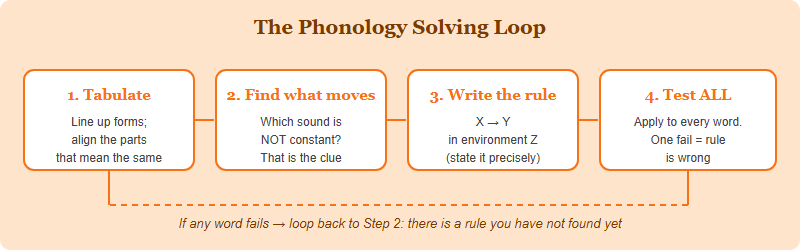
Step 1 — Tabulate. Rewrite the data in a clean grid, aligning the chunks that share meaning. If “house” appears as a root in six words, stack those six so the root sits in one column and the endings in another. Half of all phonology problems “solve themselves” the moment the data is lined up neatly, because the alternation jumps off the page.
Step 2 — Find what moves. Scan each aligned column for a sound that is not constant. If a root ends in t in some words but d in others, you have found your alternation. Circle both versions and, crucially, look at what sits immediately to the right and left of each — the trigger is almost always a neighbour or a word edge.
Step 3 — Write the rule. Force yourself to write it in the canonical form: “voiceless stop becomes voiced between two vowels.” Vague rules (“sometimes t turns into d”) earn no marks and, worse, hide the cases where you are wrong. Precision is the discipline that exposes your own errors.
Step 4 — Test against every word. Apply your rule mechanically to the full list, including any “extra” data the problem gives you. Every form must come out right. If one does not, do not patch the exception — go back to Step 2, because that single rebel word is the examiner’s way of telling you a rule is still hiding. Our 12-week study plan builds this verification habit into every practice set, because it is the skill that separates a clean full-marks solution from a near miss.


A worked mini-example (original — not a past problem)
To show the loop in motion, here is a made-up, illustrative dataset from an invented language we will call “Solang.” This is not from any real IOL, NACLO or UKLO paper — it exists only to demonstrate the method on something safe to reason about out loud.
| Solang form | Meaning | Solang form | Meaning |
|---|---|---|---|
| pat | stone | pada | stones (plural) |
| rok | river | roga | rivers (plural) |
| tas | hand | taza | hands (plural) |
| nim | bird | nima | birds (plural) |
Walk it through. Tabulating (Step 1), the plural is clearly the root plus -a. But the root’s final consonant moves (Step 2): pat → pad-a, rok → rog-a, tas → taz-a. In each pair, a voiceless consonant (t, k, s) becomes its voiced twin (d, g, z) — but only in the plural. What is different about the plural? The consonant now sits between two vowels (the root vowel and the -a ending). In the singular it sat at the word’s end.
So the rule (Step 3) is: a voiceless consonant becomes voiced when it stands between two vowels. Now test everything (Step 4). nim → nima: the m is already voiced, so the rule has nothing to change — and indeed it does not change. That “boring” fourth row is doing real work: it confirms the rule fires on voicing, not on “any final consonant,” and it gives us no exceptions. Four words, one clean rule, zero rebels. That is a full-marks shape.
Notice what we did not need: no IPA chart, no memorised sound laws, no outside knowledge of any real language. Everything came from lining up four word-pairs and asking “what moves, and what is next to it?” That is the entire game, scaled up.
When one rule is not enough: ordering
Harder phonology problems stack two or more rules, and the order you apply them in changes the output. This is where solvers who skipped the verification habit fall apart. The decision tree below is the triage we teach for any set that resists a single rule.
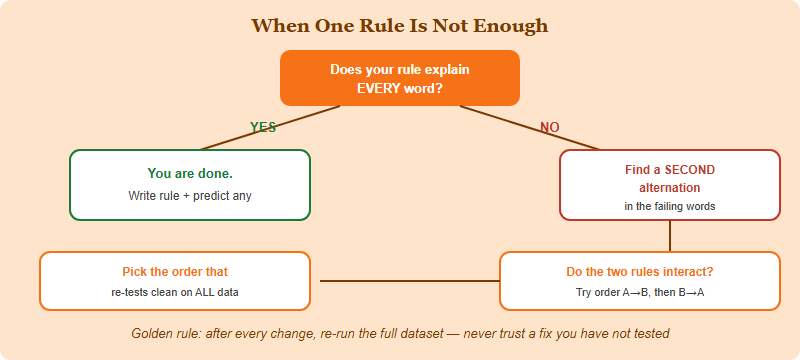
A quick illustration of why order matters, again with invented data. Suppose Solang had two rules: (A) a vowel i is inserted to break up an awkward consonant cluster, and (B) t becomes d between vowels. Take an underlying form /atra/. If you apply A first you get atira, and now the t sits between a and i — so B fires and you get adira. If you apply B first, the t in /atra/ is not between two vowels (an r follows), so B does nothing, then A gives atira. Same two rules, two different answers — adira versus atira — decided entirely by sequence. The examiner’s dataset will quietly favour one order; your job is to let the data pick. This is exactly the kind of layered reasoning the national rounds build toward, so working real national papers (see our guide to the NACLO, UKLO and OzCLO calendars) is the best ordering practice you can get before the international stage.
How phonology compares to the other problem types
Knowing where phonology sits among IOL problem types helps you budget your six hours. Here is the coach’s-eye comparison — difficulty and “trainability” are our editorial judgement, not official ratings.
| Problem type | What it asks | Core skill | How trainable |
|---|---|---|---|
| Phonology | Work out sound-change rules and their order | Spot alternations; state & order rules | High — very pattern-drillable |
| Morphology | Segment words into meaningful pieces (roots, affixes) | Aligning forms; tracking agreement | High — overlaps with phonology method |
| Rosetta-style | Match sentences to translations and decode the rest | Hypothesis testing; word order | Medium — depends on data richness |
| Writing / number systems | Crack an unfamiliar script or numeral system | Logic; base arithmetic; symbol mapping | Medium-high — numerals are drillable |
| Syntax / semantics | Deduce sentence-building or meaning rules | Structural reasoning | Medium — subtler, less mechanical |
The practical takeaway: phonology and morphology share the same “align the data, find what moves” engine, so improving at one lifts the other. If you are early in your preparation and want the fastest score gains, drill these two together. The IOL itself, founded in 2003 and now drawing dozens of nations each year (Taipei 2025 hosted 227 contestants from 42 countries), rewards exactly this kind of transferable, methodical reasoning — the antidote to staring helplessly at a wall of unfamiliar words.
Frequently asked questions
Do I need to know the International Phonetic Alphabet (IPA) for IOL phonology problems?
Not formally. The IOL states all you need is in the problem text, but comfort with a few IPA symbols and the voiced/voiceless distinction makes harder sets faster to read.
How many phonology problems appear in the IOL individual contest?
The official individual contest sets five problems over six hours (ioling.org); phonology is one possible type, so expect roughly one such problem, though the exact mix varies each year.
Can I enter the IOL directly to attempt these problems?
No. Per ioling.org, you qualify only through your accredited national contest (such as NACLO, UKLO or OzCLO); there is no independent entry. Confirm your country's route on the official site.
What is the single biggest mistake on phonology problems?
Stopping at a rule that explains most — not all — of the data. One unexplained word means a rule is missing or mis-ordered. Always re-test the full dataset.
This is an independent IOL Club guide operated by Hanlin Education for China-based international-school students. It is not affiliated with, endorsed by, or sponsored by the IOL Board or any national linguistics olympiad. The Solang examples above are original illustrations, not real past problems. Contest structure, dates and eligibility change year to year — always confirm current details on the official site, ioling.org. IOL 2026 is in Bucharest, 26 July–2 August 2026. Confirmed errors are corrected within 7 working days.
Keep reading.
From Three Hours to Six: What Actually Changes Between a National Round Paper and an IOL Paper
A national open round gives you roughly 25 minutes a problem; the IOL gives you over an hour. Four things that change…
How to Mark Your Own Linguistics Olympiad Practice Paper When There Is No Solution Sheet
Worked solutions do not exist for every past paper. A five-band self-marking rubric, the regeneration test, and the four ways students quietly…
The Deadline Before the Deadline: Planning a 2026-27 Linguistics Olympiad Autumn Backwards From the Sitting
Registration for the coming cycle is reported to close earlier than usual. An autumn planned backwards from the sitting, with compression options…