
For students targeting the IOLC 2027 Level Test, scheduled for March 7, 2027, the single most useful practice session is a full-length mock that copies the paper’s real constraints. The latest available template is the 2026 regional format: an offline, pen-and-paper session of three hours in which candidates independently solve four puzzles. The March 7, 2027 date and the December 1, 2026 registration deadline (November 23 for Hanlin-assisted registration) appear in Hanlin’s September 9, 2026 announcement of the 2027 IOLC season, while the 3-hour, 4-problem shape is documented for 2026 and flagged there as a 2026-season reference, so this article treats it as a historical practice template rather than a confirmed 2027 rule set.
That distinction matters. You are not preparing for a confirmed 2027 rule set; you are building stamina, triage and answer-sheet habits that will survive whichever confirmed format arrives in March. This article gives you a working mock protocol: how to select four balanced problems, how to run the three-hour block without spoiling yourself, and how to convert the result into targeted adjustments for the final two weeks.
Why a Timed Four-Problem Mock Catches What Untimed Practice Misses
Most preparation happens one problem at a time. That builds analytical skill but not exam endurance. A three-hour window across four puzzles forces rapid context switching — phonology to morphology to syntax to semantics or number systems — while keeping accuracy high. That particular demand is not tested by a study set you open and close at will.
In untimed practice, ninety minutes can disappear on a single dead-end hypothesis. On the real paper, ninety minutes on one problem leaves thirty for three others and typically produces three half-finished answers. A timed mock forces the decisions that actually determine your score: when to abandon a hypothesis, when to move on with partial reasoning, and how to write a justification that a marker can follow under time pressure. Because clear rule descriptions are useful in olympiad answer practice, the act of writing clarity is worth practising, not just the final translation.
A mock is also the only honest way to observe your own pace. Students routinely overestimate their speed on familiar problem types. Tracking the minutes spent per puzzle, and the point at which attention drifts, gives you real data to plan around rather than a vague sense of readiness. Without this data, you cannot know if your bottleneck is knowledge, logic, or time management.
Choosing Four Problems That Cover Different Skills
Do not draw four puzzles from the same family. Regional papers have historically mixed domains, and a mock that mirrors that mix teaches triage across types. If you need source material, our guide to IOL Past Problems: Choosing Practice Sets and Requesting Explanations covers where to source regional and international papers without duplicating a single skill. A practical four-problem set should cover the following four slots:
| Slot | Linguistic focus | What it tests under time pressure |
|---|---|---|
| 1. Phonology / sound system | IPA transcription, minimal pairs, sound-change rules | Distinguishing underlying forms from surface realisations when several rules interact. |
| 2. Morphology / word formation | Affixes, allomorphy, inflectional paradigms | Segmenting unseen words and deducing plural, tense or case rules from limited data. |
| 3. Syntax / word order | Constituent structure, agreement, scrambling | Reconstructing grammatical roles when surface order misleads, and forcing yourself to separate role from position. |
| 4. Semantics, number or writing systems | Kinship terms, numeral bases, scripts | Mapping a closed system (family, base, symbol table) before translating a target form. |
Mix difficulty deliberately: one comfortable problem you expect to finish, one you can almost finish, and two genuinely hard puzzles. That distribution gives you a real early win to stabilise nerves, then forces the hard triage decisions that a mock exists to practise. If you want a worked comparison of what changes when the paper lengthens from a national-round three hours to an IOL six-hour set, our From Three Hours to Six: What Actually Changes Between a National Round Paper and an IOL Paper is a useful add-on read before you set your own mock scope.
Running the Mock: Timing, Order and Answer-Sheet Discipline
Set the room up like a real sitting: no devices, no music, one desk, plenty of plain paper, and a physical timer. Then apply a fixed protocol so the mock produces comparable data.
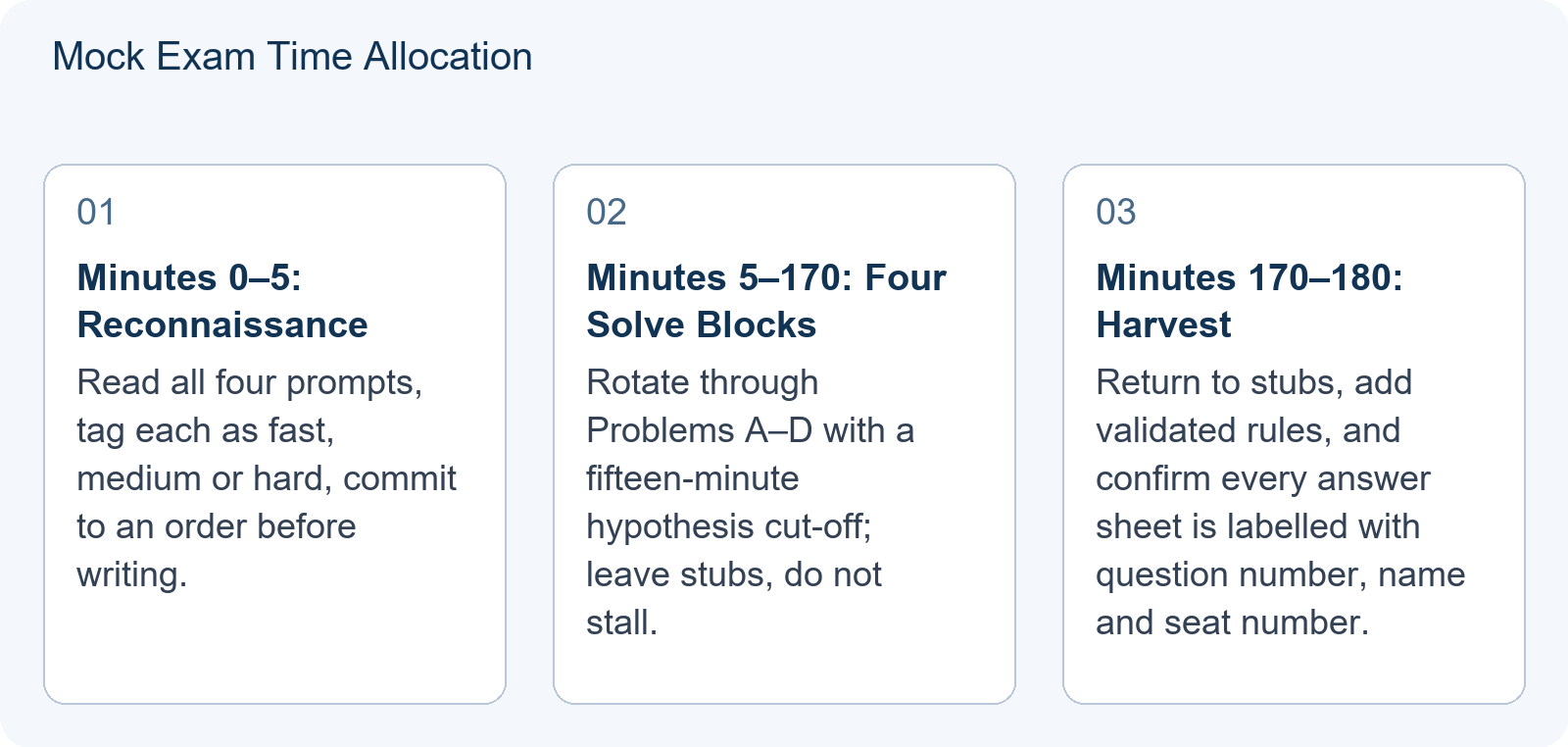
- Minutes 0–5 — Reconnaissance. Read all four prompts at speed. Mark each as fast, medium, or hard. Decide your order before writing anything, and commit to it.
- Minutes 5–50 — Problem A (your fastest). Write hypotheses as you test them, including discarded ones. Use a numbered rule list rather than prose.
- Minutes 50–95 — Problem B. If a hypothesis has not produced a prediction after fifteen minutes, write down what you know and move on.
- Minutes 95–140 — Problem C. Same discipline. Leave the answer stub in place; return only if time allows.
- Minutes 140–170 — Problem D. Give the hardest puzzle a real thirty-minute attempt, not a token.
- Minutes 170–180 — Harvest. Return to unfinished stubs and add any rule you have already validated. Then check that every answer sheet carries the question number, your name and your seat number, following the mock answer-sheet habits used in this article.
The answer-sheet habits matter as much as the reasoning. As a mock discipline, use three sensible answer-sheet habits regardless of format: do not copy the problem statement, keep each problem’s answer on its own sheet, and label each sheet with the question number, seat number and name so pages are not mismatched. These are practice suggestions, not confirmed 2027 rules. Practise all three in the mock so that they are automatic on the day.


Diagnostic Scoring in Three Steps
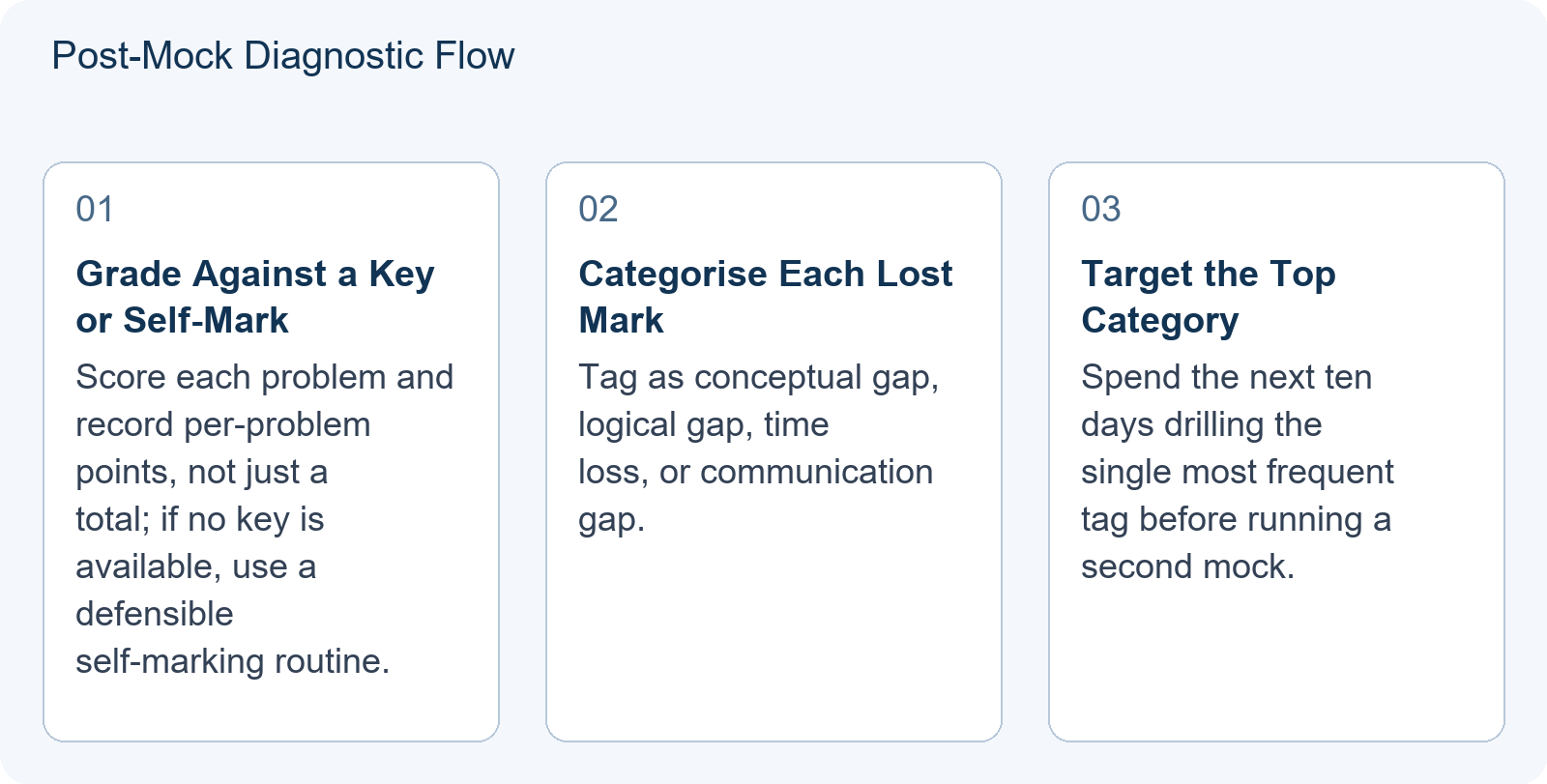
After the timer stops, grade the mock against any official key you have. If you do not have a key for a particular problem, our method for How to Mark Your Own Linguistics Olympiad Practice Paper When There Is No Solution Sheet gives a defensible scoring routine. Do not stop at the total score. The point of a full mock is diagnostic, not confessional.
Step 1: Record the raw points for each problem. Step 2: Categorize every lost mark. Was it a conceptual gap (you didn’t know the term)? A logical gap (you made an invalid inference)? A time loss (you ran out of time)? Or a communication gap (your answer was correct but unclear)? Step 3: Identify the dominant category. If most marks were lost due to time, your next mock needs stricter cut-offs. If most were lost due to communication, your next mock needs more emphasis on clear rule descriptions.
Closing: From One Mock to a Repeatable Loop
A single full-length mock is not a verdict on your readiness; it is the first reading of a cycle. Run it, diagnose in three steps, spend the next ten days on the weakest category, then run a second mock under the same conditions. By the time March 7 arrives, the timing, the answer-sheet discipline and the triage decisions will already be practised behaviours rather than on-the-day experiments. If you would like help interpreting a mock score or building a structured Level Test practice plan for the final weeks, a short conversation with a Hanlin advisor — who also runs IOLC preparation classes and consults on the 2027 season timeline — can turn your diagnostic log into a schedule.
Applying the Diagnostic: From Raw Data to a Targeted Drill
The three-step diagnostic described above transforms a raw score into an actionable plan. Consider a teaching illustration based on common patterns observed in mock sessions. A student completes the four-problem set and records the following data:
| Problem Slot | Time Spent | Outcome | Lost Mark Category |
|---|---|---|---|
| 1. Phonology | 45 mins | Full marks | N/A |
| 2. Morphology | 60 mins | Partial (rule stated, translation wrong) | Logical Gap |
| 3. Syntax | 75 mins | Incomplete (ran out of time) | Time Loss |
| 4. Semantics | 0 mins | Not attempted | Strategic Error |
In this scenario, the dominant issue is not knowledge but strategy and logic. The student spent excessive time on Problem 2 trying to force a complex morphological rule that didn’t fit all data points, leading to a logical gap. This time overrun directly caused the time loss on Problem 3 and the strategic error of skipping Problem 4 entirely.
Diagnostic Answer: The bottleneck is “over-analysis” in morphology, which cascades into poor time management for later problems. The student did not lack linguistic knowledge; they lacked the discipline to abandon a failing hypothesis quickly.
Concrete Next Practice Task: Do not simply repeat the full mock. Instead, run a targeted “Triage Drill.” Select two new morphology problems from past papers. Set a strict timer of 20 minutes per problem. Your goal is not to solve them completely, but to practice the decision point: if you have not identified a consistent rule after 10 minutes, you must write down your best partial hypothesis and move on. This drill isolates the specific behavior—abandoning dead ends—that caused the failure in the mock. By focusing on the decision process rather than the final answer, you build the mental stamina required to protect your time budget for the remaining problems on the actual exam day.
General event background is available at International Linguistics Olympiad background.
This is an independent preparation guide, not affiliated with, endorsed by, or sponsored by the International Linguistics Olympiad.
Frequently Asked Questions
Is the 2027 IOLC Level Test format confirmed?
Not at the time of writing. The 2027 official rules have not been published in the sources we can verify. This article uses the 2026 regional format — offline, three hours, four puzzles — as the best available practice template. Hanlin’s September 2026 announcement lists the March 7, 2027 date and the December 1, 2026 registration deadline (November 23 for assisted registration); the 2026 format note labels its flow as a 2026-season reference, so the 2027 format should still be re-checked against official updates.
Can I use digital tools during the mock?
No. The 2026 Level Test was a pen-and-paper sitting, so a mock that allows search engines, IPA keyboards or translation tools creates false confidence. Simulate the paper constraints: printed problems, handwriting, physical timer.
What if I don’t finish all four problems?
In practice, an incomplete but well-explained answer is often easier to credit than an unsupported guess, though 2027 scoring rules are not confirmed here. A written observation that names the pattern and the examples supporting it is worth more than an unsupported translation guess. Leave a numbered list of what you observed, what you tested, and why a candidate rule failed.
Keep reading.
IOLC Consonant Digraphs: Why bh, mb and ng Stay Single Units in Rongga-Style Data
In the 2026 IOLC Newcomer/Junior Division Rongga problem note, bh, mb and ng are recorded as consonants. Learn a data-first method for…
IOLC Team Average: How Each Participating Member Changes the Score
Understand how the IOLC team average is calculated from the individual scores of actual participating members, how adding or removing a member…
How to Use a Linguistics Olympiad Training Guide Without Skipping Problems
Stop reading linguistics guides passively. Learn the solve-first protocol to turn a training guide into an active gap-filling tool for IOLC preparation.