
When families first search for IOL past problems, the goal is rarely to collect every paper. The real need is to choose practice sets that match where a student currently stands—and to recognize the moment when an answer key stops being enough and a reasoning explanation becomes necessary. This guide focuses on that decision process, using what the competition structure and preparation experience actually show.
Choose a Problem by Reasoning Demand Rather Than Year Alone
Not every IOL past problem is interchangeable. Some require heavy phonetic analysis; others test morphological patterning, syntactic rules, or numeral system reconstruction. A student who struggles with vowel harmony in one language family may handle kinship terminology smoothly in another. Selecting by year alone—simply grabbing the most recent paper—misses this variation.
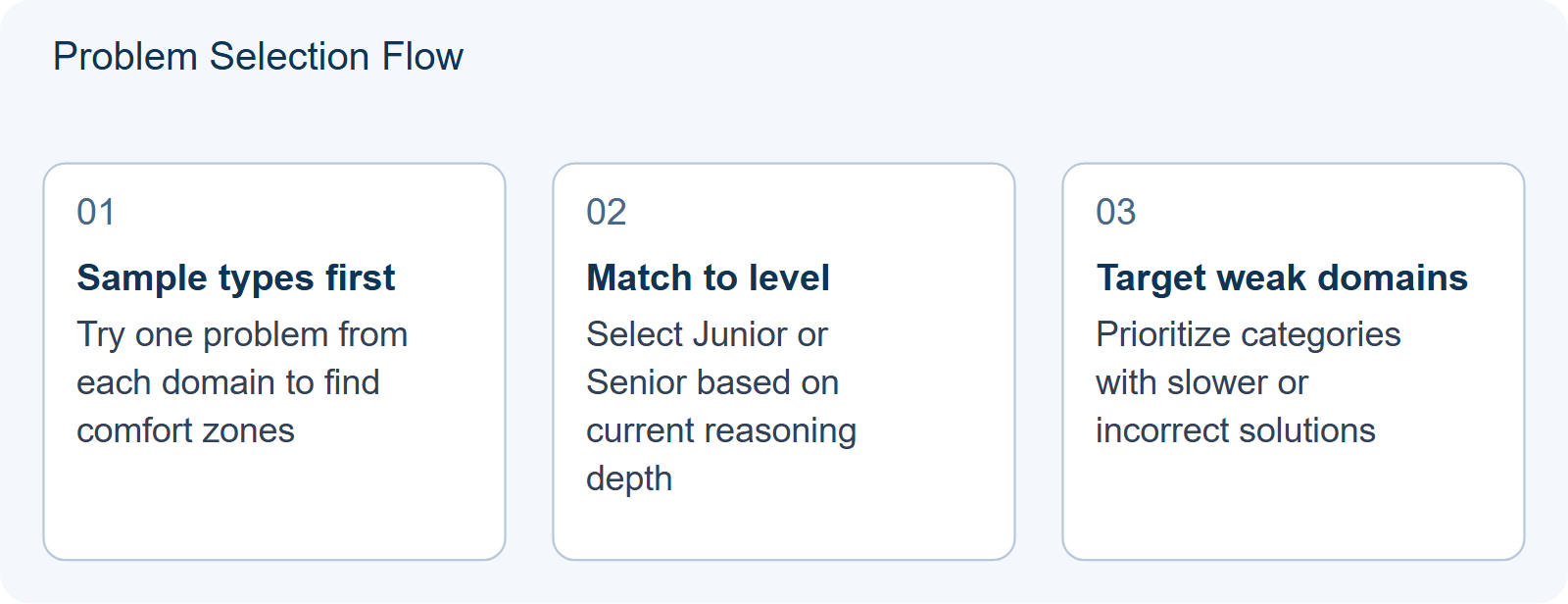
A more useful approach is to sample across problem types first. Official IOL publications and authorized competition materials cover diverse linguistic domains: phonetics, morphology, syntax, semantics, writing systems, and numeral systems. Before committing to full timed practice, a student should attempt single problems from different categories to identify which reasoning patterns feel unfamiliar versus manageable.
From a preparation provider perspective, this diagnostic step prevents wasted effort. A student who discovers early that numeral systems consistently take twice as long can prioritize that category rather than repeating comfortable problem types.
What the IOLC Level Structure Implies for Selection
The IOLC (China Linguistics Olympiad) operates two levels: Junior Level and Senior Level. Junior Level problems are designed for first-time participants with limited linguistics background; Senior Level problems assume stronger foundations and are the only path to IOL international qualification (WeChat article, “AI and Human Linguistic Reasoning: 2026 IOL-AI Results Revealed”, Sept 22, 2026). This distinction matters when selecting past problems: Junior Level papers from recent years serve as accessible entry points, while Senior Level and actual IOL global finals problems reveal the reasoning depth required for advancement.
Students targeting international qualification should eventually practice with problems at or above Senior Level difficulty, but the transition timing depends on individual readiness—not calendar pressure.
Record an Attempted Pattern Before Looking at Explanations
A common trap in self-study is checking solutions too quickly. The IOL rewards inductive reasoning: deriving rules from limited data. If a student reads the explanation after five minutes of struggle, they bypass the very cognitive process the competition tests.
A more productive method:
- Set a timer for the full problem duration (regional contests typically allow several hours)
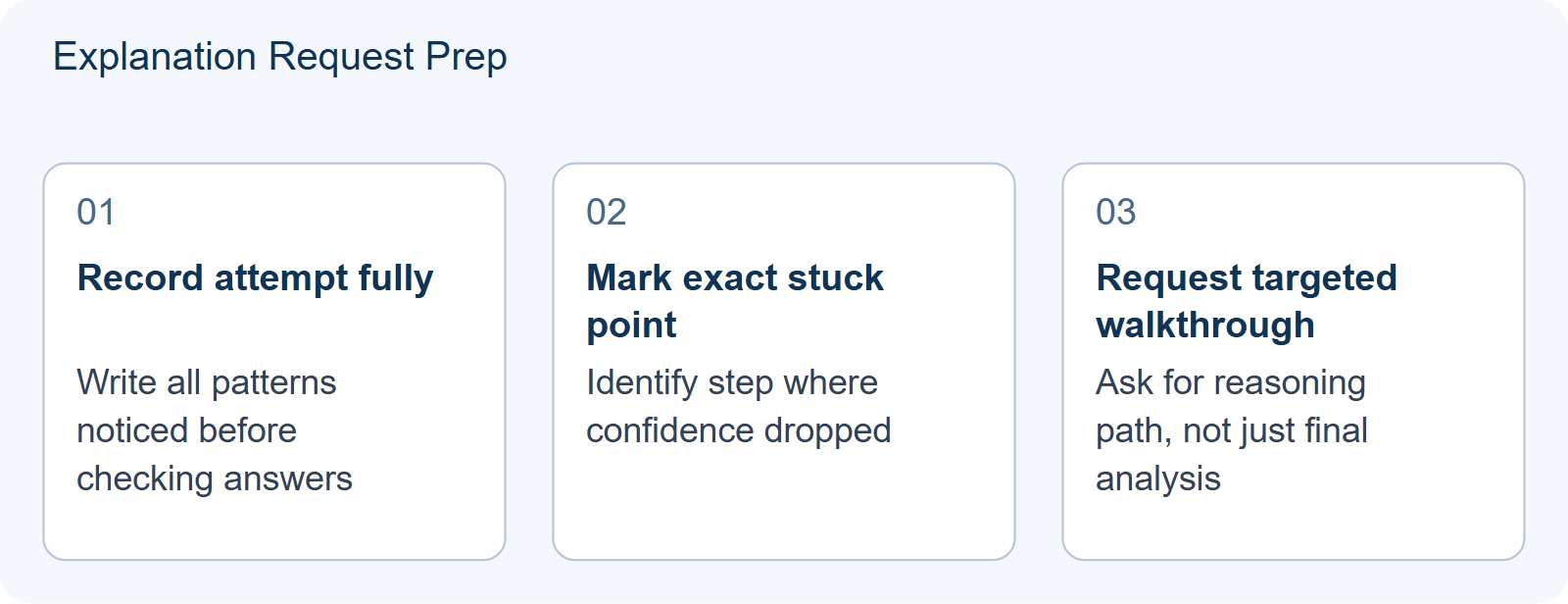
- Write down every pattern noticed, even partial or uncertain ones
- Mark where confidence drops—specific steps, not vague frustration
- Only then consult the answer key or explanation
This recorded attempt becomes valuable material for consultation. Instead of asking “I don’t understand this problem,” a student can ask “I identified the vowel alternation but couldn’t determine the conditioning environment”—a precise starting point for targeted help.
The Gap Between Finding an Answer and Explaining It
IOL scoring rewards explicit reasoning. The official instructions for past competitions state: “Unless the problem explicitly states that you do not need to do so, you should describe any patterns or rules you discover in the data. Otherwise, your answer will not receive full credit” (IOL 2026 competition materials, via preparation course content). This means an answer without reasoning may receive partial or no credit.
Many answer keys provide the correct analysis but compress the discovery process. A student seeing the finished explanation may believe they understand, yet fail to replicate the reasoning on a fresh problem. This is the gap that structured explanation—whether from detailed solution walkthroughs or coaching—addresses.


Explain the Difference Between an Answer and Reasoning
For families evaluating preparation support, it helps to distinguish three tiers of material:
| Material Type | What It Provides | Limitation |
|---|---|---|
| Problem set only | Raw past problems for practice | No verification of attempts |
| Answer key | Correct analysis and final answer | Often skips discovery steps |
| Full reasoning explanation | How to notice patterns, test hypotheses, handle dead ends | Requires matching to student’s specific gaps |
The third tier is where most self-study students need external input. Not because they cannot eventually reason independently, but because identifying one’s own blind spots is inherently difficult. A coach or structured explanation points out: “Here you assumed the pattern was phonological, but the conditioning factor is actually morphological”—a redirect that saves weeks of repeated similar errors.
Ask About Available Sets and Selected-Year Solution Coverage
When contacting preparation providers or reviewing official materials, families should ask specific questions:
- Which years and competition levels are covered in the problem sets?
- Do solutions include reasoning steps, or only final answers?
- Are explanations available for specific problems where the student recorded a stuck point?
- How does the material address the transition from Junior to Senior Level reasoning depth?
The IOLC China competition timeline for the 2027 season includes: registration closing December 1, 2026; Regional Qualifier on March 7, 2027; China National Camp April 16-18, 2027; and IOL International in Bangkok, July 21-28, 2027 (WeChat article, “AI and Human Linguistic Reasoning: 2026 IOL-AI Results Revealed”, Sept 22, 2026). This schedule means students beginning preparation now have months for deliberate practice with past problems before registration deadlines.
Preparation courses reflecting this structure may span 40 hours covering phonetics, morphology, syntax, semantics, and problem-specific strategies across multiple sessions (WeChat article, “2027 IOLC/NACLO Linguistics Olympiad Enters New Season”, Sept 9, 2026). This breadth reflects the range of reasoning types that past problems draw from—not every problem requires every topic, but systematic exposure builds transferable pattern recognition.
What to Request When Seeking Explanation Support
If a student or family decides to request coaching or detailed solutions, prepare this information in advance:
- The specific problem (year, round, problem number)
- The student’s written attempt, including partial hypotheses
- Where the reasoning stopped or felt uncertain
- Whether the difficulty was noticing the pattern, verifying it, or expressing it formally
This preparation makes consultation efficient and diagnostic rather than generic. It also helps providers determine whether the need is for concept clarification, strategy adjustment, or more extensive structured preparation.
Build the Next Practice Cycle from a Diagnosed Gap
After working through past problems with explanations, the final step is designing the next practice cycle. A diagnosed gap might be: slow initial pattern recognition in phonetic data; overcommitting to early hypotheses without testing alternatives; or difficulty translating discovered rules into formal notation.
Each gap suggests a different next problem selection. Slow pattern recognition benefits from problems with transparent, regular data sets where the challenge is speed rather than complexity. Hypothesis-testing weakness calls for problems with multiple interacting rules where premature conclusions fail. Formalization difficulty requires practice with problems that explicitly require explicit rule statements.
Effective preparation emphasizes this cyclical structure: attempt, diagnose, target, repeat. Past problems are not merely content to consume but diagnostic tools when paired with honest self-assessment and, where needed, expert explanation.
Course-Fit and Resource Request Preparation
If you are considering whether structured preparation aligns with your situation, the following preparation helps any consultation be productive:
Assess current exposure: Have you attempted any IOL or IOLC past problems? At what level (Junior/Senior)? With or without time pressure?
Identify the sticking point: Is the challenge understanding what the problem asks, finding initial patterns, verifying that patterns hold, or explaining findings in the required format?
Define the timeline: Are you preparing for the upcoming Regional Qualifier, building toward future seasons, or exploring whether linguistics competitions suit your interests?
Clarify constraints: What weekly time commitment is realistic? Is preparation primarily independent, or is regular feedback desired?
Bringing this context to any inquiry—whether about official materials, published solution sets, or preparation courses—yields more relevant guidance than a general request for “help with IOL.”
For additional context on competition structure and preparation pathways, see IOLC competition overview, preparation timeline guidance, and level selection considerations.
Frequently Asked Questions
Should I start with the most recent IOL past problems or older ones?
Start by sampling across problem types and difficulty levels rather than prioritizing recency. Junior Level problems from any recent year build foundational confidence; Senior Level and international finals problems reveal the reasoning depth needed for advancement. Once you identify which categories challenge you most, select problems targeting those specific gaps.
How do I know if I need coaching or just the answer key?
If you consistently find correct answers but cannot explain why the pattern holds, or if you understand the explanation yet fail to replicate the reasoning on new problems, you likely need structured reasoning support. Answer keys show finished analysis; coaching addresses how to discover and verify patterns independently.
What information should I prepare before requesting explanation help?
Prepare the specific problem reference, your written attempt with partial hypotheses, where your reasoning stopped, and whether the difficulty was pattern discovery, verification, or formal expression. This allows any consultation to focus precisely on your actual gap rather than repeating generic material.
Keep reading.
IOLC Consonant Digraphs: Why bh, mb and ng Stay Single Units in Rongga-Style Data
In the 2026 IOLC Newcomer/Junior Division Rongga problem note, bh, mb and ng are recorded as consonants. Learn a data-first method for…
IOLC Team Average: How Each Participating Member Changes the Score
Understand how the IOLC team average is calculated from the individual scores of actual participating members, how adding or removing a member…
IOLC 2027 Level Test: Run a 3-Hour, 4-Problem Mock Before March 7
Prepare for the IOLC 2027 Level Test (March 7) by simulating the latest source-backed 2026 regional format: three hours, four independent puzzles….