
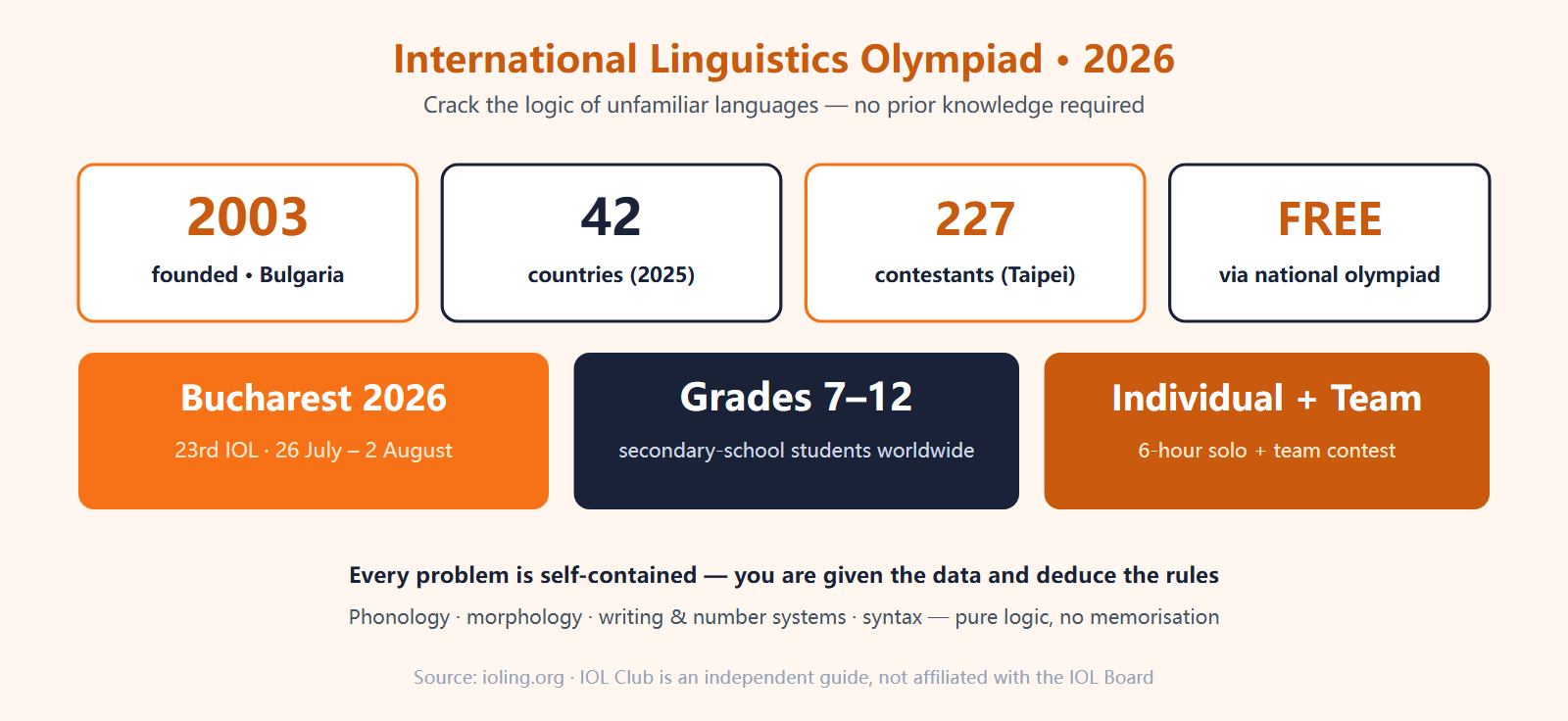
The International Linguistics Olympiad (IOL) is an annual contest for secondary-school students that hands you data from a language you have never seen — and asks you to reverse-engineer its rules using logic alone. No prior knowledge of any language is required. Founded in 2003, it has grown to 40+ countries; the 23rd IOL runs in Bucharest, 26 July – 2 August 2026.
Quick Facts (2026)
| What it is | Annual contest in theoretical, mathematical & computational linguistics for secondary-school students |
| Founded | 2003, in Borovets, Bulgaria (first contest: 6 countries) |
| 2025 scale | 42 countries & territories · 227 contestants · 57 teams (Taipei) |
| 2026 edition | 23rd IOL · Bucharest, Romania · 26 July – 2 August 2026 |
| Rounds | Individual contest (6 hours, 5 problems) + Team contest (3–4 hours, one large problem) |
| Prior knowledge | None required — every problem is self-contained |
| Who can enter | Secondary-school students (roughly grades 7–12); each country sends teams via its national olympiad |
| National feeders | NACLO (North America), UKLO (UK), OzCLO (Australia), and 40+ others |
| Governing body | The IOL Board, elected by member countries’ national olympiads |
| Official source | ioling.org (rules, host city, problem packets) |
What the Contest Actually Is
The IOL is unlike almost every other academic olympiad in one crucial way: it tests reasoning, not knowledge. A typical problem gives you a set of phrases in a language you have certainly never studied — say, a Papuan language, a Mayan script, or an invented signing system — paired with their English translations. Your job is to work out the underlying rules well enough to translate new phrases in both directions. Everything you need is on the page; nothing can be looked up or memorised in advance.
The contest has two parts. The individual contest runs six hours and contains five problems, each a self-contained puzzle in a different corner of linguistics. The team contest tackles one large, harder problem collaboratively over three to four hours. Medals (gold, silver, bronze) and honourable mentions are awarded on the individual contest; the team round has its own ranking. Full rules and the official problem packets for every year since 2003 are published at ioling.org.
Because nothing is memorised, the IOL rewards a specific kind of mind: patient, systematic, comfortable holding several hypotheses at once and discarding the ones the data kills. That is the same cognitive profile prized in theoretical computer science, formal linguistics, mathematics, and cryptography — which is why the contest carries unusual weight with admissions readers in those fields. We cover that in our college-applications analysis later in this guide.
A Problem in Miniature
To make this concrete, here is the shape of a simple problem — far easier than a real IOL one, but the same in kind. Suppose you are shown three sentences in a language you have never seen, each with its English translation:
- mira tovo = the dog sleeps
- mira pelo tovo = the big dog sleeps
- kasa pelo = the big cat
A few minutes of comparison does the rest. From the first two lines, pelo must mean “big” — and it sits after the noun it describes, not before. From lines one and three, mira is “dog” and kasa is “cat”; tovo is “sleeps.” You can now write “the cat sleeps” as kasa tovo, using a rule you deduced rather than one you were taught. A real IOL problem layers a dozen such deductions on top of each other, in a language whose sounds and grammar are nothing like English — but this is the whole game in one image: structure pulled out of data by logic alone.
This is what sets the IOL apart from the mathematics, physics, or informatics olympiads. Those reward a deep body of trained knowledge applied under pressure. The IOL deliberately removes prior knowledge from the equation and rewards the raw act of finding pattern in noise — which means a motivated beginner who has never taken a linguistics class can compete on near-equal footing with a veteran. That accessibility is rare among olympiads, and it is precisely why a single focused season of training can carry a student a long way.
The Five Problem Types
IOL problems are not random. They cluster into a handful of recurring types, and knowing the type is half the battle — it tells you what kind of pattern to hunt for. We publish a worked-example deep-dive for each type; here is the map.
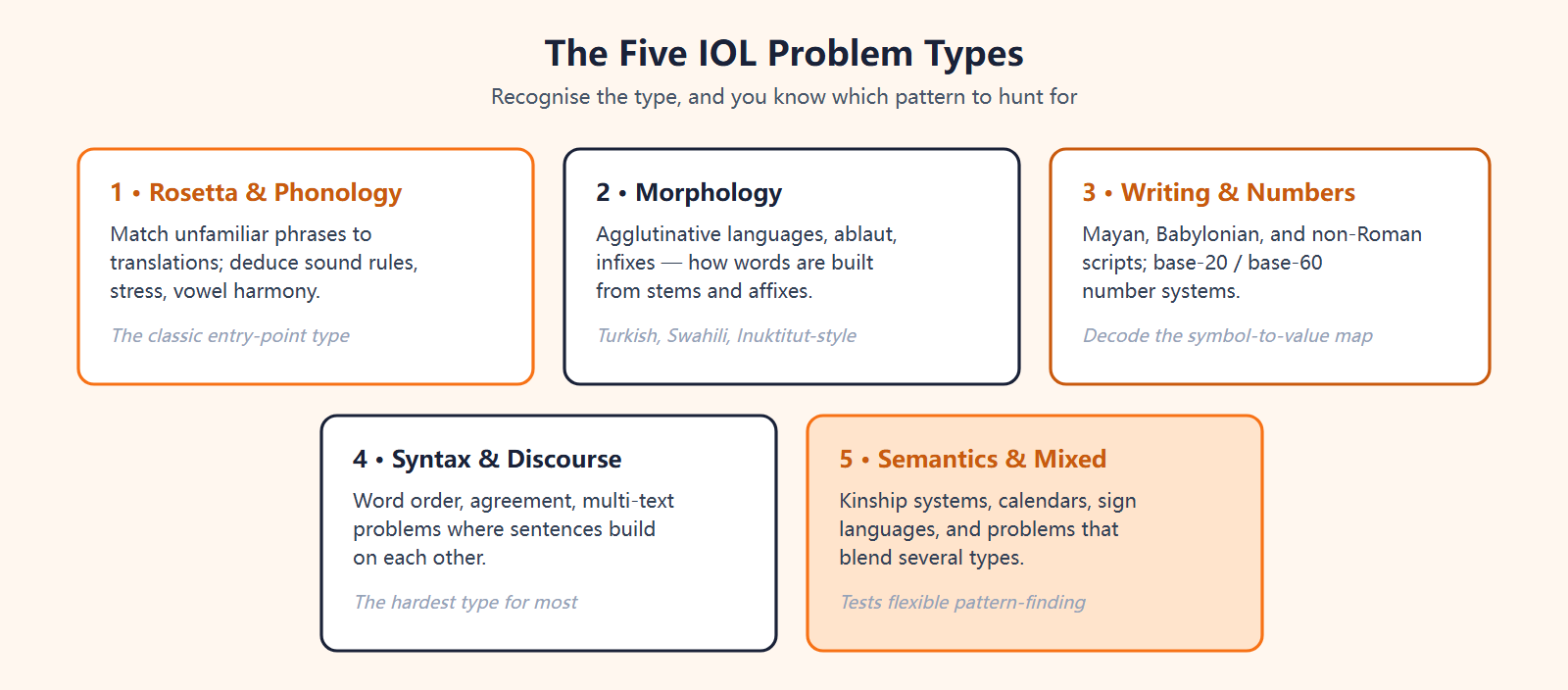
A strong contestant does not “know more languages” than a weak one. They have simply seen enough problems of each type to recognise the shape of the pattern quickly — and they have the discipline to test a hypothesis against every data point before committing to it. That is a trainable skill, which is the entire premise of our 12-week study plan.


How You Get to the IOL: National Olympiads
You do not enter the IOL directly. Each member country runs its own national linguistics olympiad, and the top performers are selected onto that country’s IOL team (usually four to eight students). The best-known national feeders are NACLO (the North American Computational Linguistics Open, serving the US and Canada), UKLO (the UK Linguistics Olympiad), and OzCLO (Australia) — but more than forty countries run their own rounds.
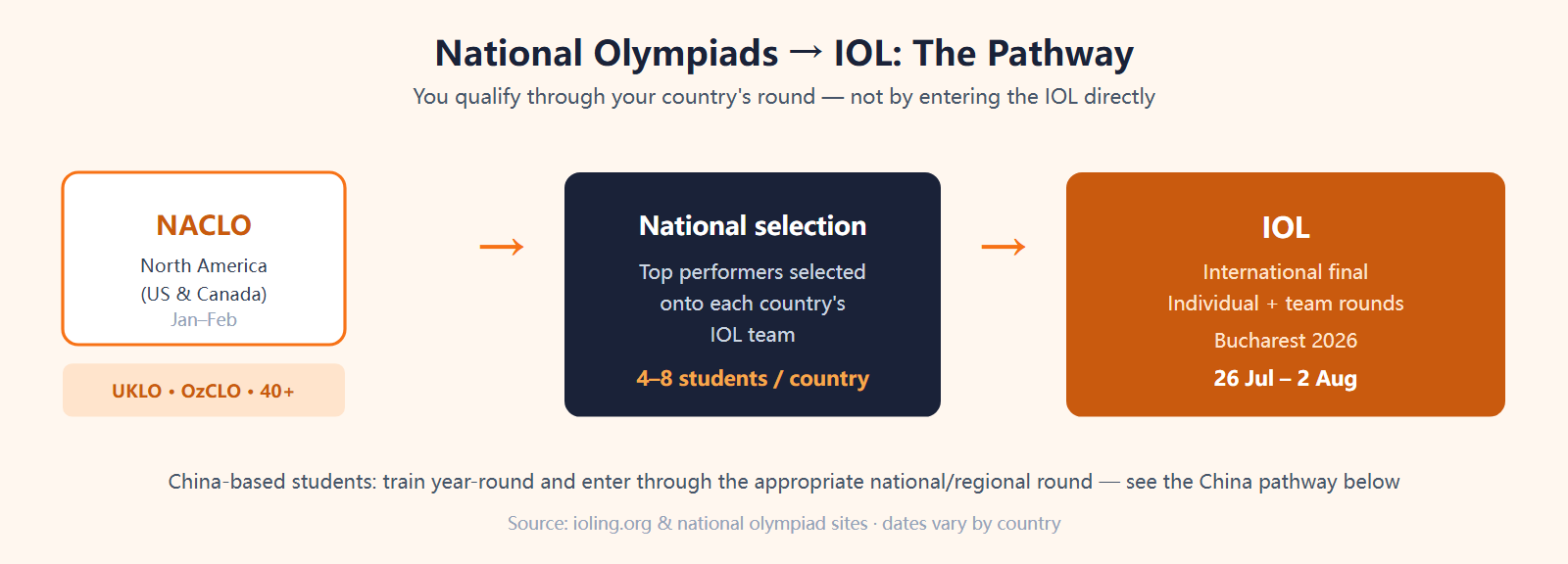
Because the national rounds differ in date, format, and difficulty, students often practise on several countries’ past papers regardless of where they sit — the underlying skill transfers completely. We map the differences, and the China pathway specifically, in our NACLO vs UKLO vs OzCLO comparison.
Who Should Enter
The IOL suits a student in grades 7–12 who enjoys puzzles, patterns, and the feeling of cracking a code — and who does not need to already know linguistics or multiple languages. In practice the strongest contestants come from two overlapping groups: students drawn to mathematics and competitive problem-solving, and students fascinated by languages, scripts, and how communication works. You need patience and a tolerance for sitting with a hard problem far longer than feels comfortable.
It is a particularly good fit for international-school students in China and across Asia for a structural reason: the contest is need-blind to your background. There is no prerequisite course, no nationality bar to training, and the entire past-problem archive is free and public. A student can go from zero to competitive in a single focused season, which is exactly what our cohort is built around.
Is the IOL Worth It for College Applications?
For students applying to selective universities — especially in computer science, linguistics, mathematics, and cognitive science — a strong IOL or national-olympiad record is a high-signal credential. Admissions readers at institutions with strong computational-linguistics and CS programmes (MIT, Carnegie Mellon, Stanford among them) recognise that IOL success demonstrates exactly the analytical reasoning their hardest courses demand. It is rarer and harder to fake than most extracurriculars, which is precisely what gives it weight.
The honest caveat: the IOL is a niche contest, and its value is concentrated in those fields. A student aiming purely at, say, business or the visual arts will get less mileage from it than one heading toward CS or linguistics. We give a tier-by-tier breakdown — which results signal what, to which programmes — in our dedicated college-applications analysis.
The China Pathway and How to Train
IOL Club runs a free, year-round training cohort built for China-based and international-school students. The spine of it is a 12-week study plan that takes a student from zero formal linguistics to contest-ready: weeks 1–3 on phonology and orthography, weeks 4–6 on morphology, weeks 7–9 on number and writing systems, weeks 10–11 on syntax and discourse, and week 12 on a full timed mock. Last cycle around 80 students used it; among those who finished, the average score on the diagnostic mock rose by roughly 40% from week 1 to week 12.
Alongside the plan, we run weekly walkthroughs on WeChat (Tuesday 7pm Beijing time), working through one annotated problem at the pace of whatever week the plan is on. Everything is free and there is no login wall on the past problems archive. If you cannot keep the full cadence, the plan still works à la carte — pick the weeks that match your weakness. To join the cohort, the contact details are below.
Hanlin students at the IOL academic camp: 2025 results
At the 2025 IOL academic camp (China), Hanlin students earned 2 Best Solution, 3 High Distinction, 2 Distinction and 5 Merit in the individual round, plus team High Distinctions and Distinctions. The cohort has placed at High Distinction and Distinction levels across 2023–2025. (Hanlin internal data.)
Frequently Asked Questions
Do I need to know other languages to enter the IOL?
No. This is the single most common misconception. Every IOL problem is self-contained — you are given all the data you need and must deduce the rules using logic. Contestants regularly solve problems in languages they have never heard of. What you need is systematic reasoning and patience, not vocabulary.
When and where is the IOL in 2026?
The 23rd IOL takes place in Bucharest, Romania, from 26 July to 2 August 2026, per the official ioling.org. It is the year’s international final; students qualify through their national olympiad earlier in the year (NACLO in North America runs in January–February, for example).
How do I qualify — can I just sign up for the IOL?
You do not enter the IOL directly. Each country selects its team through a national round (NACLO, UKLO, OzCLO, and 40+ others). You train year-round and sit the appropriate national or regional round; top performers are selected onto the IOL team. We cover the China pathway specifically in a dedicated guide.
Is the IOL worth it for university applications?
For computer science, linguistics, mathematics, and cognitive science applicants, yes — it is a high-signal, hard-to-fake credential recognised by selective programmes including MIT, CMU, and Stanford. Its value is concentrated in those fields; a student outside them will get less mileage. The skill it builds (systematic reasoning under uncertainty) transfers widely regardless.
Filed underFoundation · IOL 2026 · International Student · Independent Guide
This site is IOL Club, an independent community guide to the International Linguistics Olympiad operated by Hanlin Education. We are not affiliated with the IOL Board or with any national linguistics olympiad. Official rules, host-city announcements, and problem packets are published at ioling.org. Our editors verify every claim against ioling.org and national-olympiad sources, and correct confirmed errors within 7 working days.
Keep reading.
From Three Hours to Six: What Actually Changes Between a National Round Paper and an IOL Paper
A national open round gives you roughly 25 minutes a problem; the IOL gives you over an hour. Four things that change…
How to Mark Your Own Linguistics Olympiad Practice Paper When There Is No Solution Sheet
Worked solutions do not exist for every past paper. A five-band self-marking rubric, the regeneration test, and the four ways students quietly…
The Deadline Before the Deadline: Planning a 2026-27 Linguistics Olympiad Autumn Backwards From the Sitting
Registration for the coming cycle is reported to close earlier than usual. An autumn planned backwards from the sitting, with compression options…