
IOL morphology problems hand you words from an unfamiliar language and ask you to cut them into their meaningful pieces — the root, and the affixes that mark things like plural, tense or possession. You solve them not by knowing the language, but by a fixed routine: line up words that share meaning, find the chunk that stays constant (the root), label the chunks that change (the affixes), and build a piece-to-meaning table you can use to translate brand-new words. Per the official International Linguistics Olympiad (ioling.org), no prior linguistics is needed — everything is derivable from the data on the page.
What a morphology problem actually tests
Morphology is the study of word structure — how languages build complex words out of smaller meaningful units called morphemes. At the IOL, a morphology problem is one of the self-contained puzzles you may meet in the individual contest, which (per ioling.org) sets five problems over six hours. You are typically given a wordlist with translations, and the data is engineered so that a consistent system of roots and affixes explains every form — and, crucially, lets you generate words the problem never showed you. If you have read our overview of what the International Linguistics Olympiad is, you already know the golden rule: the answer is always inside the text in front of you.
What the examiner is really checking is whether you can do four things under time pressure: align forms so shared meaning sits in the same place, isolate the unchanging root, attach a precise meaning to each affix, and then prove your analysis by both translating and constructing words on demand. That last step is decisive. A morphology answer that only translates the words you were given is half a solution; the marks are in the “produce the word for X” tasks, where a mis-sliced affix is instantly exposed.
Morphology rewards the same temperament as phonology — patient, list-making, willing to be corrected by your own data — which is exactly why the two are the most trainable problem types. They share one engine: align the data, find what moves, name it. Improve at one and you lift the other. If you are deciding where to spend your prep hours, morphology and phonology together are the highest return on investment of any pair.
The five vocabulary words you need first
You do not need a linguistics degree, but five plain-English concepts make every morphology problem readable. Learn these and the “jargon” barrier mostly disappears.
| Term | What it means (plain English) | Why it matters in a problem |
|---|---|---|
| Morpheme | The smallest piece of a word that carries meaning — a root, or an ending like “-s” for plural. | Your whole job is to break words into these pieces. Each one should map to one meaning. |
| Root (stem) | The core piece that holds the main meaning and tends to stay constant across related words. | Find the root first; it is the anchor everything else attaches to. |
| Affix | A piece added to a root — a prefix before it, a suffix after it. | Affixes carry the grammar: number, tense, person, case. Label each one. |
| Agglutination | Stringing several clear affixes in a row, each with one tidy meaning (e.g. root + plural + possessive). | The friendliest morphology to crack — pieces line up like beads on a string. |
| Order of affixes | The fixed sequence in which affixes attach (e.g. plural always before possessive). | Get the order wrong and your constructed words are wrong even if every piece is right. |
That is the toolkit. Notice it needs no memorised terminology beyond these labels — the IOL FAQ is explicit that “all you need to solve the problem is found in the text given to you.” Many problems use agglutinative languages precisely because their neat, one-meaning-per-affix structure is fair to a solver meeting the language for the first time.
A four-step method (the coach's loop)
Here is the workflow we drill in our weekly sessions. It is deliberately mechanical — under exam stress you want a checklist, not inspiration.
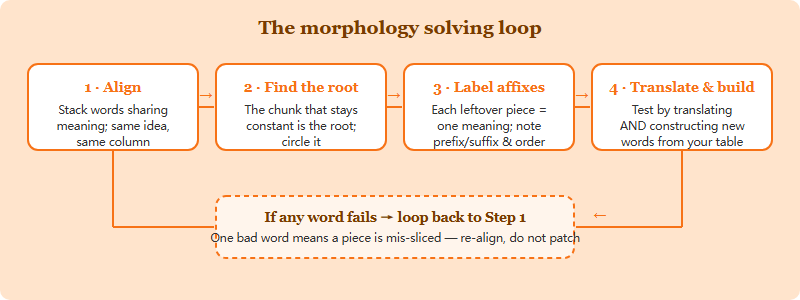
Step 1 — Align. Rewrite the data so that words sharing a meaning component sit in the same column. If six words all involve “child,” stack them so the “child” chunk lines up vertically. The neater the alignment, the more the structure reveals itself — half of morphology problems crack the instant the data is tidy.
Step 2 — Find the root. The piece that recurs unchanged across a meaning family is the root. Circle it. Everything to its left and right is grammar waiting to be labelled. Watch for a root that shifts shape slightly — that is a phonology rule riding on top of the morphology, a common difficulty bump.
Step 3 — Label each affix. Assign every leftover piece exactly one meaning: this suffix = plural, that prefix = “my.” Record whether it is a prefix or suffix and, when several affixes stack, the order they appear in. Order is grammar too, and the problem will test it.
Step 4 — Translate and build. Run your table both ways: translate the unseen forms the problem gives you, then construct the words it asks you to produce. Every one must come out clean. If a construction fails, do not bolt on an exception — return to Step 1, because the mis-fitting word is the examiner telling you a slice is wrong. Our 12-week study plan builds this build-it-back-up habit into every practice set, because constructing words is the skill that separates full marks from a near miss.


A worked mini-example (original — not a past problem)
To show the loop in motion, here is a made-up, illustrative dataset from an invented agglutinative language we will call “Tukai.” This is not from any real IOL, NACLO or UKLO paper — it exists only to demonstrate the method on something safe to reason about out loud.
| Tukai form | Meaning |
|---|---|
| mira | house |
| miratu | houses |
| mirana | my house |
| miratuna | my houses |
| kelotuna | my rivers |
| kelona | my river |
Walk it through. Aligning (Step 1) and finding the root (Step 2): mira = “house” and kelo = “river” sit unchanged at the front of their families — those are the roots. Now label the affixes (Step 3). Comparing mira to miratu, the only addition is -tu, and the only meaning added is plural — so -tu = plural. Comparing mira to mirana, the addition is -na, meaning “my” — so -na = my (possessive). Now the decisive piece: miratuna = “my houses.” The order is root + tu + na, i.e. plural before possessive. The kelo rows confirm the same order on a second root, with no exceptions.
Now test by construction (Step 4). Suppose the problem asks for “my rivers.” From the table: root kelo + plural tu + possessive na = kelotuna — and that exact form appears in the data, confirming our affix order is right. Ask instead for “houses” with no possessor: mira + tu = miratu. Clean. Six words, two roots, two affixes in a fixed order, zero rebels. That is a full-marks shape — and notice we can now produce words the dataset never listed, which is exactly what the harder tasks demand.
Notice what we did not need: no grammar textbook, no knowledge of any real agglutinative language, no outside vocabulary. Everything came from lining up six words and asking “what is constant, what is added, and in what order?” That is the entire game, scaled up to longer words with four or five stacked affixes.
Where it gets hard: zero-marking, irregularity, and stacked affixes
Real IOL morphology rarely stays as tidy as Tukai. Three difficulty bumps recur, and a method that survives them is what you are really building toward. The triage below is what we teach when a clean slice refuses to appear.
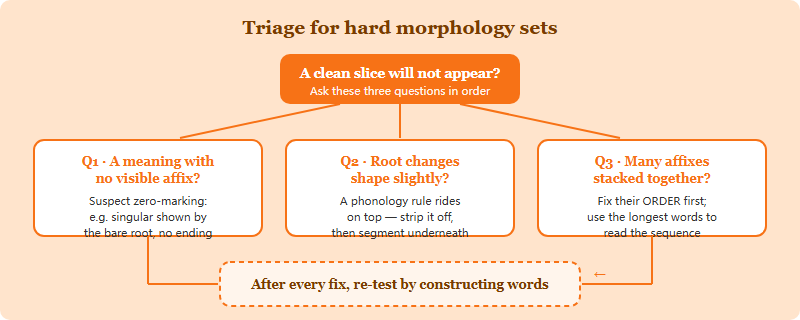
Zero-marking is the classic trap: a grammatical meaning that is signalled by the absence of any affix. In Tukai, “house” (singular, no possessor) is just the bare root mira — the singular is “marked” by having nothing added. Solvers who assume every meaning needs a visible piece invent affixes that are not there. Root allomorphy — a root that changes shape near certain affixes — is where morphology and phonology interlock; strip the predictable sound change first, then segment the cleaner form underneath. And deep stacking, where five or six affixes pile onto one root, is read most reliably from the longest words in the set, because they expose the full affix sequence at once.
How morphology compares to the other problem types
Knowing where morphology sits among IOL problem types helps you budget your six hours. Here is the coach's-eye comparison — difficulty and “trainability” are our editorial judgement, not official ratings.
| Problem type | What it asks | Core skill | How trainable |
|---|---|---|---|
| Morphology | Cut words into roots and affixes; build & produce forms | Aligning forms; labelling affixes; affix order | High — very pattern-drillable |
| Phonology | Work out sound-change rules and their order | Spot alternations; state & order rules | High — shares morphology's engine |
| Rosetta-style | Match sentences to translations and decode the rest | Hypothesis testing; word order | Medium — depends on data richness |
| Writing / number systems | Crack an unfamiliar script or numeral system | Logic; base arithmetic; symbol mapping | Medium-high — numerals are drillable |
| Syntax / semantics | Deduce sentence-building or meaning rules | Structural reasoning | Medium — subtler, less mechanical |
The practical takeaway: morphology and phonology are the trainable core of IOL preparation, and the cheapest way to convert practice hours into marks. We have seen China-based students who arrived intimidated by “unfamiliar languages” become reliably accurate on agglutinative morphology within a term, simply by drilling the align-and-label loop until it is automatic. The IOL itself, founded in 2003 and now drawing dozens of nations each year (Taipei 2025 hosted 227 contestants from 42 countries, per ioling.org), rewards exactly this transferable, methodical reasoning. Once morphology is solid, the natural next move is to practise it inside full national papers under time pressure — see our guide to the NACLO, UKLO and OzCLO calendars for where those qualifying rounds fall.
Frequently asked questions
Do I need to know grammar terminology for IOL morphology problems?
No. The IOL states everything needed is in the problem text. A handful of plain labels — root, prefix, suffix, plural, possessive — is enough to write a clear analysis.
How many morphology problems appear in the IOL individual contest?
The official individual contest sets five problems over six hours (ioling.org); morphology is one possible type, so expect roughly one, though the exact mix varies each year.
What is the most-missed move in morphology problems?
Zero-marking — a meaning shown by the bare root with no added affix. Solvers invent endings that are not there. Always check whether the plain root already carries a grammatical value.
Can I enter the IOL directly to attempt these problems?
No. Per ioling.org, you qualify only through your accredited national contest; there is no independent entry. Confirm your country's route on the official site.
This is an independent IOL Club guide operated by Hanlin Education for China-based international-school students. It is not affiliated with, endorsed by, or sponsored by the IOL Board or any national linguistics olympiad. The Tukai examples above are original illustrations, not real past problems. Contest structure, dates and eligibility change year to year — always confirm current details on the official site, ioling.org. IOL 2026 is in Bucharest, 26 July–2 August 2026. Confirmed errors are corrected within 7 working days.
Keep reading.
From Three Hours to Six: What Actually Changes Between a National Round Paper and an IOL Paper
A national open round gives you roughly 25 minutes a problem; the IOL gives you over an hour. Four things that change…
How to Mark Your Own Linguistics Olympiad Practice Paper When There Is No Solution Sheet
Worked solutions do not exist for every past paper. A five-band self-marking rubric, the regeneration test, and the four ways students quietly…
The Deadline Before the Deadline: Planning a 2026-27 Linguistics Olympiad Autumn Backwards From the Sitting
Registration for the coming cycle is reported to close earlier than usual. An autumn planned backwards from the sitting, with compression options…