
There is no syllabus to memorise for the International Linguistics Olympiad (IOL) — the entire skill is solving unfamiliar language puzzles under time. That makes past problems the single most important preparation material there is, far more than any textbook. So we did the legwork: we have collected the past IOL problems, organised them by problem type, and added worked solutions for many of the years — and we give the pack to you free. (Worked-solution coverage varies by year — our mentors are adding more over time, so message us for the current set and which years are included.) This page shows what is in it, the five problem types you will face, and the method that turns practice into points.
📥 Get the free IOL past-problems pack
Past IOL problems organised by type, with worked solutions for many years (coverage varies — not every year), plus our problem-type notes. Scan the QR on this page or message us — we'll send the pack free and route you into the weekly problem walkthroughs.
What's in the pack
A folder of past papers is not the same as a way to learn from them. The pack pairs the problems with worked solutions and a sensible order to attack them in, so your time goes into solving rather than hunting:
| In the pack | What you get |
|---|---|
| Past IOL problems by type | Individual-contest problems grouped into the five recurring types, so you can drill one skill at a time |
| Worked solutions | Step-by-step solutions for many of the years — written to show the reasoning, not just the answer (coverage varies by year) |
| National-round problems | NACLO, UKLO and OzCLO sets, which are gentler on-ramps before full IOL problems |
| Problem-type notes | Short notes on the recurring ideas — sound systems, agglutination, alignment, base systems — the problems keep testing |


The five problem types you'll face
Almost every IOL problem is a variation on five types. Knowing which one you are looking at is half the battle, because each rewards a different first move. The pack is sorted along exactly these lines so you can practise them in isolation:
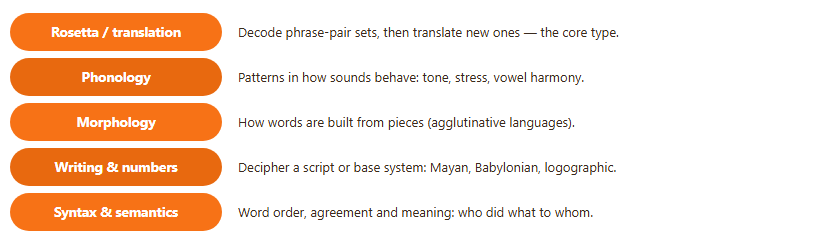
- Rosetta-style (translation). A set of phrases in an unknown language with their translations; you deduce the system and translate new ones. The bread-and-butter of the olympiad.
- Phonology & sound systems. Patterns in how sounds pattern, shift and combine — stress, tone, vowel harmony.
- Morphology & word structure. How words are built from pieces, especially in agglutinative and polysynthetic languages.
- Writing & number systems. Deciphering a script or a base system — Mayan, Babylonian, or a logographic writing system.
- Syntax & semantics. Word order, agreement and meaning — how a language signals who did what to whom.
How to actually use past problems (the part that matters)
Having the problems is the easy 10%. The 90% that builds skill is how you work them. The most common mistake is to read a problem, glance at the solution, and feel you understood it — that builds recognition, not solving ability. Use this four-step loop on every problem instead:
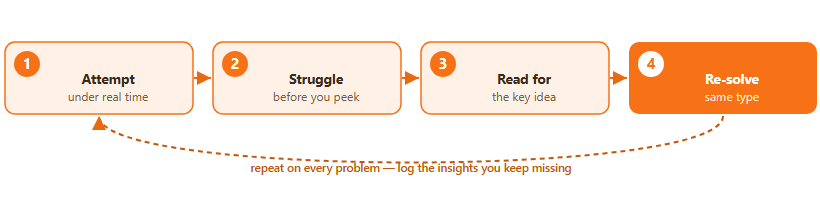
- Attempt under real time. Sit a whole problem to the clock, writing out your reasoning. The exam rewards a clear, justified analysis, so practise writing it, not just seeing it.
- Struggle before you peek. The learning is in the stuck moment. Give a hard problem 30–40 minutes before opening the solution; the first hypothesis is rarely the right one.
- Read the solution for the key idea. Don't absorb it line by line — hunt for the single insight you missed (a hidden alignment, a sound change, a base system) and name it.
- Re-solve a fresh problem of the same type. Immediately work another problem of that type. If the insight transfers, you have learned it; if not, you have only recognised it.
Keep an error log of the insights you keep missing — that log, not the number of problems done, is the real measure of progress. Guidance on which types to drill and feedback on your written analyses is where the weekly walkthroughs add the most over solo practice; ask us when you collect the pack.
Ready to start? Get the pack free.
Scan the QR on this page or message us for the past IOL problems by type, worked solutions for many years (we'll tell you which), and the problem-type notes — free. Tell us your grade and we'll point you to the right starting set.
Frequently asked questions
How do I get the IOL past-problems pack?
Scan the QR code on this page or message us. We'll send the past problems organised by type, worked solutions and our problem-type notes, free of charge, and route you into the weekly walkthroughs.
Do the problems come with solutions?
Many of the years come with full worked solutions written to teach the key insight, not just the answer — but coverage varies by year and not every problem has one yet. Our mentors are adding more over time; we'll tell you exactly which years are included when you request the pack.
Do I need to know lots of languages first?
No. IOL problems are self-contained logic puzzles — every fact you need is in the problem. The skill is pattern-finding, which is exactly what working past problems builds. Beginners start with the gentler NACLO and UKLO sets.
How many problems should I do?
Depth beats volume. One problem worked through the four-step loop, with an error log, is worth more than five problems skimmed against the solutions.
IOL Club is an independent community guide for students preparing for the International Linguistics Olympiad, operated by Hanlin Education. It is not affiliated with, endorsed by, or sponsored by the IOL Board. The worked solutions in the pack are our mentors' own work, written to help you learn. Contest dates and formats can change each year — confirm current details through the official IOL channels.
Keep reading.
From Three Hours to Six: What Actually Changes Between a National Round Paper and an IOL Paper
A national open round gives you roughly 25 minutes a problem; the IOL gives you over an hour. Four things that change…
How to Mark Your Own Linguistics Olympiad Practice Paper When There Is No Solution Sheet
Worked solutions do not exist for every past paper. A five-band self-marking rubric, the regeneration test, and the four ways students quietly…
The Deadline Before the Deadline: Planning a 2026-27 Linguistics Olympiad Autumn Backwards From the Sitting
Registration for the coming cycle is reported to close earlier than usual. An autumn planned backwards from the sitting, with compression options…