
You cannot enter the International Linguistics Olympiad directly. Per ioling.org, a student “CANNOT PARTICIPATE unless they have qualified through an accredited national contest” — so the single most important decision in your IOL journey is which national route you are eligible for. For a China-based international-school student, the practical options usually mean NACLO (US/Canada), UKLO (UK) or OzCLO (Australia), each with its own eligibility rules and entry logistics. This guide compares them — but the binding answer to “can I enter?” lives on each contest's own official site, so verify there before you commit.
First principle: the IOL is a contest of contests
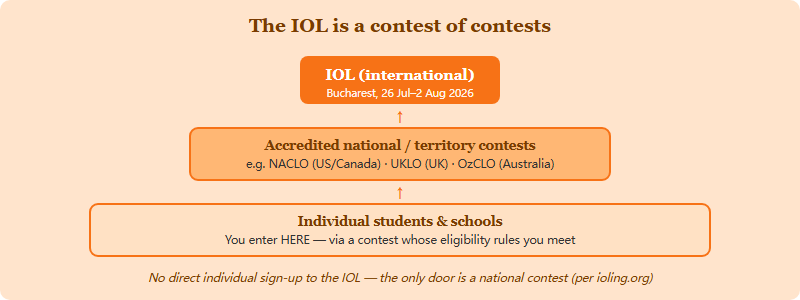
The IOL sits at the top of a pyramid. At its base are national (or territory-wide) contests, each accredited by the IOL and each selecting its own delegation. If you have read our overview of what the International Linguistics Olympiad is, you have seen the rule already: there is no individual sign-up to the international event, and “schools cannot directly apply to go to the IOL without a national/territory-wide contest” (ioling.org). That single fact reframes your whole plan — your job this year is not “qualify for the IOL,” it is “find a national contest you are genuinely eligible for, and do well in it.”
For a student physically in China, this raises a real question, because the country whose contest you enter is rarely the country you are sitting in. The rest of this guide is about navigating that honestly — including the parts where the only correct answer is “check the official eligibility page.”
The three routes most international-school students consider
NACLO, UKLO and OzCLO are three of the best-known accredited national contests, and they recur because their problems are in English and their materials are widely available for practice. They are not interchangeable, though — they differ on who may enter, where you sit the paper, and how selection to the international team works. The table below frames the axes that actually decide your route. Treat the eligibility and format columns as “what to verify,” not settled fact, because each contest sets and updates its own rules.
| Route | Broadly serves | What to confirm on its official site |
|---|---|---|
| NACLO | United States & Canada | Whether students outside the US/Canada may register; open-round vs invitational-round structure; how the team is selected. |
| UKLO | United Kingdom | Eligibility for students/schools outside the UK; round structure; how UK team selection works from the rounds. |
| OzCLO | Australia (and partners) | Whether non-Australian entrants are accepted; its team-based round format; the path from school round to selection. |
Why so many “confirm on the official site” cells? Because eligibility for international entrants is precisely the kind of rule that changes year to year and varies by contest — and getting it wrong wastes a whole season. We will not print a confident “yes, a China-based student can enter contest X,” because only that contest's current rules can say so. What we can give you is the decision framework to ask the right questions in the right order.


A decision framework: finding your eligible route
Run these checks in sequence. The order matters — each step narrows the field before you invest practice time in a contest you may not be able to enter.
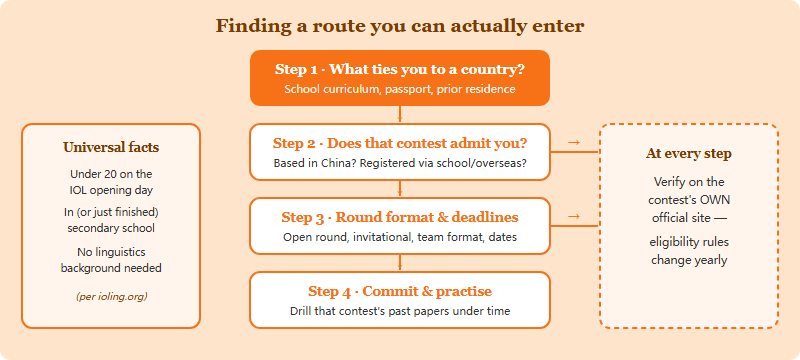
Step 1 — Identify what ties you to a country. List your real anchors: the curriculum your school follows (an American, British or Australian-pattern international school is a strong hint), your passport/nationality, and any prior residence. These are the threads that may connect you to an accredited contest.
Step 2 — Check whether that contest admits a student in your situation. This is the make-or-break step. Read the contest's eligibility page for whether students based outside the host country, or registered through an international school, may enter — and under what conditions. Do not assume; this is exactly where rules differ between NACLO, UKLO and OzCLO and where they change between years.
Step 3 — Map the round structure and deadlines. Contests differ in shape: some run an open first round followed by an invitational round; some use a team-based school round. You need to know the format and, critically, the registration and sitting dates, because a missed open-round deadline ends your season before it starts. Our guide to the NACLO, UKLO and OzCLO calendars is built for exactly this step.
Step 4 — Commit and practise that contest's papers. Once you know your eligible route, train on its past papers under timed conditions. Each contest has a recognisable house style, and tuning to it is worth real marks — the kind of focused, methodical preparation our 12-week study plan is designed around.
What is universal vs what varies (so you check the right things)
Some rules are fixed by the IOL and apply no matter which national route you take; others are entirely the national contest's call. Knowing the split tells you what you can rely on and what you must verify.
- Universal (set by the IOL, per ioling.org): contestants must be under 20 on the IOL opening day and attend — or have only just finished attending — secondary school; no prior linguistics knowledge is needed; you can only reach the IOL via an accredited national contest; you compete in the language of that contest.
- Varies by national contest (verify on each official site): whether students based in China or registered through an international school may enter; the round structure and registration/sitting dates; how the national team is selected from the rounds; any fees; whether a guest or self-proctored arrangement exists.
There is one more universal worth internalising: the IOL is explicitly “a contest about thinking like a language scientist, not about being a polyglot” (ioling.org). You do not need to speak many languages, and you do not need a linguistics course — which means a motivated student in a Chinese international school is on a level field with anyone, provided they secure an eligible national route. That proviso is the whole ballgame, and it is why this article spends so much energy on eligibility rather than problem technique.
A realistic timeline and the honest caveat
Because national rounds typically fall months before the international event (the IOL is held mid-year — Bucharest, 26 July–2 August 2026), your eligibility research has to happen early. A sensible rhythm: settle your route question in the autumn, register the moment your chosen contest opens, sit the qualifying round(s) on schedule, and only then think about the international stage if you are selected. Build in slack — if your first-choice route turns out to exclude you at Step 2, you want time to investigate an alternative rather than discovering the gap the week of a deadline.
The honest caveat, stated plainly: this guide deliberately does not tell you “you are eligible for NACLO/UKLO/OzCLO,” because we cannot — only each contest's current official rules can, and they change. Anyone promising a guaranteed national-team place, or claiming a fixed answer on overseas eligibility without pointing you to the official source, is overstepping. The IOL, founded in 2003 and now drawing dozens of nations each year (Taipei 2025 hosted 227 contestants from 42 countries, per ioling.org), is reachable for a well-organised international-school student — but the path always begins with verifying your route at the source.
Frequently asked questions
Can I sign up for the IOL directly as an individual?
No. Per ioling.org, you cannot participate unless you have qualified through an accredited national contest; schools cannot apply directly either. Find an eligible national route first.
As a student based in China, can I enter NACLO, UKLO or OzCLO?
It depends on each contest's current eligibility rules, which vary and change yearly. We do not state a fixed yes/no — confirm overseas-entrant eligibility on each contest's own official site.
What requirements does the IOL set for every contestant?
Per ioling.org: under 20 on the opening day, attending or just-finished secondary school, and no prior linguistics needed. National team-selection rules are set by each contest.
Do I need to know many languages to qualify?
No. The IOL describes itself as thinking like a language scientist, not being a polyglot. You compete in your national contest's language and solve from the data given.
This is an independent IOL Club guide operated by Hanlin Education for China-based international-school students. It is not affiliated with, endorsed by, or sponsored by the IOL Board, NACLO, UKLO, OzCLO or any national linguistics olympiad. Eligibility for overseas or China-based entrants is set by each national contest, varies, and changes year to year — we do not assert a fixed answer; always verify on each contest's official site and on ioling.org. IOL 2026 is in Bucharest, 26 July–2 August 2026. Confirmed errors are corrected within 7 working days.
Keep reading.
From Three Hours to Six: What Actually Changes Between a National Round Paper and an IOL Paper
A national open round gives you roughly 25 minutes a problem; the IOL gives you over an hour. Four things that change…
How to Mark Your Own Linguistics Olympiad Practice Paper When There Is No Solution Sheet
Worked solutions do not exist for every past paper. A five-band self-marking rubric, the regeneration test, and the four ways students quietly…
The Deadline Before the Deadline: Planning a 2026-27 Linguistics Olympiad Autumn Backwards From the Sitting
Registration for the coming cycle is reported to close earlier than usual. An autumn planned backwards from the sitting, with compression options…