
In the International Linguistics Olympiad (IOL), your score is built mostly from how you reason, not just your final answer. Examiners award partial credit for correctly translated fragments and for clearly stated rules, even when a sentence comes out wrong. Understanding that changes how you spend your time. This guide explains the marking logic and turns it into a practical, point-maximising strategy.
Why partial credit changes everything
The IOL is a problem-solving contest in which “no prior knowledge of linguistics or languages is required” and “the most challenging problems only require logical ability, patient work, and a willingness to think outside the box” (per ioling.org). Because problems are scored on partial progress rather than all-or-nothing, two students who both fail to fully crack a hard problem can still finish far apart — the one who recorded a correct partial rule banks marks the blank page does not.
That single fact has three consequences:
- Never leave a problem empty. A half-formed but correct generalisation is worth more than a perfect-looking guess with no working.
- Write your rules down. Many IOL tasks ask you to state the pattern you found; an examiner can only reward reasoning that is on the paper.
- Breadth can beat depth. Harvesting partial marks across several problems can outscore sinking your whole session into finishing one.
Important caveat: the precise points allocation, the weight given to justifications, and any tie-break rules vary by edition and by individual problem. Treat the figures and structures below as a framework, and confirm the current marking conventions on ioling.org — never assume a specific number.
The three things examiners reward
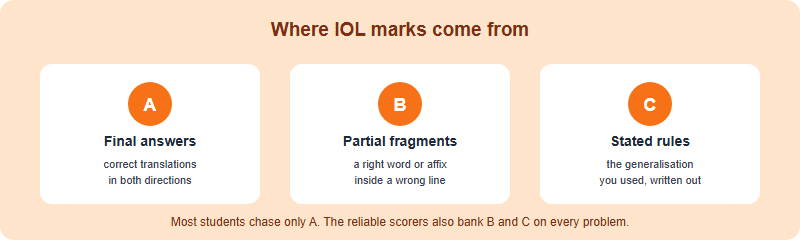
A — Final answers. The obvious one: correct translations of the requested sentences, each direction usually scored separately.
B — Partial fragments. If your translation of a sentence is mostly wrong but contains a correctly identified word, affix or marker, that fragment can still earn credit. This is why writing a careful word-by-word gloss pays off even when the whole sentence eludes you.
C — Stated rules. When a problem asks you to explain the system (or simply gives room to), a clearly written, correct rule is markable in its own right. A neat sentence such as “the subject takes the suffix -ka; the verb comes last” can score even if your translations contain slips.
A worked scoring scenario (illustrative)
The table below is an invented illustration — not real IOL marking — to show how the same effort produces different totals depending on what you write down. Imagine a problem worth a notional 20 points: 12 for translations, 8 for the explanation.
| Student | What they did | Translations | Explanation | Notional total |
|---|---|---|---|---|
| Mei | Solved 3 of 4 sentences, wrote no rule | 9 / 12 | 0 / 8 | 9 / 20 |
| Arjun | Solved 2 sentences, but glossed every word and stated the case rule clearly | 6 / 12 + 2 partial | 6 / 8 | 14 / 20 |
| Sara | Left the problem blank, “saving time” for an easier one | 0 / 12 | 0 / 8 | 0 / 20 |
Arjun scores highest despite translating fewer sentences than Mei, because he captured fragment credit and the explanation marks. Sara’s “time-saving” decision is the worst outcome of all. The lesson: writing down your reasoning is not optional polish — it is where a large share of the points live. For how those rules are actually constructed, see our breakdown of what the IOL is and how its problems work.


Turning the marking logic into a time strategy
Because partial credit is generous, the individual round becomes an exercise in marginal points per minute. The diagram below shows a sensible default allocation; treat the exact session length and number of problems as values to confirm on ioling.org for the current edition.
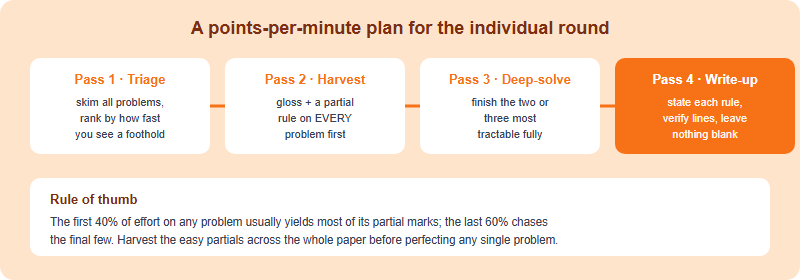
The non-obvious move is Pass 2. Before you fall in love with one beautiful problem, spend a fixed block laying down a gloss and a tentative rule on every problem. You lock in the cheap partial marks first, then return to deep-solve. Students who skip this and tunnel into a single hard problem routinely leave easy points uncollected elsewhere.
What a mark-friendly write-up actually looks like
Examiners read hundreds of scripts under time pressure. A write-up that is easy to mark is a write-up that earns every point it deserves — buried or ambiguous reasoning gets the benefit of fewer doubts, not more. The goal is to make your correct thinking impossible to miss.
Four habits separate a clean script from a messy one:
- State rules as a numbered list, not a paragraph. “(1) word order is SOV; (2) subjects take -ka, objects take -n; (3) plural stacks outside case” is instantly checkable. A flowing paragraph hides the same content where a tired marker may not find it.
- Gloss before you translate. Writing a word-by-word breakdown under each answer shows the fragments you identified, which is exactly where partial marks live. Even a wrong final sentence can carry several correct glossed pieces.
- Label your answers to the question asked. If the problem numbers its sub-questions, mirror that numbering. Unlabelled answers force the marker to guess which response belongs to which prompt.
- Show one example per rule. Pointing to the data line that justifies a rule (“see sentence 2”) demonstrates the rule is evidence-based, not guessed, and makes your reasoning auditable.
The table contrasts the same correct idea expressed two ways. Both students “knew” the answer; only one reliably banks the marks.
| Messy script (loses marks) | Clean script (earns marks) |
|---|---|
| “I think the verb is at the end and the words change a bit for who does what, also plurals.” | “Rule 1: order = SOV. Rule 2: subject suffix -ka, object suffix -n (see lines 1–2). Rule 3: plural -tu/-sa stacks outside case.” |
| Translation written with no working | Translation with a word-by-word gloss underneath |
| Answers run together, no labels | Each answer labelled to its sub-question |
None of this requires extra solving ability — it is purely presentation discipline, and it is the cheapest set of marks in the contest. Build the habit in practice so it costs you no thought on the day. For how the underlying rules are actually derived from the data, our guide to the IOL and its problem types walks through the reasoning step by step.
How to practise for the marking, not just the answer
Most students train only their solving and ignore their write-up — then lose marks they had earned in their heads. Build these habits before IOL 2026 (Bucharest, 26 July – 2 August 2026, per ioling.org):
- Self-mark with a fragment lens. When you check a practice problem, give yourself credit for every correct word and rule, not just whole sentences. You will be surprised how many marks you were throwing away.
- Always write the rule. Make “state the generalisation in one sentence” a non-negotiable final step on every practice problem.
- Rehearse the four passes. Do full timed sets occasionally so triage and write-up become automatic under pressure.
- Plan the season backwards. National rounds (NACLO, UKLO, OzCLO) come first; see our national olympiad calendars to time your build-up, and our 12-week study plan to structure it.
None of this guarantees a medal — outcomes depend on the field, the problem set and your own work — but it ensures the marks you actually earn make it onto the page.
FAQ
Does the IOL give partial credit?
Yes — IOL problems are generally scored on partial progress, so correctly identified fragments and clearly stated rules can earn marks even when a full answer is wrong. Confirm specifics for the current edition on ioling.org.
Should I write down my reasoning or just the answer?
Write it down. Many problems ask you to state the pattern, and examiners can only reward reasoning that appears on your paper. A clear rule is markable even with translation slips.
Is it better to finish one problem or attempt several?
Because partial credit is available, harvesting partial marks across several problems often beats sinking all your time into perfecting one. Triage first, then deep-solve the most tractable.
How long is the individual round?
The duration and number of problems vary by edition, so check the current regulations on ioling.org rather than relying on a fixed figure.
This is an independent community guide operated by Hanlin Education for China-based international-school students. It is not affiliated with, endorsed by, or sponsored by the IOL Board. Competition formats, dates, marking and rules change year to year — always confirm current details on ioling.org. We correct any errors within 7 working days of notification.
Keep reading.
From Three Hours to Six: What Actually Changes Between a National Round Paper and an IOL Paper
A national open round gives you roughly 25 minutes a problem; the IOL gives you over an hour. Four things that change…
How to Mark Your Own Linguistics Olympiad Practice Paper When There Is No Solution Sheet
Worked solutions do not exist for every past paper. A five-band self-marking rubric, the regeneration test, and the four ways students quietly…
The Deadline Before the Deadline: Planning a 2026-27 Linguistics Olympiad Autumn Backwards From the Sitting
Registration for the coming cycle is reported to close earlier than usual. An autumn planned backwards from the sitting, with compression options…