
A semantics or kinship problem at the International Linguistics Olympiad (IOL) gives you words or terms from an unfamiliar language and asks you to work out how that language divides up meaning — colours, verbs of motion, or, most famously, family relationships — then apply the system to new cases. Unlike a translation puzzle, the challenge here is not vocabulary but the hidden logic of how meaning is organised. This guide gives you a method you can drill.
Why semantics and kinship are their own problem family
The IOL’s public materials group its puzzles under a handful of recurring families — translation (Rosetta), phonology, morphology, syntax, number and writing systems, and problems built around semantic and relational systems. Our other guides cover the first families in depth; this article fills the last gap. Semantics problems sit apart because the answer is rarely a single “correct translation.” Instead you are reconstructing a system of distinctions: which real-world situations a language treats as the same, and which it keeps separate.
The official IOL position is that “no prior knowledge of linguistics or languages is required,” and that everything you need is contained in the problem itself (per ioling.org). Kinship problems are the purest example: you are handed a family tree and a list of terms, and you must deduce the rule that maps one onto the other. It is closer to a logic grid than to a language test — which is exactly why students from a maths or computer-science background often find these problems approachable. If you are still deciding whether the event suits you, our complete guide to what the IOL is sets the scene.
The four axes that structure most kinship systems
Family-relationship terms across the world’s languages tend to vary along a small number of dimensions. If you learn to check each axis in turn, you can crack most kinship data sets methodically rather than by guessing.
| Axis | The question it asks | English example |
|---|---|---|
| Generation | Is the person older or younger, and by how many generations? | “grandmother” vs “mother” vs “daughter” |
| Sex | Is the relative male or female? | “brother” vs “sister” |
| Lineage (side) | Is the relative on the mother’s side or the father’s side? | English ignores this; many languages do not |
| Relative age | Is the sibling older or younger than the speaker? | English ignores this; Chinese distinguishes 哥 vs 弟 |
The trap for English speakers is assuming other languages carve family the way English does. English has one word “cousin” for eight distinct relationships; many languages split them by sex, side and relative age. Conversely, some languages use one word where English uses several. Your job is to find which axes the target language cares about — and, just as importantly, which ones it ignores.
A 5-step method for semantics and kinship problems
The same workflow that powers our Tuesday walkthroughs applies here. Work it in order and resist filling in gaps from your intuition about English.
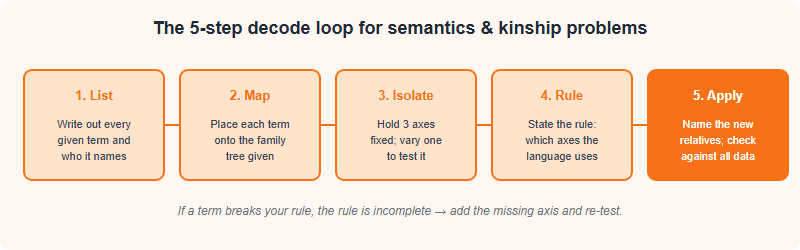
Step 1 — List. Write out every term the problem gives you next to the person it names. Do not skim: the exact set of examples is your entire evidence base.
Step 2 — Map. If a family tree is provided, place each term onto the correct node. If no tree is given, sketch one from the descriptions. Seeing the relationships spatially exposes patterns that a list hides.
Step 3 — Isolate one axis. Pick two relatives who differ on only one dimension — say, same generation and side but different sex. If their terms differ, that axis matters. If the term is identical, the language ignores that distinction.
Step 4 — State the rule. Write, in plain words, which axes the language encodes and how. For example: “male relatives one generation up on the father’s side share one term; the mother’s side uses another.” A precise rule is worth more than a lucky answer.
Step 5 — Apply and verify. Name the new relatives the problem asks about, then run your rule back over every term in the data. If one line contradicts it, your rule is missing an axis — do not blame the data.


An illustrative mini-example
Here is a small invented data set — not a real IOL problem, because we never reproduce past papers. Suppose a made-up language “Toran” gives these terms for one family:
| Toran term | Relationship (from the speaker) |
|---|---|
| ama | mother’s older sister |
| ama-ni | mother’s younger sister |
| seka | father’s older sister |
| seka-ni | father’s younger sister |
Working the axes: the base word changes with side (mother’s side = ama, father’s side = seka), while the suffix -ni marks relative age (younger). Sex is held constant here (all aunts), so we cannot yet tell whether Toran distinguishes it — an honest solver notes that gap rather than assuming. From this rule, “mother’s younger sister” is ama-ni, and if the problem later asked for “father’s older sister” we would predict seka. The discipline is: state what the data proves, and flag what it does not.
How to practise this problem family
Semantics and kinship problems reward two habits: drawing diagrams, and reasoning about what a data set cannot tell you. Both are trainable.
- Always sketch the tree. Even when the problem gives one, redraw it and annotate each node with the term. The physical act of mapping surfaces the pattern.
- Test one axis at a time. Resist the urge to explain everything at once. Kinship rules are built from independent dimensions; find them one by one.
- Distinguish “merged” from “unknown.” If two relatives share a term, the language merges that distinction. If a distinction simply never appears in the data, you don’t know — say so.
- Fit it into a full plan. This family is one slice of the syllabus. Our 12-week study plan and the national olympiad calendars show where semantics practice sits alongside phonology, morphology and translation drills.
Because these problems lean on logic rather than memorised facts, they are among the most improvable with structured practice. A student who has never seen a kinship problem can reach a confident method within a few focused sessions — which is why we return to them regularly in the Tuesday walkthroughs (7pm Beijing time).
Semantics beyond kinship: colour, motion and containers
Not every semantics problem is about family. The same “how does this language divide the world?” logic appears in other domains, and recognising the domain early helps you pick your axes.
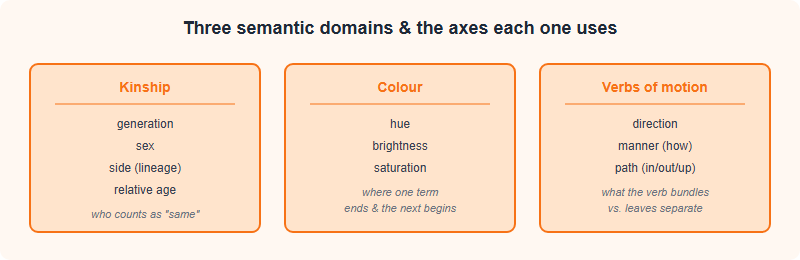
A colour problem might show which shades a language calls by one name and ask you to place a new sample; a motion problem might reveal that a language bundles “direction” into the verb itself. In every case, the winning move is to name the axes, then find where the language draws its boundaries — the same skill kinship problems train.
A useful diagnostic when you first read a semantics problem is to ask: is this a merging problem or a splitting problem? Sometimes the target language uses fewer terms than English, lumping distinctions together (one word for “aunt” regardless of side). Sometimes it uses more, splitting a single English word into several (separate words for older and younger sibling). Naming which direction the language runs, relative to your own, immediately tells you which axes to interrogate first — and stops you from wasting time testing distinctions the data will never resolve. This “compare to my baseline, then look for the gaps” instinct is exactly what the decode habit from our other guides trains, applied to meaning rather than sound or structure.
Frequently asked questions
Q: Do I need to know anthropology or linguistics for kinship problems?
No. The IOL states no prior knowledge is required. Everything you need is in the data; you reconstruct the system by logic alone.
Q: How are semantics problems different from Rosetta translation problems?
Rosetta problems mostly test vocabulary matching and grammar. Semantics problems test how a language divides meaning — which situations it treats as the same — which is closer to a logic puzzle.
Q: What if the data doesn’t reveal whether an axis matters?
Then you cannot claim it does. State the rule the data supports and note the gap. Honest uncertainty scores better than a confident wrong assumption.
Q: Are semantics and kinship problems common at the IOL?
They are one of the recurring problem families. For the exact mix in any given year, confirm on the official samples and past-problem archives at ioling.org.
This is an independent community guide operated by Hanlin Education for China-based international-school students. It is not affiliated with, endorsed by, or sponsored by the IOL Board. Competition facts change year to year, so confirm current details on ioling.org. Errors are corrected within 7 working days of notice.
Keep reading.
From Three Hours to Six: What Actually Changes Between a National Round Paper and an IOL Paper
A national open round gives you roughly 25 minutes a problem; the IOL gives you over an hour. Four things that change…
How to Mark Your Own Linguistics Olympiad Practice Paper When There Is No Solution Sheet
Worked solutions do not exist for every past paper. A five-band self-marking rubric, the regeneration test, and the four ways students quietly…
The Deadline Before the Deadline: Planning a 2026-27 Linguistics Olympiad Autumn Backwards From the Sitting
Registration for the coming cycle is reported to close earlier than usual. An autumn planned backwards from the sitting, with compression options…