
Most preparation guides for the International Linguistics Olympiad (IOL) are short crash plans. This one is the opposite: a multi-year runway for a Grade 8 or 9 international-school student who wants to build toward the olympiad properly rather than cram for one attempt. The idea is simple — start early, qualify through a national olympiad, and treat the international final as a two-to-three-year goal, not a single deadline.
Why a long runway beats a last-minute sprint
The IOL is reached by placing well in a national linguistics olympiad — for international-school students, typically contests such as NACLO, UKLO or OzCLO — and each country sends a delegation from that national round (per ioling.org). Those national contests run on annual cycles, which means a student realistically gets one qualifying attempt per year. Starting in Grade 8 or 9 gives you multiple cycles before university applications, and that changes everything about how you should train.
A 12-week sprint can teach you the mechanics of the problem types. But the students who reach the international final almost always have two or three national-olympiad attempts behind them — the first to learn the format, the next to compete seriously. A multi-year plan turns the first attempt from a make-or-break event into a low-stakes rehearsal. If you are brand new to the competition, begin with our complete guide to what the IOL is, then use this article to plan the years around it.
The runway, year by year
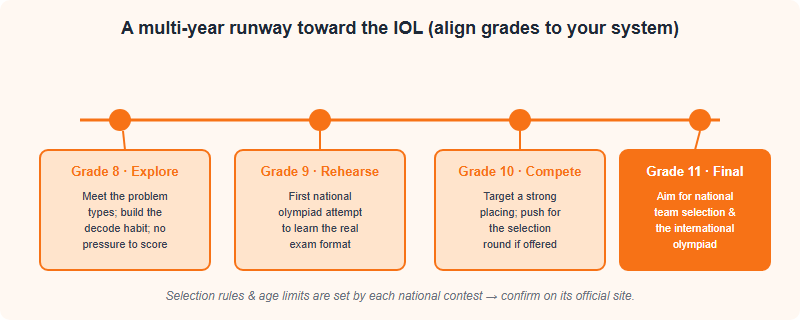
Below is a grade-by-grade map. Ages and grades are approximate — align them to your own school system, and remember that the qualifying contests set their own eligibility rules, so confirm on each contest’s official site before assuming you can enter.
Grade 8 — Explore, don’t score
The first year is about discovering that you enjoy the puzzles and learning the decode habit that every problem type shares: reconstruct the rules from the data alone. Spend this year meeting the problem families — translation (Rosetta), phonology, morphology, syntax, and number/writing/meaning systems — one at a time. Do not track your score; track whether you can explain your reasoning. Our 12-week study plan is a perfect Grade 8 on-ramp because it introduces each family without assuming any background.
Grade 9 — Rehearse the real thing
Now sit a national olympiad for the first time, with the explicit goal of learning the format rather than winning. Contests such as NACLO, UKLO and OzCLO have first rounds that are open and low-stakes; confirm each contest’s eligibility and dates on its official site, and use our national olympiad calendars to schedule around your school year. Whatever your score, you now know what a timed paper feels like — the single most valuable thing a first attempt buys you.
Grade 10 — Compete seriously
With one cycle behind you, this is the year to push for a strong placing. You know the format, you have a method for each problem family, and you can now train for depth and speed. If your national contest has an invitational or selection round beyond the open first round, aiming for it is a realistic Grade 10 target.
Grade 11 — Aim for the final
This is the year to target national team selection and, through it, the international olympiad itself. By now the competition is less about learning new problem types and more about consistency under pressure. A student who started in Grade 8 arrives here with two or three national attempts of experience — a genuine edge over someone attempting it cold.


What to build each year (beyond just solving problems)
A runway is more than a list of contests to enter. Three capabilities compound over the years, and it helps to be deliberate about each — building coverage first, then stamina, then the write-up skill that ties it all together.
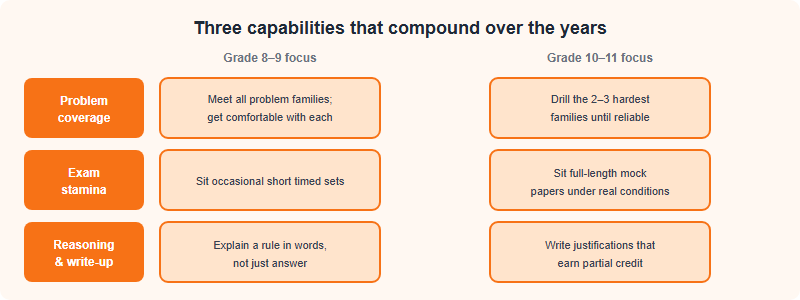
The bottom row is the one students neglect. Linguistics olympiads reward a clearly justified rule, not just a final translation, so a student who can articulate their reasoning banks marks even on problems they do not fully crack. Building that habit from Grade 8 pays off far more than memorising exotic facts — and it is a skill that transfers directly to university-level work, where the ability to defend a method matters as much as the result.
There is a sequencing logic to the three rows, too. Coverage comes first because you cannot drill your weak families until you know what they are. Stamina builds naturally once you have enough method to fill a full paper. And the write-up habit, though it should start early, only reaches its full value in the later years when you are chasing every available mark under real time pressure. Trying to force all three at once in a single Grade 11 sprint is exactly the failure mode a runway avoids.
Common runway mistakes — and the fix
A multi-year plan can go wrong in predictable ways. Most failures are not about talent; they are about pacing and mindset. Here are the traps we see most often and how to avoid each.
| Mistake | Why it hurts | The fix |
|---|---|---|
| Treating the Grade 9 attempt as make-or-break | Turns a low-stakes rehearsal into a source of anxiety and burnout | Define the first attempt explicitly as “learn the format” — score is irrelevant |
| Only doing problems you are already good at | Your weakest families stay weak and cap your total on contest day | Deliberately rotate through every family; spend most time on the hardest two or three |
| Answering without justifying | Loses partial credit that explained reasoning would have banked | Write the rule in words on every practice problem, from Grade 8 onward |
| Cramming only in the final weeks | Skills built in a rush fade fast and crack under pressure | Keep a light, steady load year-round; ramp up only before each contest season |
| Assuming you are eligible | Age and enrolment rules differ by contest and can rule you out unexpectedly | Confirm each national olympiad’s eligibility on its official site before you plan around it |
The through-line across all five is temperament. A runway works because it removes urgency from the early years, letting curiosity — not fear of a single deadline — drive the practice. Students who internalise that tend to still be enjoying the puzzles in Grade 11, which is precisely when enjoyment translates into performance.
Where this fits with the rest of a student’s life
A multi-year plan only works if it is sustainable, so keep it honest and light-touch — this is an enrichment pursuit, not a second full-time job.
- Low weekly load, high consistency. One or two focused problems a week, done well and written up properly, beats a monthly binge. The point is to keep the decode habit alive between contest seasons.
- Ride the natural calendar. National olympiads cluster at particular times of year; plan your heavier practice into the weeks before your contest and rest afterwards. The calendar guide makes this concrete.
- Keep perspective on admissions. A serious multi-year engagement with the IOL is a strong signal for computer-science and linguistics applications, but it is one part of a profile, not a guarantee. Pursue it because the puzzles are genuinely interesting; the admissions upside is a by-product, not a promise.
Students in our Tuesday walkthroughs (7pm Beijing time) who followed a runway like this consistently report the same thing: the early, pressure-free years were what made the later, competitive ones enjoyable rather than stressful. Starting young is not about grinding harder — it is about giving yourself room to learn before it counts.
Frequently asked questions
Q: Is Grade 8 too early to start preparing for the IOL?
No — it is arguably ideal. Starting early gives you multiple national-olympiad cycles as low-stakes rehearsals before applications. Focus on exploring problem types, not on scoring.
Q: How many times can I attempt a national olympiad before the IOL?
Typically once per annual cycle, so a Grade 8 start gives several attempts before university. Exact eligibility and age limits are set by each contest — confirm on its official site.
Q: Can I still reach the IOL if I only start in Grade 11?
It is harder but not impossible. You will have fewer rehearsal cycles, so an intensive, well-structured plan matters more. The runway simply gives earlier starters more room.
Q: What single habit matters most over the years?
Writing clear justifications for your rules. Linguistics olympiads reward explained reasoning, so a student who can articulate a rule banks marks even on problems they do not fully solve.
This is an independent community guide operated by Hanlin Education for China-based international-school students. It is not affiliated with, endorsed by, or sponsored by the IOL Board. Competition facts change year to year, so confirm current details on ioling.org. Errors are corrected within 7 working days of notice.
Keep reading.
From Three Hours to Six: What Actually Changes Between a National Round Paper and an IOL Paper
A national open round gives you roughly 25 minutes a problem; the IOL gives you over an hour. Four things that change…
How to Mark Your Own Linguistics Olympiad Practice Paper When There Is No Solution Sheet
Worked solutions do not exist for every past paper. A five-band self-marking rubric, the regeneration test, and the four ways students quietly…
The Deadline Before the Deadline: Planning a 2026-27 Linguistics Olympiad Autumn Backwards From the Sitting
Registration for the coming cycle is reported to close earlier than usual. An autumn planned backwards from the sitting, with compression options…