
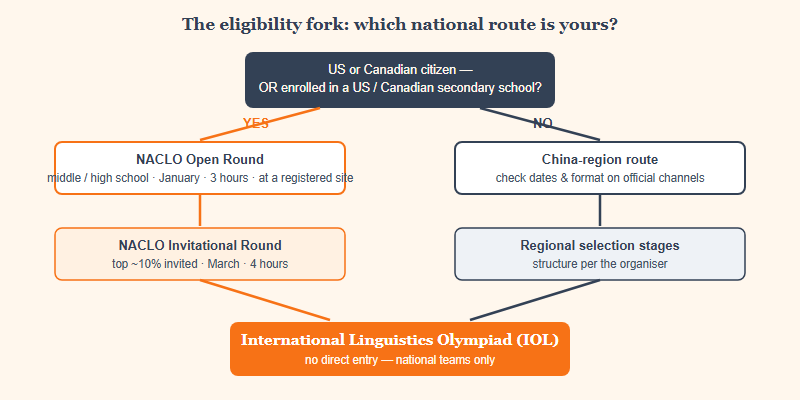
Short answer: there is no direct entry to the International Linguistics Olympiad. Every student arrives through a national or regional olympiad first. NACLO — the North American Computational Linguistics Open Competition — is open to middle and high school students who are US or Canadian citizens, or who are enrolled in a US or Canadian secondary school. A student at an international school inside mainland China is generally not on that route and should look at the China-region pathway instead.
Why this one question decides your whole year
Most students who ask us about the IOL open with a preparation question: which books, how many past papers, when to start. That is the second question. The first is whether the national round you are picturing is a round you can legally sit.
The IOL has no open application. You do not register on ioling.org and turn up. You reach the international event by being selected onto a national team through a national or regional olympiad, and each of those olympiads sets its own eligibility rule. Get the rule wrong and you spend an autumn drilling problem sets for a competition that will not accept your registration in January.
NACLO’s rule is stated in terms of two things: citizenship and school enrolment. You are eligible if you are a middle or high school student who is a US or Canadian citizen, or who is enrolled in a US or Canadian secondary school. The competition is targeted at high schoolers, though younger students do take part. Both halves matter, and the “or” is doing real work — a Canadian citizen studying elsewhere is covered by the first half; a non-citizen enrolled in a US high school is covered by the second.
What that rule does not cover is the case that describes most of our readers: a student holding a Chinese passport, enrolled in an international school inside mainland China. That student is not on the NACLO route. Not because they are less capable — the problems are identical in kind — but because the North American route is defined geographically and by citizenship. For that student, the relevant path is the China-region route, and specifics there should be confirmed on official channels rather than assumed from how NACLO works.
What the NACLO route actually asks of you
If you are on the North American route, NACLO runs as two rounds with very different demands, and knowing the difference changes how you train.
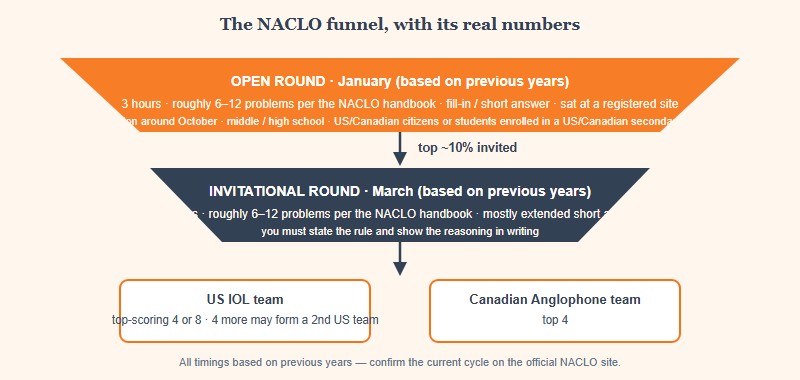
The Open Round is the entry point. Based on previous years, registration opens around October and the round is sat the following January. It runs three hours, contains roughly 6–12 problems in each round, per the NACLO handbook, and answers are in fill-in or short-answer form. In recent cycles NACLO has not offered a general online option, so you sit it at a registered university site or an approved high-school site, with narrow exceptions — confirm the current cycle’s policy on the official NACLO site. That is a logistical fact worth planning around: you need a site, and you need to be registered with it before the deadline. Year-specific dates should always be confirmed on the official NACLO site rather than inferred from last year’s calendar.
Roughly the top 10% of Open Round performers are invited to the Invitational Round, held around March. That round runs four hours and is markedly harder. The problem count is in the same band — roughly 6–12 problems in each round, per the NACLO handbook — but the answer format changes fundamentally: it is mostly extended short-answer, where you must state the linguistic rule you discovered and lay out your reasoning clearly in writing. Getting the right translation is no longer enough on its own.
From the Invitational Round, the top-scoring four or eight US students form the US IOL team, and the top-scoring four Canadian students form the Canadian Anglophone IOL team. NACLO may also invite four more top-scoring US students to form a second US team — those students are a team in their own right, not reserves for the first one.
Open Round vs Invitational Round: what changes
| Open Round | Invitational Round | |
|---|---|---|
| When (based on previous years) | Sat in January; registration around October | Around March |
| Duration | 3 hours | 4 hours |
| Problem count | Roughly 6–12 problems in each round, per the NACLO handbook | Roughly 6–12 problems in each round, per the NACLO handbook |
| Answer format | Fill-in / short answer | Mostly extended short answer — state the rule, show the reasoning |
| Who sits it | Open to all eligible middle and high school entrants | Roughly the top 10% of Open Round performers, by invitation |
| What it selects for | Speed and accuracy at finding a pattern under time pressure | Depth: can you articulate the system you found, in writing, so an expert reader follows it |
| Where it leads | An invitation, if you place high enough | Top-scoring 4 or 8 US students and top-scoring 4 Canadian students → the IOL; NACLO may invite 4 more top-scoring US students to form a second US team |
The practical lesson from that table: a student who trains only on quick pattern-spotting can clear the Open Round and then stall badly in March, because the Invitational asks a different question. It asks you to be legible. Train the writing, not just the solving.
If you are on the China-region route, what should you do differently?
Very little about the content, and quite a lot about the logistics.
The content is genuinely the same discipline. Most national olympiads on this circuit draw on the same core problem families — phonetics and phonology, morphology, syntax and grammar, writing systems, and number systems — and the same style of task: you are given a sample of an unfamiliar language and asked to deduce its grammar, translate sentences, or decipher a script by observing patterns. So a student in Shanghai preparing on NACLO-style past problems is training the right muscles even though they will not sit NACLO itself. Past problems from any national olympiad are legitimate training material regardless of which round you eventually enter.
What differs is everything procedural: when registration opens, what the format and duration are, how selection stages are structured, and what the eventual team-selection rule is. We are not going to invent those numbers here. Confirm the China-region route’s dates, format and entry procedure on official channels before you build a calendar around them — and treat any secondhand figure, including a figure from last year, as provisional until you have checked it.
The one thing worth saying plainly to parents: the eligibility split is not a quality ranking. It is an administrative boundary. A student excluded from NACLO is not excluded from the IOL; they are routed through a different national door.


Do you need a second language or coding background?
No, on both counts, and this is the single most common misconception we hear.
You do not need to speak a second language, and you do not need to have written any code. Problems present a sample of a language you have almost certainly never encountered — Swahili, an Inuit language, ancient Egyptian, and so on — and everything you need to solve them is on the page. Prior knowledge of the specific language is not an advantage the problems are built to reward; observation is.
The “computational” in NACLO’s name describes the lineage of the problems, not a programming requirement. Problems are set by professionals in linguistics, computational linguistics and language technology. That is precisely why the puzzle types map so directly onto the real problems in natural language processing, machine translation, speech recognition and language-model research: inferring a system’s rules from limited data is what those fields do all day.
Why this field is a live research frontier, not a curiosity
A June 2026 paper in Nature — “Mapping the neuronal building blocks of human language with language models,” by Cai, Kfir, Jamali, Huang, Kim, Cash and Williams — recorded single-neuron activity during speech. The researchers found neurons that fire specifically for upcoming nouns, and others that fire at phrase boundaries, with semantic and syntactic information encoded by different cells. They also found that brains and large language models track sentence context in comparable ways.
We cite it here for one reason. The hidden structure that IOL problems ask a fifteen-year-old to reconstruct from twenty sentences of an unfamiliar language — where the phrase boundaries are, which category a word belongs to, what rule governs the ending — is the same structure that neuroscientists are now locating in individual neurons. The competition is not a party trick built on obscure languages. It is a training ground in the exact analytical move that language science and language technology are both built on.
A preparation plan that works on either route
Because the content overlaps almost completely, one training plan serves both groups.
Train the five families separately. Phonetics and phonology, morphology, syntax and grammar, writing systems, and number systems. Students who train “linguistics puzzles” as one undifferentiated pile develop a lopsided profile and then lose a whole problem in a three-hour paper because they have never done a script-decipherment task. Keep a log by family, not by paper.
Read for structure, not for facts. Three books do most of the work for most students: A Course in Phonetics by Peter Ladefoged, for the sound systems that phonology problems assume; Language Universals and Linguistic Typology by Bernard Comrie, for the range of ways human languages organise grammar — which is what stops you assuming every language works like English; and The Oxford Handbook of Computational Linguistics edited by Ruslan Mitkov, for the computational framing behind the problem-setting.
Write your solutions out, from the start. On the NACLO route this is not optional: the Invitational Round is mostly extended short-answer, and the marker needs to follow your reasoning. Even on the Open Round, where fill-in answers suffice, a student who habitually writes “the suffix marks plural, and it assimilates to the preceding vowel” solves faster than one who only pattern-matches, because the sentence forces the rule to be explicit.
Practise under the real clock. Three hours across roughly 6–12 problems is somewhere between about 15 and 30 minutes each, depending on how long that year’s paper runs — and that budget is the thing most students have never actually felt. Four hours in the Invitational buys you more thinking time per problem, but the extended written answers consume much of the difference. Time at least one full paper per month at full length rather than doing single problems at leisure.
Frequently asked questions
Can I enter the IOL directly if my country has no national olympiad?
There is no direct-entry route to the IOL — participation runs through national or regional olympiads that select teams. If you are unsure which body covers your situation, check ioling.org and the relevant national organiser rather than assuming, and do not register for a national round whose eligibility rule you have not read in full.
I have a Chinese passport but I attend an international school in Shanghai. Am I eligible for NACLO?
Generally no. NACLO is for middle and high school students who are US or Canadian citizens, or who are enrolled in a US or Canadian secondary school. An international school inside mainland China does not meet the enrolment condition, so the China-region route is the relevant path. The problem content is the same, so nothing about your preparation is wasted — confirm the China-region entry procedure on official channels.
How many students actually reach the Invitational Round, and how many make a team?
Roughly the top 10% of Open Round performers are invited to the Invitational Round. From there, the top-scoring four or eight US students form the US IOL team, and the top-scoring four Canadian students form the Canadian Anglophone team; NACLO may also invite four more top-scoring US students to form a second US team, which is a team in its own right rather than a set of reserves. Exact figures for a given cycle should be confirmed on the official NACLO site.
Do I need to know a second language or how to program?
Neither. Problems present a sample of an unfamiliar language and everything needed to solve them is on the page — you deduce the grammar, translate, or decipher a writing system by observing patterns. The problems are set by specialists in linguistics, computational linguistics and language technology, which is why they connect to NLP and machine translation, but no coding is required to sit either round.
The one-line takeaway
Check the eligibility rule before you buy a book. If you are a middle or high school student who is a US or Canadian citizen, or enrolled in a US or Canadian secondary school, the NACLO Open Round in January is your door, and the four-hour Invitational in March is where the writing starts to matter — both of those months are based on previous years, so confirm the current cycle on the official NACLO site. If you are not, the China-region route is your door, and the content you train is the same — only the paperwork and the calendar change. Both doors open onto the same room.
IOL Club is an independent community guide to the International Linguistics Olympiad. We are not affiliated with, endorsed by or sponsored by the IOL Board, NACLO, or any national organiser; the official sources are ioling.org and the NACLO organisers, and all round dates, eligibility rules and selection numbers should be confirmed there before you act on them. Any student results referenced across this site are de-identified Hanlin data and vary by individual. Confirmed errors are corrected within 7 working days.
Keep reading.
From Three Hours to Six: What Actually Changes Between a National Round Paper and an IOL Paper
A national open round gives you roughly 25 minutes a problem; the IOL gives you over an hour. Four things that change…
How to Mark Your Own Linguistics Olympiad Practice Paper When There Is No Solution Sheet
Worked solutions do not exist for every past paper. A five-band self-marking rubric, the regeneration test, and the four ways students quietly…
The Deadline Before the Deadline: Planning a 2026-27 Linguistics Olympiad Autumn Backwards From the Sitting
Registration for the coming cycle is reported to close earlier than usual. An autumn planned backwards from the sitting, with compression options…