
Verse problems give you poems or song lines in an unfamiliar language, plus enough translation to work with, and ask you to reconstruct the rules of the poetry — its metre, its rhyme scheme, its line structure. You do not need to be a poet. Poetic form is a system like any other, governed by countable patterns of syllables and sounds. Here is how to scan a language you have never seen and win points doing it.
A verse problem is not asking whether the poem is beautiful. It is asking you to find the countable rules the poet obeyed: how many syllables per line, which syllables are heavy or stressed, where the lines rhyme, and how their structure repeats. Everything you need is on the page, exactly as in a translation or morphology problem — the material just happens to be arranged in lines.
Poetry, metre and versification problems have appeared across the olympiad world, so it is worth practising the genre even if you cannot predict when one will turn up — confirm the content of any particular contest on ioling.org. If the competition itself is still new to you, our introduction to the IOL sets the scene. The good news for verse problems specifically: they reward patient counting more than flashes of inspiration, which makes them very trainable.
The three raw materials of verse
Almost every poetry problem turns on one or more of three ingredients. Learn to look for all three.
- Metre — the rhythmic pattern of a line, measured in syllables. In some traditions the pattern is about weight (heavy vs light syllables, often tied to long vowels or closed syllables); in others it is about stress (strong vs weak beats); in others still it is simply a fixed count of syllables per line. A repeating unit within the line is called a foot.
- Rhyme — matching sounds, usually at line-ends. Rhyme can sit on the final syllable, the final vowel, or a whole final chunk. Some traditions rhyme at the start of lines (alliteration) rather than the end.
- Parallelism — repeated grammatical structure across lines, common in many oral poetries, where line two mirrors the shape of line one with different words. It is a structural rhyme rather than a sound rhyme.
Your task is to measure these, not admire them. That measuring has a reliable four-step shape.
A four-step scanning method
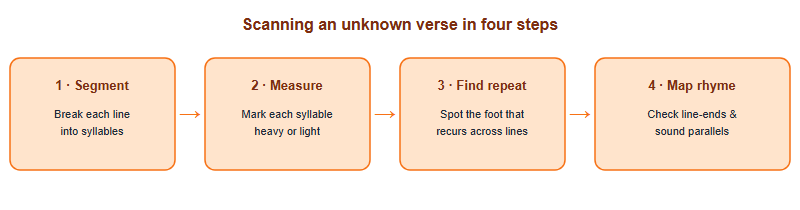
Step 1 — Segment into syllables. Rewrite each line as a row of syllables. Do not trust spelling to hand you the boundaries; use the sound structure. Getting a clean syllable count is often half the problem.
Step 2 — Measure each syllable. Decide, from the data, whether the tradition counts weight or stress, and mark every syllable accordingly. If the problem tells you which vowels are long, heavy usually means long or closed; if it marks stress, use that. When in doubt, mark both and see which produces a clean pattern.
Step 3 — Find the repeating unit. Line up your marked lines and look for the foot that recurs. If every line is “light-heavy, light-heavy…,” you have found a rising duple metre. The pattern that holds across all the data — not most of it — is the rule.
Step 4 — Map rhyme and parallelism. Now compare line-ends for shared sounds and compare line structures for shared grammar. Label the rhyme scheme with letters (ABAB, AABB) and note any grammatical mirroring. Only when a rule survives every line should you use it to complete or correct a verse.


A worked mini-example
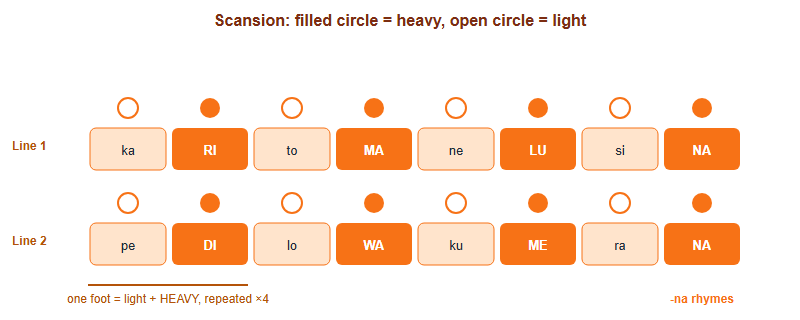
Here is a deliberately clean, entirely invented couplet. Uppercase marks a heavy (stressed) syllable, lowercase a light one — a convention I am using purely to make the pattern visible. Real problems use genuine verse and give you the clues you need; this toy shows the moves.
| Line | Syllables (heavy in CAPS) | Weight pattern | Feet | Ends in |
|---|---|---|---|---|
| 1 | ka RI to MA ne LU si NA | light-heavy × 4 | 4 rising feet | -na |
| 2 | pe DI lo WA ku ME ra NA | light-heavy × 4 | 4 rising feet | -na |
Scanning it: each line has eight syllables that alternate light-heavy, so the foot is a rising pair and there are four feet per line — a tidy metre. Both lines end in the syllable -na, so we have an end-rhyme (scheme AA for this couplet). From that rule you could now judge whether a proposed third line fits: mo TA ke SI pa LU re NA would scan correctly (light-heavy × 4) and rhyme (-na), while a line ending in -ti or running to nine syllables would break the form.
Traps that cost points
Verse problems have signature pitfalls. Guard against these:
- Importing English rhythm. Do not assume the language stresses words the way English does. Derive the weight or stress rule from the data, then apply it.
- Confusing weight with count. Some traditions count syllables only; others count heavy vs light. Decide which the data supports before you commit to a pattern.
- Mis-reading where rhyme sits. Rhyme may fall on the final vowel, the final syllable, or a longer tail — and some traditions alliterate at line-starts. Check several possibilities.
- Ignoring elision and contraction. Poets often merge or drop vowels to fit the metre. A line that looks a syllable too long may be using a licensed contraction, which is itself part of the rule.
- Missing parallelism. If the sounds do not rhyme, the organising principle may be grammatical parallelism. Compare structures, not just endings.
Every one of these is settled by returning to the data and testing your rule against all of it. A pattern that fits three lines and breaks on the fourth is not the pattern — the fourth line is telling you something, and the marking scheme, whose approach you can review on ioling.org, rewards the solver who listens to it.
How to train verse-scanning on the page
Because these problems reward counting and pattern-matching, they respond well to deliberate practice:
- Scan short poems in languages you know. Mark syllable weight or stress and label the rhyme scheme. The mechanical skill transfers directly to unknown data.
- Build a scanning template. A fixed worksheet — segment, mark, tabulate, compare — stops you skipping the bookkeeping under time pressure.
- Work genuine problems cold, then study the solutions. Attempt any archived verse problem without hints, then read the official reasoning. Our 12-week study plan shows how to schedule this, and the past-problems pack is where to find material.
Verse problems intimidate students who think poetry is about taste. It is not — inside the olympiad it is about countable structure, and structure is exactly what a trained solver measures. Bring a ruler, not a muse, and these become some of the most reliably scorable problems in the paper.
Quick answers
Do I need to know the language of the poem?
No. The metre, rhyme and structure are all recoverable from the data and the translations you are given, using logic alone.
What is the difference between metre and rhyme?
Metre is the rhythmic pattern of syllables within a line; rhyme is matching sound, usually at line-ends. Many problems test both at once.
Is the couplet here a real olympiad problem?
No. It is an original, simplified illustration. For genuine problems and official solutions, see ioling.org and our past-problems pack.
How do I know whether to count stress or syllable weight?
Let the data decide: mark both, and keep whichever produces a single clean pattern across every line.
This is an independent guide operated by Hanlin Education for China-based international-school students. It is not affiliated with, endorsed by, or sponsored by the IOL Board. Competition details change from year to year, so always confirm current facts on ioling.org. Spotted an error? We correct verified mistakes within 7 working days.
Keep reading.
From Three Hours to Six: What Actually Changes Between a National Round Paper and an IOL Paper
A national open round gives you roughly 25 minutes a problem; the IOL gives you over an hour. Four things that change…
How to Mark Your Own Linguistics Olympiad Practice Paper When There Is No Solution Sheet
Worked solutions do not exist for every past paper. A five-band self-marking rubric, the regeneration test, and the four ways students quietly…
The Deadline Before the Deadline: Planning a 2026-27 Linguistics Olympiad Autumn Backwards From the Sitting
Registration for the coming cycle is reported to close earlier than usual. An autumn planned backwards from the sitting, with compression options…