
The Twenty-third International Linguistics Olympiad, hosted by Romania, concluded in Bucharest on 2 August 2026. The official figures: 255 contestants, 65 teams, 46 countries and territories, and 84 medals, 14 of them gold. Read that scoreboard as calibration rather than celebration and it tells you, more precisely than any preparation guide can, what this contest actually asks of a student.
What ioling.org actually published
Start with the record, because second-hand summaries of a contest week drift fast and the drift is almost always in the flattering direction. Where ioling.org publishes a number, that number governs, and it is worth checking the contestant count and the closing date on the official results page before you repeat either.
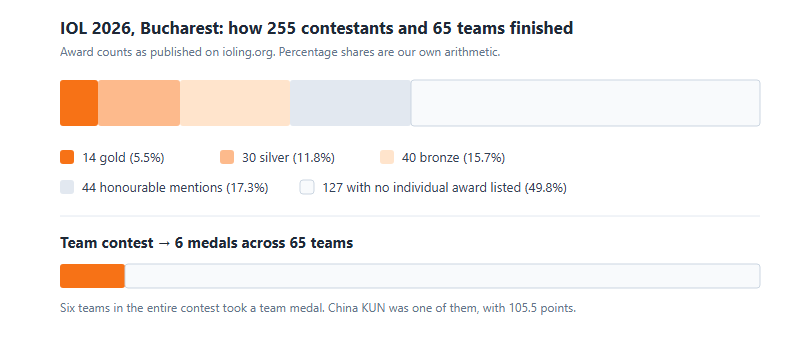
The organisers state that the jury “awarded 84 medals (14 gold, 30 silver, and 40 bronze) out of 255 participants”, and alongside those medals it awarded 44 honourable mentions, 6 team contest medals, a trophy to the country with the highest average score, and 9 best solution prizes. Five separate award systems, five different denominators. Most confusion about IOL results comes from mixing them up.
If you are new to the contest and are reading a results table before you have read a problem, start instead with what the International Linguistics Olympiad actually is and come back here. The numbers below will mean considerably more once you know that the individual contest asks you to solve problems from raw language data, with no prior knowledge of the languages involved.
Roughly half the room leaves without an individual award
This is the single most useful thing on the page, and it is the thing prize announcements never say. Take the published counts and divide them by the published field size and you get the real shape of the contest.
| Individual award | Number awarded | Share of 255 contestants |
|---|---|---|
| Gold | 14 | 5.5% |
| Silver | 30 | 11.8% |
| Bronze | 40 | 15.7% |
| All medals | 84 | 32.9% |
| Honourable mention | 44 | 17.3% |
| No individual award listed | 127 | 49.8% |
Three readings follow, and each one should change how a student plans.
- A gold is roughly one contestant in eighteen. Fourteen of them existed in the entire world in 2026. Students reach the IOL through a national selection round rather than by registering directly, so the base rate is not 14 in 255 of “students interested in linguistics” — it is 14 in 255 of students who had already cleared a national round.
- A medal of any colour is about one in three. That makes a medal, rather than gold, the sensible thing for a strong first-time contestant to aim at — bearing in mind that this is a rate observed across the field in one year, not a prediction for any individual.
- Around half the field leaves with no individual award listed at all. Not because those students are weak — they had all cleared a national round to get there — but because that is simply the shape of the award table. If you go in expecting the award to be the return on the year, the arithmetic says you will probably be disappointed. If you go in for the training, the arithmetic is irrelevant.
China's published results, and the eleven-point window
China appears on the official 2026 listing under two team entries, China QIAN and China KUN. These students are on the public record at ioling.org; they are not our students and we are not the operator of the China national round. We are reading their published scores because published scores are the only calibration instrument a prospective contestant has.
| Contestant (team) | Individual score | Individual award | Other recognition |
|---|---|---|---|
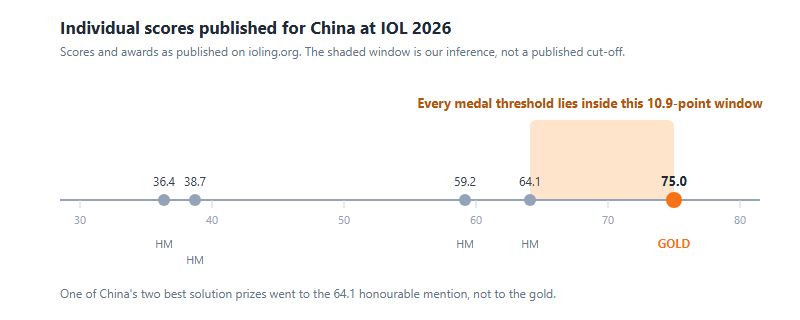
| Qi Jia (China QIAN) | 75.0 | Gold | — |
| Zhou Haoxuan (China QIAN) | 64.1 | Honourable mention | Best solution, Problem 1 |
| Zhou Yukai (China KUN) | 59.2 | Honourable mention | — |
| Wang Zichen (China KUN) | 38.7 | Honourable mention | — |
| Zhou Shenghao (China QIAN) | 36.4 | Honourable mention | — |
| Fu Boran (China KUN) | — | Not in the individual awards list | Best solution, Problem 4 |
Now put two of those numbers side by side. A score of 64.1 received an honourable mention. A score of 75.0 received a gold. Assuming awards were assigned by score in the usual way, it follows that the bronze threshold, the silver threshold and the gold threshold all sat somewhere above 64.1 and at or below 75.0 — three separate cut-offs compressed into a window under eleven points wide.
That is our inference from two published data points, not a published cut-off, and ioling.org publishes scores rather than thresholds, so confirm anything you plan to rely on there. But as a training instruction it is worth more than any generic advice about “aiming high”. It says that near the top of the table, one fully correct problem, or one problem where you produced the paradigm but did not write out the justification, is not the difference between a medal and no medal — it is potentially the difference between bronze and gold. Marginal points are not marginal in that band.


Team contest points are a different currency
This is where scoreboards get misread every year. China KUN took a bronze in the team contest with 105.5 points. China QIAN received an honourable mention in the team contest with 102.0 points. Neither of those figures belongs on the same axis as the 75.0 that won an individual gold.
They are separate contests with separate papers and separate scales. A team number that is numerically larger than an individual number does not mean the team performed “better”. If you correct one habit in how you read results, correct that.
| Team entry | Team contest points | Team contest award |
|---|---|---|
| China KUN | 105.5 | Bronze |
| China QIAN | 102.0 | Honourable mention |
Then look at the gap between those two rows: 3.5 points separated a team medal from no team medal, between two entries from the same country. And only six team medals existed across all 65 teams. Set against the individual contest, where about a third of contestants took a medal, the team contest is a far narrower gate.
Team preparation is therefore a different activity from individual preparation, and cannot be left to the week before. A team contest is one artefact produced by several people under time pressure: it rewards deciding fast who owns which part of the data, agreeing notation before anyone starts writing, and leaving enough time for one person to read the whole thing as a reader would. Those are rehearsable behaviours, and the 3.5-point margin above is the argument for rehearsing them.
Best solution is a second ladder, not a bonus for the top scorer
Nine best solution prizes were awarded in 2026. That is fewer than the 14 golds — on the published counts, a best solution was the rarer of the two.
Two of the nine went to contestants listed for China: Zhou Haoxuan of China QIAN for Problem 1, and Fu Boran of China KUN for Problem 4. The detail worth sitting with is that Zhou Haoxuan's individual score, 64.1, earned an honourable mention rather than a medal. A student whose total placed him outside the medals nevertheless wrote one of the nine solutions the jury singled out in the entire contest.
That is not a fluke, it is the structure. Total score measures how much correct output you produced across the whole paper. A best solution measures whether one write-up states the system clearly enough that a reader can re-derive every answer from it. The two are optimised by different behaviour under time pressure, and a student who is strong on one is not automatically strong on the other. Practically:
- Write the rule, not just the answers. A filled-in table with no statement of the pattern can score well and will never be a best solution.
- State your ordering. If two processes apply, say which applies first and give the form that proves it. That single sentence is often the whole difference in readability.
- Name your exceptions. An acknowledged residue reads as control; an unacknowledged one reads as a gap.
- Budget for it. Exposition costs minutes you have to take from somewhere. Decide in advance which problem gets that investment rather than discovering at the end that no problem did.
If you are deciding whether to try: the route from here
Nobody registers directly for the IOL. Entry runs through a national round, so the first question is not “can I medal” but “which national round am I eligible for”. The two routes below are our own compilation from tracking recent cycles, not an official publication, and cycle dates move — confirm the eligibility rules and this year's dates on ioling.org and with the relevant national organiser before you plan around any of it.
- Students in mainland China. As our site describes the route, a regional written round (the IOLC assessment) leads to a China round run as an academic camp, which in turn leads to the international IOL. In the 2026 cycle the regional round ran in March, the China round was held in late April at a school in Nanjing, and an Asia-Pacific round also ran in March. Award bands are reported to us as High Distinction for roughly the top 10%, Distinction for 10–30% and Merit for 30–50%, across two entry levels, a novice level and a professional level. Treat all of that as our compilation and verify with the organiser.
- Students in the United States or Canada. NACLO runs an Open Round in late January and an Invitational Round in March, and the top finishers form the US and Canadian IOL teams. NACLO requires US or Canadian citizenship or school enrolment, which is why students based in mainland China take the China route rather than trying to enter through NACLO.
Our page on the competition and how the rounds fit together sets out the sequence in more detail. But the honest framing, given everything above, is this: if the only acceptable outcome is a medal, the published rates say that is a one-in-three proposition at best for a student who has already won a national round, and the year is a bad bet. If the acceptable outcome is a year spent learning to extract a grammatical system from raw data and write it down so someone else can follow it — a skill that is genuinely rare and transfers to linguistics, computer science and mathematics alike — then the scoreboard is not the point and the 127 contestants with no listed award had a good year too.
One more note on the 2026 result specifically. Our own briefing reads Qi Jia's gold as China's first individual IOL gold since 2019, the first in seven years. ioling.org publishes results rather than historical narrative, so its silence on that point is expected rather than a contradiction — but it is our reading of the results history and not an official IOL statement, and anyone repeating it should check the year-by-year results pages themselves.
Frequently asked questions
How many medals were awarded at IOL 2026?
The jury awarded 84 medals (14 gold, 30 silver and 40 bronze) plus 44 honourable mentions, among 255 contestants in Bucharest.
When and where did IOL 2026 take place?
The Twenty-third IOL was hosted by Romania in Bucharest and concluded on 2 August 2026, with 255 contestants from 46 countries and territories.
What score won a gold medal at IOL 2026?
China’s gold medallist scored 75.0. ioling.org publishes scores rather than cut-offs, so treat any threshold you read as inference and confirm there.
Do you need a high score to win a best solution prize?
Not necessarily. At IOL 2026 a best solution prize went to a contestant whose individual score earned an honourable mention rather than a medal.
IOL Club is an independent guide operated by Hanlin Education for China-based international-school students. We are NOT affiliated with, endorsed by, or sponsored by the IOL Board, and we are not the operator of the China national round; the contestants named above are on the public record at ioling.org and are not presented as our students. Award counts, scores and dates in this article are as published on ioling.org; percentage shares, the medal-threshold window and the route dates and award bands are our own compilation or arithmetic, and cycle details change, so confirm with ioling.org and your national organiser before acting on them. Results vary and no outcome is predicted or guaranteed. Errors reported to our editorial desk are corrected within 7 working days.
Keep reading.
From Three Hours to Six: What Actually Changes Between a National Round Paper and an IOL Paper
A national open round gives you roughly 25 minutes a problem; the IOL gives you over an hour. Four things that change…
How to Mark Your Own Linguistics Olympiad Practice Paper When There Is No Solution Sheet
Worked solutions do not exist for every past paper. A five-band self-marking rubric, the regeneration test, and the four ways students quietly…
The Deadline Before the Deadline: Planning a 2026-27 Linguistics Olympiad Autumn Backwards From the Sitting
Registration for the coming cycle is reported to close earlier than usual. An autumn planned backwards from the sitting, with compression options…