
Most students starting linguistics olympiad training have no idea where they actually stand. Below are three original mini-problems written for this article, worth 24 marks in 45 minutes, plus full solutions and a marking scheme. The point is not the score. The point is that your score band maps to a specific next step.
How to run this properly
A diagnostic only works if you do not cheat the conditions. Four rules:
- Timebox it. 10 minutes for Problem 1, 15 for Problem 2, 20 for Problem 3. Stop when the time is up, even mid-thought – part of what you are measuring is speed.
- No internet, no notes. Every problem below is self-contained. You need no knowledge of any real language, and none of these languages exists.
- Write your reasoning, not just answers. Several marks below are for stating the rule. This mirrors how these competitions actually mark, and it is the habit most beginners skip.
- Do not scroll ahead. The solutions sit directly under Problem 3. Cover them or work on paper first.
The three problems
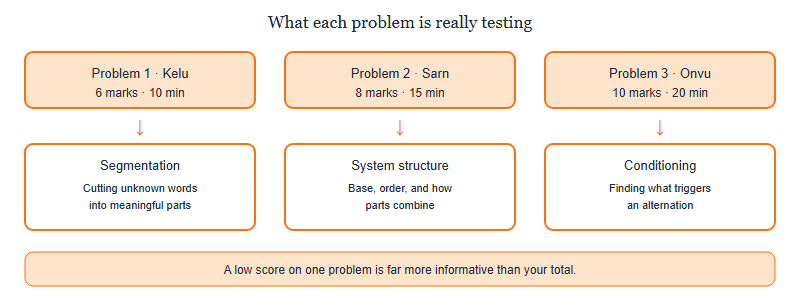
Problem 1 – Kelu (10 minutes, 6 marks)
Here are four sentences in Kelu, an invented language, with their English translations.
| # | Kelu | English |
|---|---|---|
| 1 | nimoka | the child sees the fish |
| 2 | nimora | the child sees the bird |
| 3 | tumoka | the woman sees the fish |
| 4 | nisika | the child eats the fish |
(a) Translate into English: tumora. (1 mark)
(b) Translate into Kelu: the woman eats the bird. (2 marks)
(c) Describe the structure of a Kelu verb form. (3 marks)
Problem 2 – Sarn numerals (15 minutes, 8 marks)
Sarn, also invented, writes its numbers as single words. Here are eight of them.
| Sarn | Value | Sarn | Value |
|---|---|---|---|
| ker | 3 | sunpolker | 28 |
| pol | 5 | bosun | 40 |
| polker | 8 | bosunpol | 45 |
| sunat | 21 | polsun | 100 |
(a) What do sun and at mean? (1 mark)
(b) Write 63 in Sarn. (3 marks)
(c) What number is bosunpolat? (2 marks)
(d) State the rule for how multiples of twenty are built. (2 marks)
Problem 3 – Onvu plurals (20 minutes, 10 marks)
Onvu, invented, forms plurals with a suffix that has two shapes.
| Singular | Meaning | Plural |
|---|---|---|
| tapa | river | tapano |
| kesi | road | kesinu |
| moru | stone | moruno |
| veli | tree | velinu |
| siko | field | sikonu |
| maki | boat | makino |
| teku | wind | tekunu |
(a) Give the plurals of luta “song”, nemo “star”, and pamu “hill”. (3 marks)
(b) State precisely what determines the choice between -no and -nu. (4 marks)
(c) Two rival theories fit part of the data: (i) the final vowel of the singular decides, and (ii) the presence of a front vowel anywhere in the singular decides. For each, name a row that refutes it. (3 marks)


Solutions and marking scheme
Mark yourself strictly. If you wrote the right answer with no reasoning where reasoning was asked for, take the answer marks and none of the reasoning marks – that is exactly what would happen in a real contest.
Problem 1. The morphemes are ni- “child”, tu- “woman”, -mo- “see”, -si- “eat”, -ka “fish”, -ra “bird”.
- (a) the woman sees the bird. 1 mark.
- (b) tusira. 2 marks (1 for tu- plus -si-, 1 for -ra in the right slot).
- (c) A verb form is subject prefix + verb root + object suffix, in that fixed order, written as one word. 3 marks – one for identifying three slots, one for the correct order, one for correctly labelling which slot carries the subject and which the object.
Problem 2. The system is built on twenty. sun = 20, multipliers precede it, and additions follow, largest first. Watch the crucial row here: from bosun = 40 alone you cannot tell whether bo means 2 and multiplies, or means 20 and simply adds. polsun = 100 settles it – pol is 5, and 5 + 20 is not 100 – so the pattern is multiplicative and bo = 2.
- (a) sun = 20; at = 1 (from sunat = 21). 1 mark for both.
- (b) kersunker = (3 x 20) + 3 = 63. 3 marks – 1 for using ker as a multiplier, 1 for the multiplier preceding sun, 1 for the trailing ker.
- (c) 40 + 5 + 1 = 46. 2 marks.
- (d) Multiples of twenty are formed by placing the multiplier word directly before sun; any remainder follows, in descending order of size. 2 marks – 1 for multiplier-before-sun, 1 for the descending order of the additive part. Award a bonus point to yourself if you noticed that polsun is the row that rules out an additive reading.
Problem 3. The suffix is -no after a, o, u and -nu after e, i – but the vowel that decides is the first vowel of the singular, not the last.
- (a) lutano, nemonu, pamuno. 3 marks, one each. Note nemo: the first vowel is e, so it takes -nu despite ending in o.
- (b) Full credit needs three things: the two vowel classes (a/o/u versus e/i), the statement that the first vowel of the stem governs the choice, and the recognition that later vowels are irrelevant. 4 marks.
- (c) 3 marks. Theory (i) is refuted by siko, maki or teku – any one will do, 1 mark. Take maki: its final vowel is i, which should give -nu, yet the plural is makino. Theory (ii) is refuted only by maki, 2 marks – it contains the front vowel i, so a “front vowel anywhere” rule predicts -nu, but the actual plural is -no; only the first vowel, a, gets it right. If you also noticed that teku kills a rule based on the initial consonant, you were reading the data the way a setter writes it.
What your score means – and what to train next
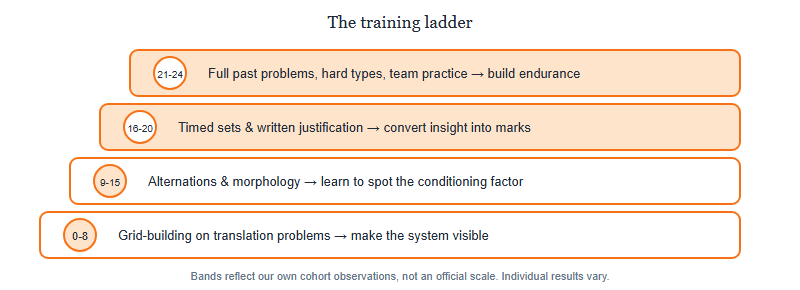
Add your marks out of 24, then read the band. These bands come from what we see repeatedly in our own coaching cohorts rather than from any official scale, and individual results vary a great deal.
| Score | What it says about you | Train this next | Realistic horizon |
|---|---|---|---|
| 0-8 | You are still reading data as text rather than as a system | Translation problems only. Build a habit of writing every form into a grid before answering anything | Come back to this diagnostic in six weeks |
| 9-15 | Segmentation works; you lose marks where a form alternates | Morphology and sound-alternation sets, and start writing rules in full sentences | Ready for full-length problems in a term |
| 16-20 | Solid analysis, patchy justification or slow under time | Timed sets, plus deliberate practice at writing the rule so a marker can follow it | Ready to sit a national round seriously |
| 21-24 | The mini-problem format is no longer stretching you | Full past problems under real time limits, harder types (syntax, semantics), and team practice | Endurance is now the limiting factor, not insight |
Three further things are worth saying about what this test does and does not tell you.
The pattern matters more than the total. A student scoring 6/6, 7/8, 2/10 is a completely different case from one scoring 3/6, 4/8, 8/10. The first can segment and count but cannot yet find a conditioning environment; the second thinks structurally but is careless with basics. Those two students should not be doing the same practice this month.
A low score at fifteen is not a verdict. These problems reward a way of looking at data that almost no school curriculum teaches, so most people are bad at them the first time. What predicts progress is not the first score but whether the second score, six weeks later, has moved.
Mini-problems flatter you. Real contest problems are substantially longer, with more rules interacting at once and far less help along the way. Scoring 22/24 here means you are ready to start on full-length material, not that you have finished. When you get there, work through our organised pack of past problems, where some years also come with worked solutions – specific coverage depends on the year.
Turning a diagnostic into a term of work
A diagnostic is only useful if it changes what you do on Tuesday. Take the weakest of your three scores, pick the corresponding row from the table above, and run that focus for six weeks before retesting. If you want the whole term mapped out rather than a single focus, our twelve-week study plan sequences problem types in roughly the order this diagnostic tests them, and if you are new to the competition itself, start with what the IOL actually is and how students reach it.
One practical note on the season: entry to the international event runs through a national or regional round, and those rounds set their own eligibility and calendars. Check the current requirements for your own route on official channels, and confirm international-level details on ioling.org, rather than assuming this year matches last year.
Frequently asked questions
Are these real past problems?
No. All three languages are invented for this article. Real past problems are longer and harder, and we do not reproduce them here.
I scored badly. Should I give up on the IOL?
No. Most students score low the first time. What matters is whether your score moves after six focused weeks.
Do I need to know a second language or programming?
Not for these problems. Every rule you need is derivable from the data on the page, with no outside knowledge.
How often should I retake a diagnostic like this?
Every six to eight weeks. More often than that and you are measuring memory of the answers rather than skill.
This is an independent guide operated by Hanlin Education for China-based international-school students. We are not affiliated with, endorsed by, or sponsored by the IOL Board. Kelu, Sarn and Onvu are invented languages written for this article; no past-paper material is reproduced. Score bands reflect our own coaching observations, are not an official scale, and individual results vary. Confirm current eligibility, dates and contest format on the official site, ioling.org. If you spot an error, tell us and we will correct it within 7 working days.
Keep reading.
From Three Hours to Six: What Actually Changes Between a National Round Paper and an IOL Paper
A national open round gives you roughly 25 minutes a problem; the IOL gives you over an hour. Four things that change…
How to Mark Your Own Linguistics Olympiad Practice Paper When There Is No Solution Sheet
Worked solutions do not exist for every past paper. A five-band self-marking rubric, the regeneration test, and the four ways students quietly…
The Deadline Before the Deadline: Planning a 2026-27 Linguistics Olympiad Autumn Backwards From the Sitting
Registration for the coming cycle is reported to close earlier than usual. An autumn planned backwards from the sitting, with compression options…