
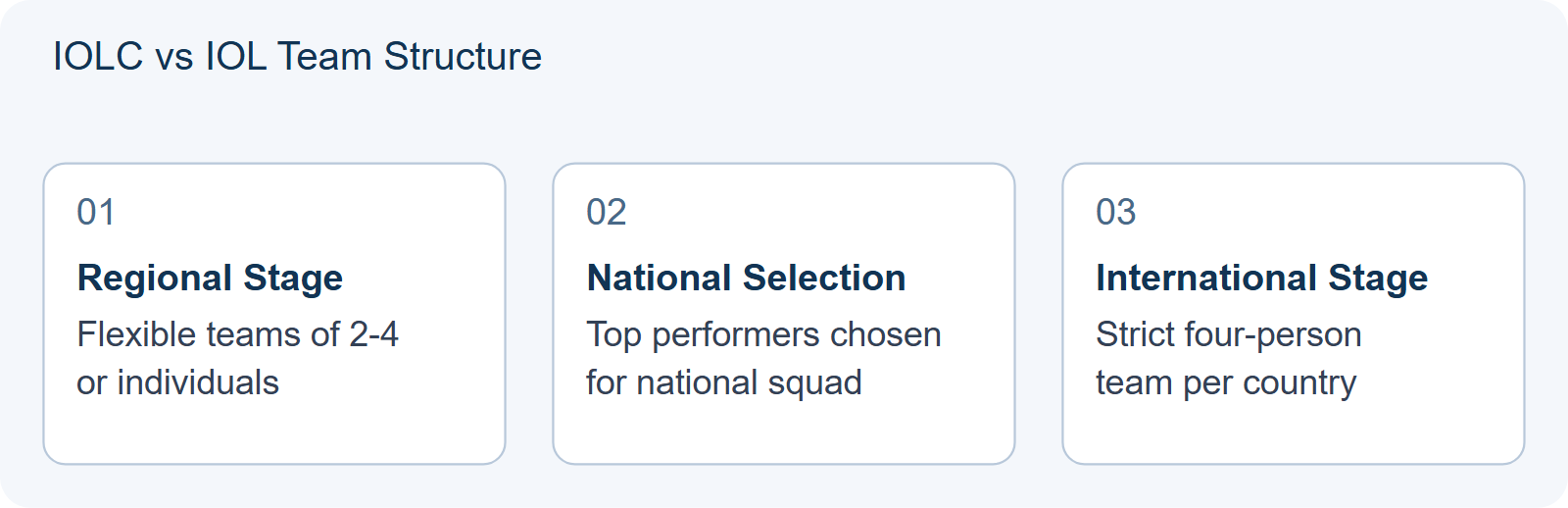
Many students preparing for the IOL team contest misunderstand the structural differences between national selection rounds and the final international stage. A common error is assuming the “team of four” rule applies uniformly across all phases. In reality, the International Linguistics Olympiad (IOL) mandates a fixed team of four students per country, whereas the China National Linguistics Olympiad (IOLC) Regional Round allows for individual entries or teams of two to four students. Understanding this distinction is critical for strategic preparation.
The Two Stages of Team Formation
The path to the IOL involves distinct competitive environments. For Chinese students, the journey begins with the IOLC. According to official guidelines, the Regional Round (Level Test) permits registration as an individual or in a team of 2–4 people. This flexibility allows students to leverage collaborative strengths early on. However, the ultimate goal—the IOL International Finals—requires a strict national team composition of exactly four members selected through the China National Linguistics Olympiad process.
This structural shift means that preparation strategies must evolve. While regional contests reward effective collaboration among small groups, the international stage demands that each of the four team members can independently solve complex linguistic puzzles under pressure, as well as contribute to collective problem-solving. Ignoring this transition often leads to poor performance when students move from the supportive environment of a 2–4 person regional team to the high-stakes, fixed-quota international arena.
Why Most Students Ignore Team Dynamics
Linguistics olympiads are primarily tests of logical deduction and pattern recognition rather than rote memorization. Many candidates focus exclusively on individual problem-solving skills, neglecting the IOL team contest aspect until they reach the national level. At the IOLC Regional Round, teamwork offers tangible benefits: shared cognitive load, diverse perspectives on ambiguous data, and the opportunity to earn team-specific honors. Yet, because the international format is rigidly set at four participants, students who rely too heavily on one teammate’s strength may find themselves exposed when roles are redistributed or when individual accountability increases.
Furthermore, the nature of the problems changes. Regional questions might be shorter or less nested, allowing quick consensus-building. International problems, such as those seen in the 2026 Bucharest finals involving rare languages like Yupik or Sakurabiat, require deep, sustained reasoning. Here, the “team” dynamic shifts from simple division of labor to rigorous peer review and hypothesis testing. If students do not practice validating each other’s logic during the regional phase, they lack the discipline needed for the international stage.
Strategic Preparation for Both Formats
To bridge this gap, prospective competitors should adopt a dual-track preparation strategy. First, utilize the flexibility of the IOLC Regional Round to experiment with different team compositions. Practice solving problems in pairs and trios to identify complementary skill sets. Second, simulate the constraints of the international format by practicing with a fixed group of four, ensuring every member can handle any part of the puzzle.
Consider integrating resources that highlight the difficulty curve. For instance, analyzing IOL-AI 2026 Results reveals how top models struggle with long-chain reasoning, mirroring the challenges human teams face. This insight underscores the need for robust verification protocols within your study group. Additionally, choosing the right entry level is crucial; refer to guides on Choosing the Right 2027 Entry Level to ensure you are competing against peers with similar experience, which makes team dynamics more balanced and instructive.
Finally, remember that the IOL is not just about speed but about clarity. As noted in discussions on Answer-Sheet Habits, documenting your reasoning clearly is vital. In a team setting, this documentation becomes the medium of communication. Poorly explained solutions lead to confusion and lost points, regardless of whether the answer is technically correct.
| Feature | IOLC Regional Round | IOL International Finals |
|---|---|---|
| Team Size | Individual or 2–4 persons | Fixed team of 4 per country |
| Selection Basis | Regional/National Ranking | National Team Selection |
| Primary Focus | Collaborative Problem Solving | Individual & Collective Rigor |
| Preparation Tip | Test different pairings | Simulate fixed-role pressure |


HYPOTHETICAL/ILLUSTRATIVE: The ‘Blind Handoff’ Practice Drill
To concretely apply the advice on bridging regional flexibility with international rigidity, consider a specific preparation scenario involving a hypothetical four-person study group. This example illustrates how to transition from loose collaboration to the high-stakes peer review required at the IOL International Finals. Imagine two students, Alex and Jordan, working on a complex morphological puzzle involving an obscure language family. In many regional practice sessions, teams often fall into a trap of premature consensus: one student spots a pattern, shouts it out, and the others immediately accept it without verification. This habit is fatal in the international format, where individual accountability is paramount.
Instead, the group adopts a “Blind Handoff” protocol. Alex solves the first half of the problem independently for fifteen minutes, writing down every logical step and assumption on a separate sheet. Crucially, Alex does not show this work to Jordan yet. Jordan then attempts to solve the second half or verify the initial data set using only the raw linguistic evidence provided in the prompt, ignoring any verbal hints from teammates. After both have completed their isolated phases, they swap papers. The critical decision point arises here: Jordan must critique Alex’s reasoning, not just the final answer. If Jordan finds a gap in logic—such as an unverified phonological rule—they must explicitly flag it before the team integrates the solutions.
This practice contrasts sharply with the common alternative: open-floor brainstorming. While open discussion is efficient for simple regional tasks, it masks individual weaknesses. In the Blind Handoff method, if Alex cannot articulate why a certain affix maps to a specific grammatical function, the flaw is exposed immediately. This forces each member to develop the clarity of expression mentioned in the article’s section on answer-sheet habits. The reusable self-check for students is simple: Can you defend your solution to a teammate who has zero prior context about your thought process? If the answer requires pointing back to a shared conversation rather than written evidence, the preparation is insufficient for the international stage.
| Practice Mode | Common Regional Habit | IOL-Ready Protocol (Blind Handoff) |
|---|---|---|
| Information Flow | Immediate verbal sharing | Delayed written exchange |
| Verification Focus | Agreement on final answer | Critique of logical steps |
| Individual Accountability | Low (reliant on group) | High (must justify independently) |
| Outcome | Faster completion, hidden errors | Slower start, robust error detection |
The key takeaway from this illustrative drill is that the shift from regional to international competition is not merely about difficulty, but about the discipline of isolation followed by rigorous integration. By practicing the Blind Handoff, students simulate the pressure of the fixed four-person team where every member must be capable of independent deduction. This ensures that when the actual contest begins, the team functions as four strong individuals collaborating, rather than one leader dragging three passive participants. Students should record these drills to identify recurring patterns of logical gaps, turning subjective teamwork issues into objective areas for improvement.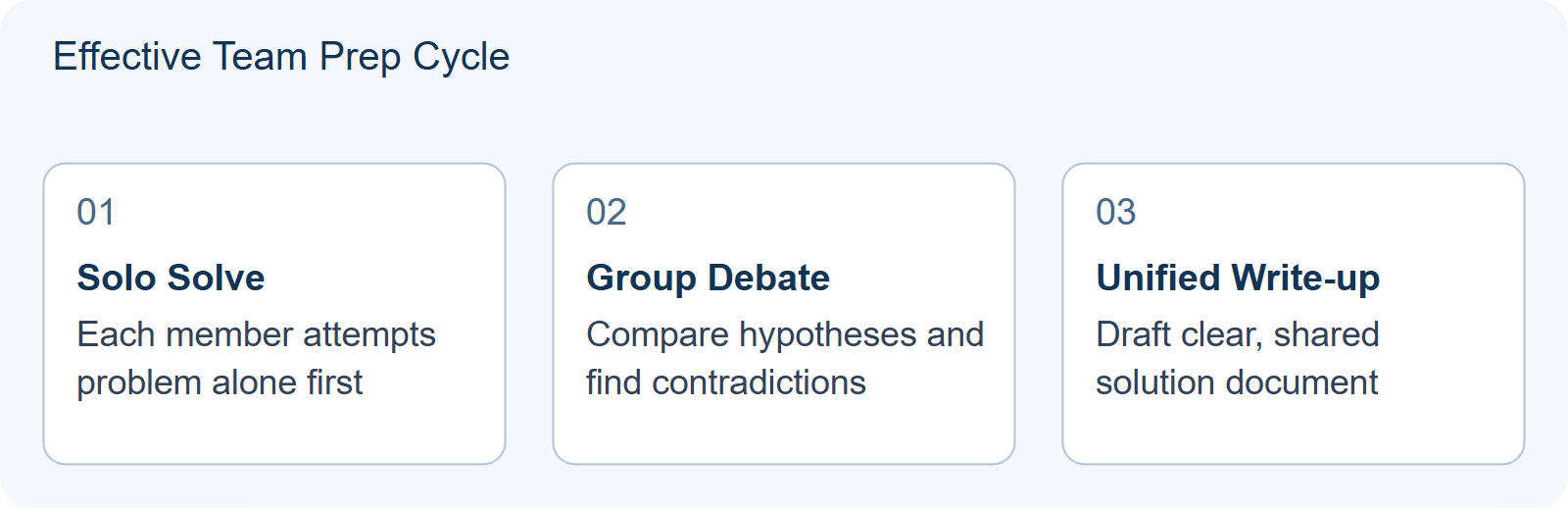
Frequently Asked Questions
Can I compete individually in the IOLC Regional Round?
Yes, the IOLC Regional Round allows registration for individuals or teams of 2–4 persons. Team participation offers additional honors and potential advancement opportunities.
Is the team size always four for all linguistics competitions?
No. Only the International Linguistics Olympiad (IOL) requires a fixed team of four. Regional and national selection rounds like IOLC have flexible team sizes (2–4).
How does AI impact my team preparation strategy?
AI benchmarks show that while models can solve some problems, they struggle with long-chain reasoning. Teams should focus on verifying logic and explaining steps clearly, skills where humans still excel.
Keep reading.
IOLC Consonant Digraphs: Why bh, mb and ng Stay Single Units in Rongga-Style Data
In the 2026 IOLC Newcomer/Junior Division Rongga problem note, bh, mb and ng are recorded as consonants. Learn a data-first method for…
IOLC Team Average: How Each Participating Member Changes the Score
Understand how the IOLC team average is calculated from the individual scores of actual participating members, how adding or removing a member…
IOLC 2027 Level Test: Run a 3-Hour, 4-Problem Mock Before March 7
Prepare for the IOLC 2027 Level Test (March 7) by simulating the latest source-backed 2026 regional format: three hours, four independent puzzles….