
Number and writing-system problems are a recurring IOL problem type that hands you a small set of numerals or written forms paired with their values, then asks you to read or write new ones. You solve them not with prior knowledge but by reverse-engineering the system's base, its building blocks and its rules. This guide gives you a five-step decoding method, a worked illustrative example, and a checklist you can drill before the 23rd IOL in Bucharest (26 July–2 August 2026).
What a “number & writing systems” problem actually tests
The International Linguistics Olympiad individual contest is a set of five problems solved over six hours, in any order, with no calculators, calendars, phones or internet allowed (per the official regulations on ioling.org). One or more of those five is often a self-contained system problem: you receive everything you need inside the data block, and your job is to infer the rules.
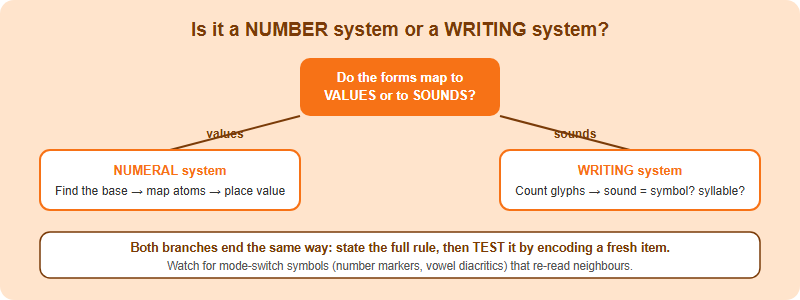
Two flavours dominate this family:
- Numeral systems — a language's way of writing numbers. The classic real examples on the official sample set are Inuktitut Numbers and Basque Numbers (browsable in the official samples on ioling.org/problems). Historical scripts like Mayan (a base-20 dot-and-bar system) and Babylonian cuneiform (a base-60 system) belong to the same logical family.
- Writing systems / scripts — alphabets, syllabaries, abjads, abugidas or braille, where each symbol maps to a sound, a syllable or a feature. The official samples include Japanese Braille, a script-mapping puzzle.
What unites them: there is a finite inventory of symbols, a rule for combining them, and a hidden structure (a base, a direction, a stacking convention) you have to expose. If you have not yet met the contest format, start with our explainer on what the IOL is, then come back here for the decoding drills.
The five-step decoding method
Every number/writing-system problem yields to the same disciplined loop. Do not guess early — build evidence first.
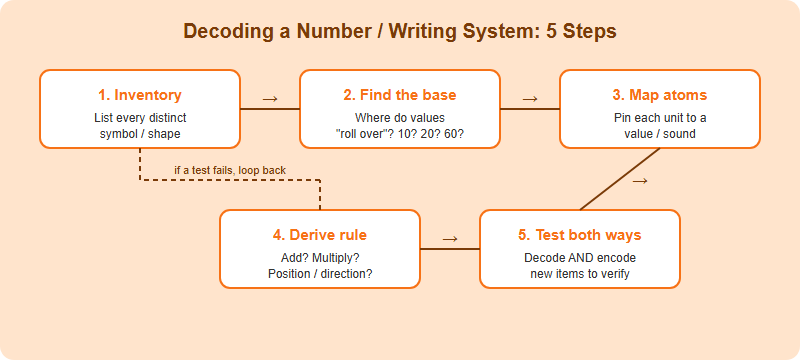
Step 1 — Inventory the symbols. Before any arithmetic, write out the complete set of distinct marks. For a numeral system, how many primitive shapes exist? Two (like dots and bars)? Ten? For a script, how many distinct glyphs, and do any repeat? The size of the inventory is your first clue to the base or the unit type (alphabet vs syllabary).
Step 2 — Find the base (the “roll-over” point). Numeral systems are defined by where they restart. Decimal rolls over at 10; the Mayan system rolls over at 20 (vigesimal); Babylonian cuneiform rolls over at 60 (sexagesimal). Look for the smallest value whose written form suddenly adds a new column, stack or position — that boundary is the base.
Step 3 — Map the atoms. Assign each smallest unit a value or a sound. In a dot-and-bar system, you might find a dot = 1 and a bar = 5; in a syllabary, one glyph = “ka”. Build a tiny lookup table and keep it visible.
Step 4 — Derive the combination rule. Now ask how atoms combine: by addition (a Roman-numeral-like sum), by multiplication-by-position (place value, where the column tells you the power of the base), or by spatial stacking. Note the direction too — left-to-right, right-to-left, top-to-bottom.
Step 5 — Test in both directions. This is the step weak solvers skip. A correct rule must let you decode an unseen form into a value and encode a given value back into the script. If either direction breaks, your rule is incomplete — loop back to Step 2 or 4. The IOL marking rewards a fully stated, working rule, not a lucky single answer.


A worked illustrative example (our own invented system)
To stay compliant with the rule against reproducing copyrighted past problems, here is a made-up mini number system that behaves like a real base-20 (vigesimal) one — the same logic as Mayan numerals, with shapes we invented for teaching. Work it before reading the solution.
The data. In the fictional “Orbit” numerals, a small circle o is worth one unit and a horizontal line — is worth five units. Symbols stack within a level, and the system is base-20 with two stacked levels (a lower “units” level and an upper “twenties” level), read bottom-to-top.
| Written form (bottom level) | Reads as | Value |
|---|---|---|
o o o |
1 + 1 + 1 | 3 |
— o o |
5 + 1 + 1 | 7 |
— — o o |
5 + 5 + 1 + 1 | 12 |
— — — |
5 + 5 + 5 | 15 |
Now the two-level part. Because the base is 20, a value of 20 or more uses the upper level, where each unit is worth twenty. So the number 27 = (1×20) + 7 is written as one circle on the upper level sitting above “— o o” on the lower level. The number 45 = (2×20) + 5 is two circles up top above a single bar below.
Your turn (encode): write 33. Solution: 33 = (1×20) + 13, and 13 = 5 + 5 + 1 + 1 + 1, so it is one circle on the upper level above “— — o o o” on the lower level. Notice you proved the rule by going value → script, exactly the Step-5 encode test.
This is precisely how a real vigesimal problem feels. The shapes differ; the reasoning — inventory, base, atoms, rule, two-way test — is identical. For a structured way to fit drills like this into your weeks before the contest, follow our 12-week IOL study plan.
Quick reference: bases and traps by system type
Use this table to orient fast when a system problem appears. The historical bases are well-documented facts; treat them as pattern recognition, not as answers to memorise.
| System type | Typical base / unit | Tell-tale sign in the data | Common trap |
|---|---|---|---|
| Mayan-style numerals | Base 20 (vigesimal) | Two primitive shapes (dot, bar); vertical stacking | Assuming base 10; a special zero/placeholder symbol |
| Babylonian-style cuneiform | Base 60 (sexagesimal) | Values jump by 60 across positions; no true zero in early forms | Empty columns are ambiguous — context disambiguates |
| Body-part / mixed tally systems | Often base 5 or 20 | Sub-bases nest (e.g. 5s inside 20s) | Irregular “subtractive” forms (like 4 = 5−1) |
| Alphabet (script) | ~20–30 symbols | One glyph per consonant/vowel sound | Same sound, two glyphs (positional variants) |
| Syllabary (script) | 40–100+ symbols | One glyph per consonant+vowel syllable | Glyphs share a sub-shape for the same vowel/consonant |
| Braille / featural | Fixed cell / feature grid | Dots in a fixed matrix encode letters or numbers | A “number sign” flips the same dots to digits |
One genuinely useful first-party observation from coaching Chinese international-school students: the single most common lost mark on these problems is not the base — most solvers spot that. It is forgetting that scripts and numerals frequently carry a mode-switch symbol (a “this is now a number” marker, or a vowel-changing diacritic) that silently re-reads the surrounding glyphs. Always ask: “Is there a symbol whose only job is to change how its neighbours are read?”
How to drill this before Bucharest 2026
The 23rd IOL runs in Bucharest from 26 July to 2 August 2026 (per ioling.org). National selection rounds such as NACLO, UKLO and OzCLO come earlier in the year and are the realistic on-ramp for most students — our national olympiad calendars guide lays out those dates and routes (always confirm current dates on the official sites).
A concrete four-week mini-plan that complements the full study plan:
- Week 1 — Numerals. Drill the official Inuktitut Numbers and Basque Numbers samples on ioling.org/problems. For each, write out your base-finding reasoning in full sentences.
- Week 2 — Scripts. Work the Japanese Braille sample; force yourself to encode three new words, not just decode.
- Week 3 — Mixed past sets. Pull one full year from “Problems by Year” and time a single problem to 60–70 minutes (a sensible per-problem budget inside the five-problem, six-hour paper).
- Week 4 — Two-way discipline. Re-solve last week's problems but only score yourself if your stated rule survives the encode test.
Honest note: solving sample numerals does not guarantee a medal, and no coaching can. What it does reliably build is the habit of proving a rule both ways under time pressure — the transferable skill that the marking actually rewards.
FAQ
Do I need to know Mayan or Babylonian numerals before the IOL?
No. IOL problems are self-contained — all the data you need is in the problem. You reverse-engineer the system on the spot using the five-step method.
Can I use a calculator for number-system problems?
No. Per the official regulations on ioling.org, calculators, calendars, phones and internet are all forbidden; you do the arithmetic by hand. Confirm current rules on ioling.org.
Where can I find real past number and writing-system problems?
Browse the official archives on ioling.org/problems: the Samples set, “Problems by Year”, and “Solvers' Choice”. Use them to practise; do not memorise answers.
When and where is the 2026 IOL?
The 23rd IOL is in Bucharest, Romania, from 26 July to 2 August 2026. Always re-check the date on ioling.org before planning travel.
This is an independent community guide operated by Hanlin Education for China-based international-school students. It is not affiliated with, endorsed by, or sponsored by the IOL Board. Problem types and methods are described in our own words; we do not reproduce copyrighted past problems. Always confirm current dates, rules and archives on the official site, ioling.org. Confirmed factual errors are corrected within 7 working days.
Keep reading.
From Three Hours to Six: What Actually Changes Between a National Round Paper and an IOL Paper
A national open round gives you roughly 25 minutes a problem; the IOL gives you over an hour. Four things that change…
How to Mark Your Own Linguistics Olympiad Practice Paper When There Is No Solution Sheet
Worked solutions do not exist for every past paper. A five-band self-marking rubric, the regeneration test, and the four ways students quietly…
The Deadline Before the Deadline: Planning a 2026-27 Linguistics Olympiad Autumn Backwards From the Sitting
Registration for the coming cycle is reported to close earlier than usual. An autumn planned backwards from the sitting, with compression options…