
You do not need a seat in Bucharest to get real training value out of IOL 2026, which runs 26 July – 2 August. The week produces the single most valuable asset in linguistics-olympiad prep — a brand-new, professionally designed problem set you have never seen — plus a natural deadline that focuses a summer of practice. Here is a concrete follow-along protocol: what to track during the week, where materials appear afterwards, and how to run a “shadow IOL” with classmates.
Why IOL week matters even if you are not competing
Each year's olympiad adds one individual set and one team problem to the public archive — problems written and tested by the international problem committee specifically so that no prior language knowledge helps. For self-training students, that makes each new set uniquely honest: it is the only material on earth that is guaranteed fresh, calibrated to real contest difficulty, and (eventually) paired with official solutions. The 2025 olympiad in Taipei drew 227 contestants on 57 teams from 42 countries; the problems those contestants sweated over are exactly the kind of material you will train on next.
There is also a motivational point that sounds soft but is not: most students who quit olympiad prep quit in the unstructured stretch between qualifying seasons. Anchoring your summer to IOL week — a real event, with real stakes for real teams — gives the stretch a spine. If you are still deciding whether this contest is for you at all, start with our complete guide to the IOL, then come back to this protocol.
The shape of the week, from a distance
The public rhythm of an IOL is fairly stable from year to year: an opening ceremony, the individual contest, an excursion-and-rest day, the team contest, and a closing ceremony where results and awards are announced. Exact day-by-day scheduling for Bucharest is published by the organisers — check ioling.org and the official 2026 host channels for the timetable rather than relying on any third-party summary, including this one. What matters for your protocol is not the precise hour of each event but the sequence: individual problems exist from mid-week; results land at the close; materials reach the public archive afterwards.
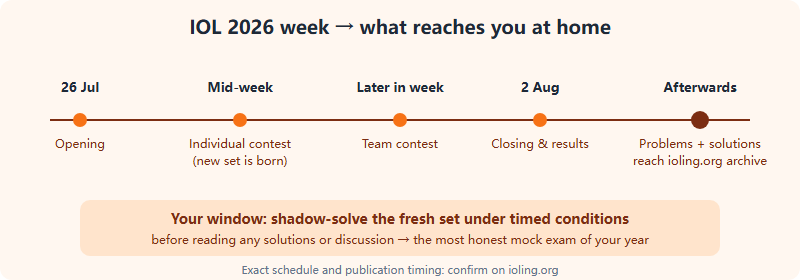
The shadow-solve protocol: your most honest mock of the year
Past IOL problem sets and official solutions have been made freely available on ioling.org after each olympiad — that is what makes our past problems pack and usage method possible in the first place. The 2026 set will be at its most valuable in the window after it becomes public but before you have seen any solutions or online discussion. Protect that window deliberately:
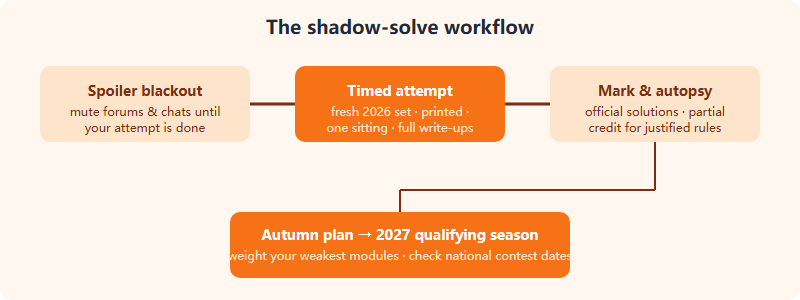
- Declare a media blackout on problem content. Once the contest has been sat, spoilers spread through olympiad forums and group chats quickly. Mute the channels until you have taken your attempt.
- Book your shadow session in advance. Put a six-hour block in your calendar for the first free weekend after the problems appear. Treating it as a fixture — not “sometime in August” — is what separates students who actually do it from students who mean to.
- Sit it under contest conditions. Print the problems, one sitting, no lookups, handwritten solutions with full justifications. Write your rule statements as if a grader will mark them, because later you will grade them.
- Mark against official solutions only after the attempt. Score generously for correctly identified rules and harshly for unjustified answers — that mirrors the contest's partial-credit spirit.
Filed next to a benchmark attempt from earlier in the summer, this gives you a clean before/after measurement on genuinely unseen material — something no amount of re-solving old favourites can provide.


Run the team problem as a group session
The IOL team contest gives a team of four one long, hard problem to crack together, and its past problems are famously deep — recent editions have involved entire writing systems or large datasets that no individual could finish alone. When the 2026 team problem becomes available, it converts directly into the best group-training session of your school year:
- Assemble three or four classmates (a linguistics club, a maths-olympiad friend, anyone who enjoys puzzles).
- Reserve a classroom or library room for an afternoon; print one copy of the data per person plus one shared master sheet.
- Spend the first 20 minutes reading silently, then negotiate a division of labour out loud — who attacks which subsystem — before anyone starts writing.
- Reconvene every 45 minutes to merge findings on the master sheet.
The linguistic content is only half the training value; the other half is learning how four people share one problem without duplicating or colliding — the exact skill national teams practise before the real event.
A week-by-week follow-along plan
| Period | What to do | Purpose |
|---|---|---|
| Before 26 Jul | Sit one timed benchmark set from the past problems archive; file your score and error notes | Baseline for the summer |
| 26 Jul – 2 Aug | Follow official announcements on ioling.org and host channels; note which countries' teams and results interest you | Context and motivation; zero spoiler risk before materials release |
| Results weekend | Read the medal boundaries and results when published; do not read problem discussions yet | Calibrate what top scores look like |
| First free weekend after problems publish | Shadow-solve the 2026 individual set, timed, blackout intact | Most honest mock of the year |
| Following week | Mark against official solutions; full autopsy; compare with your July baseline | Measured progress on unseen material |
| Mid-August | Group session on the 2026 team problem | Collaboration skills + hardest single problem of the year |
| Late August | Fold findings into your autumn plan; check NACLO/UKLO/OzCLO registration windows for the next cycle on their official sites | Bridge into the qualifying season |
From August back-bridge to the 2027 qualifying season
The IOL is reached through national selection — contests such as NACLO in North America, UKLO in the UK and OzCLO in Australia feed their national teams, and China-based international-school students typically enter whichever route their school circumstances allow. Registration windows for the next cycle generally open in the autumn and the contests themselves cluster in the winter and early spring; the exact dates for the 2027 cycle will be set by each national body, so check their official sites once the new school year starts.
Practically, that means the autopsy notes from your shadow-solve become the seed of your autumn plan. If the 2026 set exposed, say, slow progress on morphology-heavy data, that is the module to front-load when you restart structured training — our 12-week study plan is built to absorb exactly this kind of personalised weighting. Students who run the full loop — benchmark, follow the week, shadow-solve, autopsy, re-plan — enter the qualifying season in September with something most competitors lack: recent, measured data on their own solving under honest conditions.
FAQ
Where will the IOL 2026 problems be published?
Past IOL problem sets and solutions have been made freely available on ioling.org after each olympiad. Watch the official site for the 2026 materials; publication timing varies by year.
Can I watch IOL 2026 live from home?
Follow official announcements on ioling.org and the 2026 host channels. Coverage arrangements differ year to year, so confirm what the organisers provide rather than assuming a livestream.
How soon should I attempt the 2026 problems after they appear?
As soon as you can sit a full timed session — ideally the first free weekend — and strictly before reading solutions or forum discussion, so the attempt stays honest.
Does shadow-solving actually help me qualify next year?
It gives you a measured baseline on unseen, contest-grade material, which makes your autumn training plan sharper. No method guarantees qualification or results.
IOL Club is an independent guide operated by Hanlin Education for China-based international-school students. We are not affiliated with, endorsed by, or sponsored by the IOL Board. Schedules, publication timing and coverage arrangements change — always confirm current details on ioling.org. If you spot an error, we correct verified issues within 7 working days.
Keep reading.
From Three Hours to Six: What Actually Changes Between a National Round Paper and an IOL Paper
A national open round gives you roughly 25 minutes a problem; the IOL gives you over an hour. Four things that change…
How to Mark Your Own Linguistics Olympiad Practice Paper When There Is No Solution Sheet
Worked solutions do not exist for every past paper. A five-band self-marking rubric, the regeneration test, and the four ways students quietly…
The Deadline Before the Deadline: Planning a 2026-27 Linguistics Olympiad Autumn Backwards From the Sitting
Registration for the coming cycle is reported to close earlier than usual. An autumn planned backwards from the sitting, with compression options…