
You need five things to start a linguistics olympiad club: a staff sponsor, one protected hour a week, a supply of problems, a session format that is not a lecture, and one real contest date to aim at. You do not need a linguistics teacher, a budget, or anyone who already knows what a morpheme is. This playbook covers the first twelve weeks.
What a linguistics club actually needs (and what it does not)
The most common reason a school linguistics club never starts is that a student assumes it requires an expert. It does not. The defining feature of this olympiad is that the problems are self-contained: the official IOL FAQ states plainly that “all you need to solve the problem is found in the text given to you,” and that prior linguistics knowledge is “not technically” required. That single fact is what makes a student-led club viable in a way that, say, a student-led organic chemistry club is not.
Here is the honest requirements list.
| You genuinely need | You do not need |
|---|---|
| A staff sponsor (for room booking and school approval — they do not have to solve anything) | A teacher with a linguistics background |
| One fixed hour per week, same room, same time | A budget, a website, or a logo |
| A supply of problems with answers you can withhold for a week | Textbooks or a syllabus |
| A whiteboard or projector for the explain phase | Laptops or any software |
| Four to eight regulars — enough for pair work | Thirty sign-ups on day one |
| One target contest date on the calendar | Anyone who has competed before |
If your school already runs maths or informatics olympiad clubs, pitch this as complementary rather than competing: the overlap in students is high, and the club needs an hour, not a season. If nothing similar exists, that is an advantage — you are not fighting for the same Tuesday slot. Before your first meeting, read our overview of what the International Linguistics Olympiad is so you can answer the “what even is this?” question in thirty seconds.
The 60-minute session format that keeps people coming
We have run weekly walkthrough sessions for China-based students for several seasons, and the single biggest structural lesson is this: solve first, explain second, teach never. Sessions that open with someone teaching a concept lose the room in ten minutes. Sessions that open with a puzzle on the desk keep it.
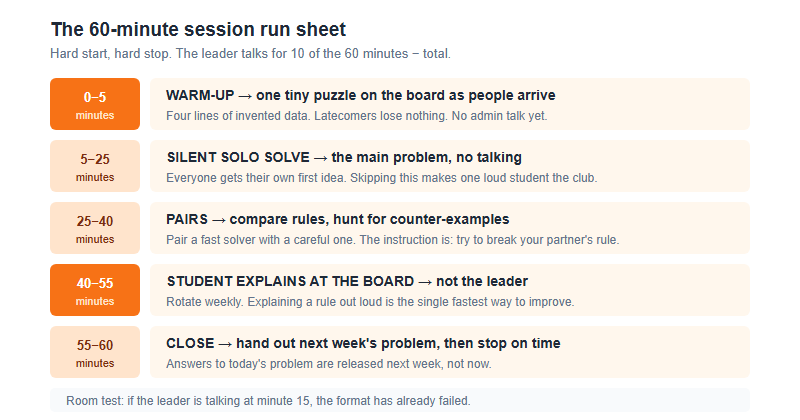
Three details do most of the work:
- Silent solo time comes first. If you go straight to group discussion, the fastest talker announces a hypothesis and everyone else stops thinking. Twenty minutes of silence is what makes the pair phase worth having.
- A student explains, not the leader. Rotate the explainer every week and let them be wrong in public. Reconstructing your reasoning out loud is exactly the skill the written justification demands in a real contest.
- Stop on time, every time. Clubs die from overrun far more often than from boredom. A club that reliably ends at the hour is one students keep in their timetable.
Your first twelve weeks, week by week
Do not try to cover everything. A first term should give members one full pass over the main problem families and one honest experience of a timed paper. This arc mirrors our twelve-week study plan, compressed into club sessions.
| Weeks | Focus | Session goal |
|---|---|---|
| 1-2 | Translation-style (Rosetta) problems | Everyone solves one end-to-end and sees that it is possible without knowing the language |
| 3-4 | Morphology — segmenting unfamiliar words | Build the habit of a written alignment grid before guessing meanings |
| 5-6 | Number and writing systems | A confidence week: these often click fastest for maths-minded members |
| 7-8 | Phonology — sound patterns and alternations | Introduce the idea that a rule can depend on the surrounding sounds |
| 9-10 | Syntax and semantics | Longer data sets; practise writing the justification, not just the answer |
| 11 | Mock paper under time pressure | One serious sitting. Members find out what their real pace is |
| 12 | Mock review + next-season planning | Score the reasoning, agree who is registering for a contest |
Resist the urge to add a lecture on phonetics in week one. Members who solve three problems before they meet any terminology absorb the terminology far more easily when it finally shows up — because by then they have already met the thing the word names.


Where the problems come from — and the one rule about answers
A club runs on problem supply. Two sustainable sources — and one thing to get from the contest itself:
- A curated practice set. Our free IOL past problems pack is assembled and organised for exactly this use — grouped by problem family so a club leader can plan a term without hunting week by week.
- Club-written mini-problems. By week six, ask members to invent a four-line fragment of a made-up language with one hidden rule. Writing a problem teaches structure faster than solving three. It also gives you an infinite warm-up supply.
- Your national contest’s own site. Use it for the registration window, eligibility and whether your school can host a sitting — the logistics only the organiser can confirm, and worth re-checking every season.
Then the one rule: never hand out the answer in the same session as the problem. Release solutions a week later, after at least one member has explained their attempt. The moment a club becomes “problem, then immediate model solution”, attendance holds but learning stops — members start waiting for the answer instead of generating one. A week’s delay is uncomfortable and it is the difference between a study group and an audience.
Recruiting and keeping a genuinely mixed group
The recruitment pitch that works is not “come do linguistics”. It is a puzzle. Put six lines of an invented language on a poster with the question underneath and the room number at the bottom. People who stop to read it are your members.
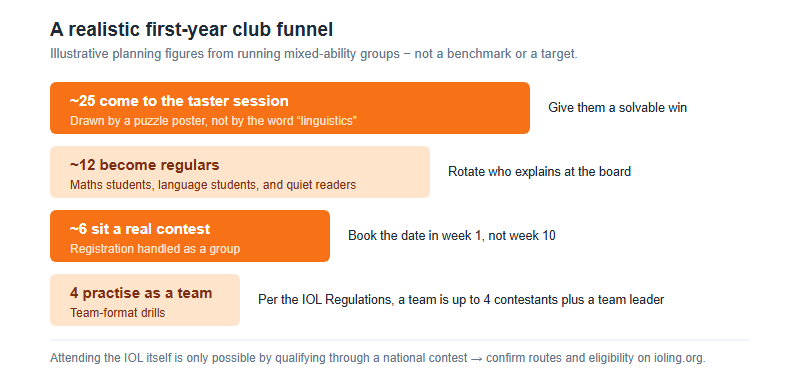
Two retention notes worth taking seriously. First, the members who quit earliest are usually strong students who lost twice in public — so make the pair phase the place where wrong ideas get tested, and make “I killed my own hypothesis with item 7” an explicitly praised outcome. Second, mixed backgrounds are a feature: maths-minded members are typically faster at number and writing systems, while members who have grown up between languages often notice sound and word-structure patterns first. Pair across those groups deliberately rather than letting friends pair up.
It is also worth telling members early what the ceiling looks like, because it is motivating and it is public record: at IOL 2025 in Taipei, 227 contestants in 57 teams from 42 countries and territories took part, and the 23rd IOL runs in Bucharest from 26 July to 2 August 2026.
Pointing the club at a real contest
A club without a date on the calendar drifts into a puzzle social. Fix a target in week one, and be accurate about how the pathway works: according to the official IOL FAQ, “you can only participate in the IOL by qualifying through your national contest” — the IOL itself does not select individual students. Contestants must also be under 20 on the opening day and be attending, or have only just finished attending, secondary school.
For a China-based international school, the practical questions are which national or regional contest your students are eligible for, when its registration window opens, and whether your school can host a sitting. Those answers vary by contest and by passport, and they change year to year — so treat the contest’s own site as the authority and confirm eligibility on ioling.org before promising anyone a route. Put the registration deadline in the school calendar the same week you book the room; clubs miss windows far more often than they miss preparation.
A four-week launch checklist
- Week -4: find a staff sponsor, book a recurring room and hour, name the club something a non-member understands.
- Week -3: assemble the first six problems and their solutions; write your term arc; identify the target contest and its registration window.
- Week -2: put up puzzle posters; ask two teachers to mention it once in class; avoid a sign-up form with more than one field.
- Week -1: run a dry session with two friends to test the timings.
- Week 1: taster session — one solvable problem, everyone gets a win, hard stop at the hour, next week’s problem in their hands as they leave.
That is the whole launch. The club will not feel impressive in week three; it will feel like six people quietly writing in a room. That is what it is supposed to look like — and by week twelve, those six will have sat a timed paper and know exactly what they want to do next season.
FAQ
Q: Do we need a teacher who knows linguistics?
No. The official FAQ notes that everything needed to solve a problem is in the text provided. A sponsor for room booking and approval is enough.
Q: How many members do we need to be viable?
Four to eight regulars is plenty — enough for pair work and a rotating explainer. Large sign-up lists usually shrink to that anyway.
Q: Can our club send someone straight to the IOL?
No. Per the official FAQ, participation comes only through qualifying at your national contest. Check eligibility and dates on ioling.org.
Q: What year group should we recruit from?
Mixed works best. Contestants must be under 20 on the opening day and in secondary school, so younger members have several seasons of runway.
This is an independent guide operated by Hanlin Education for China-based international-school students. We are not affiliated with, endorsed by, or sponsored by the IOL Board. Contest structure, eligibility and dates change; please confirm current details on the official site, ioling.org. Any factual error reported to our editorial desk is corrected within 7 working days.
Keep reading.
From Three Hours to Six: What Actually Changes Between a National Round Paper and an IOL Paper
A national open round gives you roughly 25 minutes a problem; the IOL gives you over an hour. Four things that change…
How to Mark Your Own Linguistics Olympiad Practice Paper When There Is No Solution Sheet
Worked solutions do not exist for every past paper. A five-band self-marking rubric, the regeneration test, and the four ways students quietly…
The Deadline Before the Deadline: Planning a 2026-27 Linguistics Olympiad Autumn Backwards From the Sitting
Registration for the coming cycle is reported to close earlier than usual. An autumn planned backwards from the sitting, with compression options…