
Many students preparing for the International Linguistics Olympiad (IOL) or national qualifiers such as NACLO and IOLC make a predictable error early: they treat a Linguistics Olympiad Training Guide like a textbook. They read it cover to cover, memorize definitions of phonemes and morphemes, and then turn to problems. When unfamiliar data appears, they freeze and assume they have not studied enough. Often the real problem is not insufficient reading. It is that they studied in isolation, without connecting concepts to the exact decisions a competition problem asks them to make.
A training guide is not a syllabus to finish. It is a reference to consult just in time. The goal is not to have read the guide. The goal is to solve problems more accurately. This article gives a practical protocol for using a guide without skipping the hard part: the problem attempt itself.
Why Passive Reading Feels Productive but Rarely Transfers
The core skill tested in linguistics olympiads is not knowledge retention but pattern inference under uncertainty. Unlike a history or biology exam where factual recall can secure points, an IOL-style problem presents novel data from a language you may never have seen. You must deduce rules from limited examples. If you read a guide section about consonant alternation before attempting a problem that depends on consonant alternation, you may recognize the term but still fail to apply the logic. You lack the pressure of the dataset, the need to choose between competing hypotheses, and the feedback of a wrong answer.
Passive reading creates an illusion of competence. The definition looks clear while the author explains it. But when the data is messy and the rule is hidden, recognition is not enough. Students often report feeling blank even after studying the relevant chapter. The fix is to reverse the order. Engage with the problem first. Identify the exact point of failure. Then use the guide to resolve that specific ambiguity. If you have not built a practice set yet, start with IOL Past Problems: Choosing Practice Sets and Requesting Explanations. The point is to choose a problem, sit with it, and let it expose the gap.
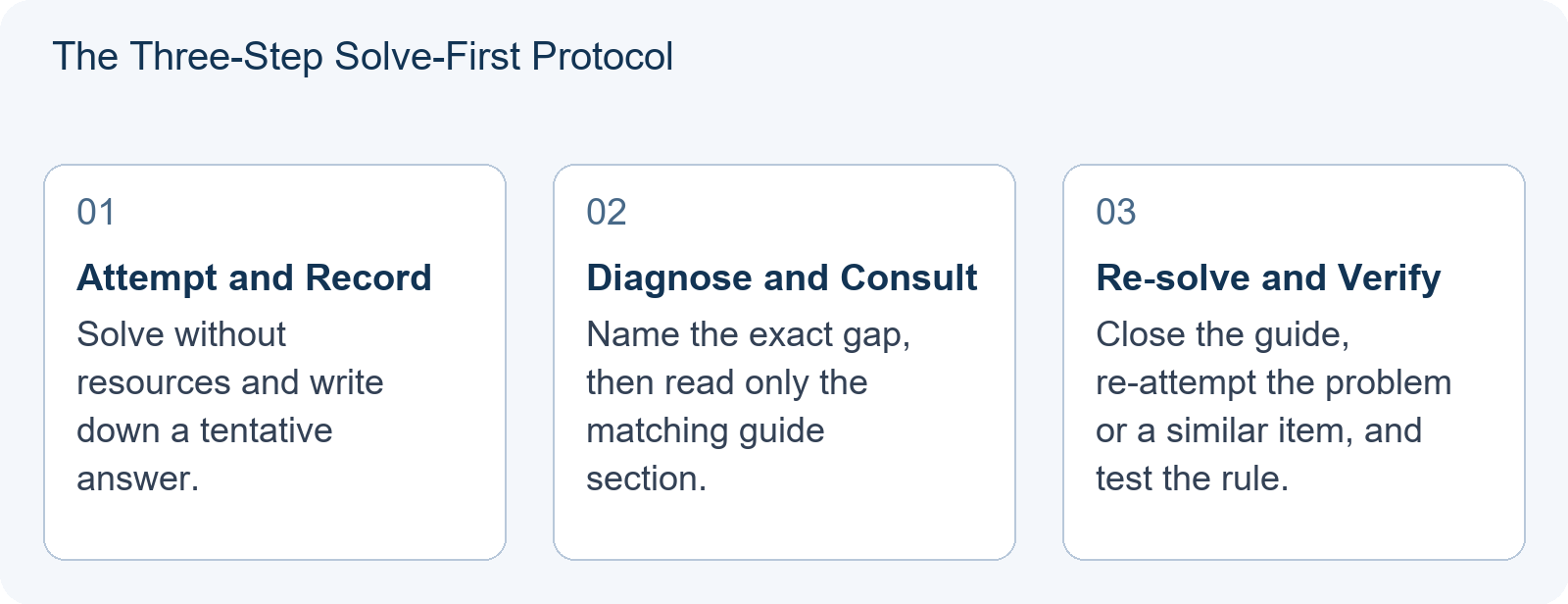
The Three-Step Solve-First Protocol
The protocol has three steps. Use it for every practice session, even a short one.
- Attempt and Record. Attempt the problem without looking at any resource. Struggle through the first hypothesis. Write down a tentative answer, even if you are unsure. The written attempt matters because it gives you evidence of how you think before the guide intervenes.
- Diagnose and Consult. Identify exactly where you got stuck. Was it a symbol you misread? A confusion between phonological and morphological conditioning? A missing case distinction? Be specific. I did not know what to do is not a diagnosis. I could not tell whether the nasal deletion was conditioned by the following consonant or by stress is a diagnosis. Open the guide and read only the section that addresses that gap. Do not browse adjacent chapters.
- Re-solve and Verify. Close the guide and re-attempt the same problem or a similar one. Can you now state the rule in your own words? Can you test it against every matching form in the data? If the guide gave you a distinction but you still cannot apply it, your gap note was too broad. Narrow it and repeat.
This method ensures that every minute spent reading is tied to a concrete problem-solving need. It also prevents the accumulation of irrelevant terminology. You are building a mental map where concepts are linked to the decisions that make them useful.
How to Judge Whether a Guide Fits IOLC-Style Problems
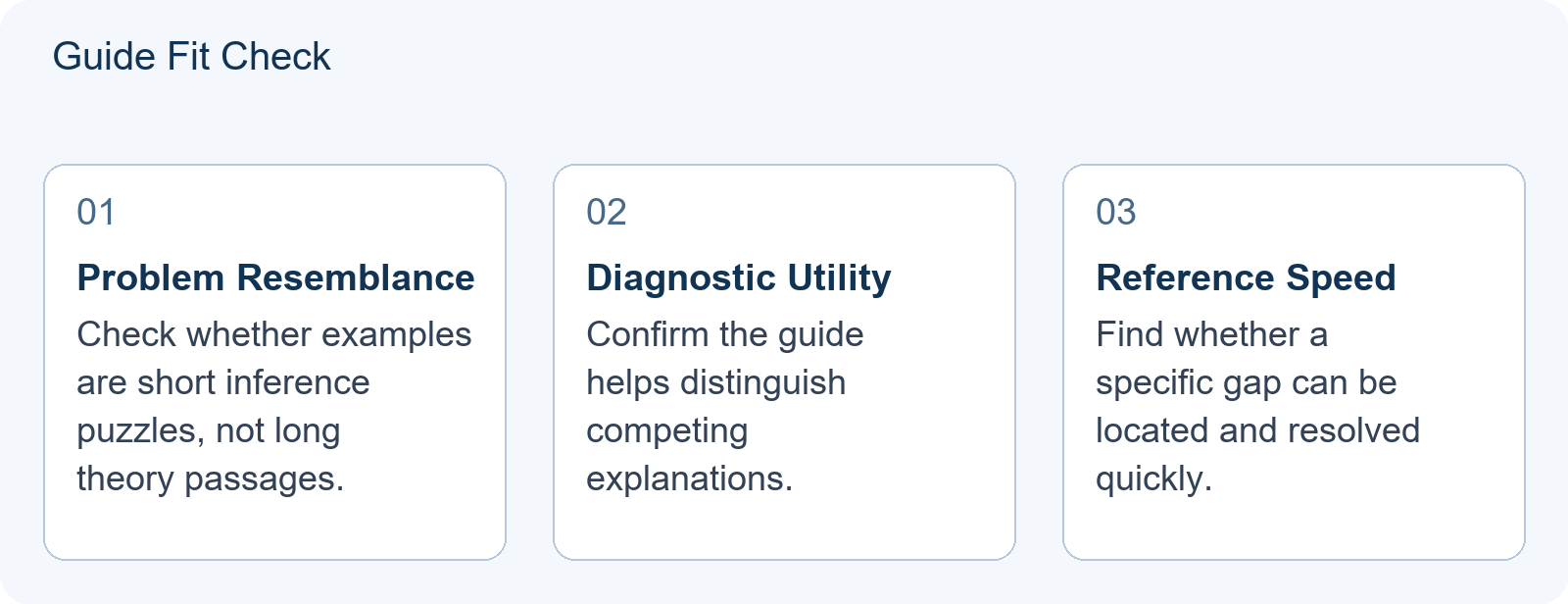
Not all linguistics resources are suitable for olympiad preparation. University textbooks often prioritize theoretical completeness over puzzle-solving utility. A good Linguistics Olympiad Training Guide should meet three practical tests.
- Problem resemblance. Does the guide illustrate concepts using datasets similar to competition puzzles? Look for short, self-contained examples where you must infer a rule, not long descriptions of a theory.
- Diagnostic utility. Are there exercises that force you to distinguish between competing explanations? For example, can you tell apart a phonological rule from a morphological alternation? Can you decide whether an apparent exception is real or caused by missing data?
- Reference speed. Can you find a relevant section quickly during practice? Long paragraphs of theory are less useful than clear headings, bulleted conditions, and compact tables of exceptions.
Hanlin describes its compiled IOLC linguistics notes as putting common linguistics knowledge and competition problem types together so students can check gaps while practising. That is the right kind of structure for this protocol. It supports targeted reading instead of a forced march through every chapter. The point is not that one publisher owns the only useful guide. The point is that a guide earns its place when it helps you return to a problem with a sharper hypothesis.


Labelled Teaching Illustration: Using a Guide Section After a Toy Allomorph Miss
This is a hypothetical teaching illustration, not an official contest problem or solution.
Suppose a student is practising with a homemade dataset using familiar English words. The data is: cat becomes cats [kæts], dog becomes dogs [dɔgz], and bus becomes buses [ˈbʌsɪz]. The student notices that the plural ending is sometimes [s], sometimes [z], and sometimes [ɪz]. They guess that the forms are random or must be memorized word by word. They try to write a rule but cannot get past the three different endings.
Following the protocol, the student writes a gap note: I do not know what conditions the three plural endings. They consult the guide section on allomorphs and voicing. They read only that section. The guide explains that the regular English plural has three predictable allomorphs: [s] after voiceless non-sibilant consonants, [z] after voiced non-sibilant sounds, and [ɪz] after sibilants. The student closes the guide and re-solves. cat ends in [t], a voiceless non-sibilant, so the plural is [kæts]. dog ends in [g], a voiced non-sibilant, so the plural is [dɔgz]. bus ends in [s], a sibilant, so the plural is [ˈbʌsɪz]. The student then verifies with two extra items: book [bʊk] becomes books [bʊks], and rose [roʊz] becomes roses [ˈroʊzɪz]. The concept clicks because it solved an immediate puzzle. This is not a linguistics olympiad problem. It is a controlled illustration of how to use a guide after a specific miss.
When a Curated Guide Helps More Than a University Textbook
For beginners, curated guides often offer a real advantage. University books frequently introduce terminology before demonstrating why anyone needs it. Olympiad-focused materials usually start with a puzzle and derive the term from the need to explain the data. That order matches the cognitive process used in competitions: observe, hypothesize, test, revise.
Curated guides can also warn about common traps. For example, a guide might highlight that apparent irregularity is often caused by an incomplete dataset or an unnoticed condition. Recognizing such traps saves time during an exam because you stop looking for a mysterious exception and start checking whether your rule has been tested in every environment. Comprehensive knowledge matters later, but early preparation benefits most from focused, application-oriented resources.
If you use AI explanations as a supplement, pair them with a solve-first routine such as Using AI for Linguistics Olympiad Prep in 2026-27: A Solve-First Protocol That Keeps the Skill Yours. The guide remains a reference. The problem attempt remains yours.
Building a One-Page Index From Your Own Gaps
As you work through more problems, you will notice recurring gaps. Create a personal index page in your notebook. List each gap you encountered and the guide section that resolved it. Over time, this becomes a custom map of your weak spots. For example, if you repeatedly struggle with tone sandhi, mark it as a high-priority review area. If you keep missing the difference between a clitic and an affix, write the exact diagnostic question that helped you decide.
Before starting a new practice set, glance at your index. This proactive review helps prevent repeating the same mistake. It also lets you see improvement in concrete terms. If a topic that once caused a gap no longer appears in your notes, you have probably internalized it. If it keeps appearing, you need a different example or a more precise source section, not more passive rereading.
If you cannot find a similar item for re-solving, set one yourself using Set Your Own Linguistics Olympiad Problem: The Practice Method That Finds the Holes in Your Understanding (2026). Writing a small problem forces you to decide what data would prove or disprove your rule. That is exactly the discipline the guide is meant to support.
How to Avoid Skipping Problems Even When the Guide Is Excellent
The better the guide, the greater the temptation to read ahead. A clear explanation can feel like progress. But in a linguistics olympiad, the score depends on what you can do with data you have not seen before. The guide can shorten the search for a concept. It cannot replace the search itself.
Protect the problem attempt in three ways. First, set a timer before you open the guide. Give yourself a real chance to form a hypothesis. Second, keep a written gap note. This prevents vague reading. Third, always return to a problem after consulting the guide. If you only read and never re-solve, you are back to passive study. The protocol is simple, but it is not automatic. It requires you to tolerate confusion for a few minutes before you reach for help.
Over time, this habit changes how you read. Instead of asking whether you have finished the guide, you ask which problem you can now solve because of it. That is the practical difference between owning a guide and using one.
Frequently Asked Questions
Should I memorize all terms in the guide?
No. Memorization is less useful than understanding how to apply terms to infer patterns from novel data. Focus on usage, not definitions.
Is Hanlin’s guide the only option?
No. Other resources exist, including Neacşu’s Linguistics Olympiad: Training guide, which appears in the Textbooks in Language Sciences series. Choose based on how well the structure supports your solve-first workflow.
What if I still do not understand after reading the targeted section?
Rewrite the gap note more narrowly, apply the concept to a simpler known dataset, or explain the rule aloud. If you remain stuck, use the existing footer contact to ask about a preparation path.
Keep reading.
IOLC Consonant Digraphs: Why bh, mb and ng Stay Single Units in Rongga-Style Data
In the 2026 IOLC Newcomer/Junior Division Rongga problem note, bh, mb and ng are recorded as consonants. Learn a data-first method for…
IOLC Team Average: How Each Participating Member Changes the Score
Understand how the IOLC team average is calculated from the individual scores of actual participating members, how adding or removing a member…
IOLC 2027 Level Test: Run a 3-Hour, 4-Problem Mock Before March 7
Prepare for the IOLC 2027 Level Test (March 7) by simulating the latest source-backed 2026 regional format: three hours, four independent puzzles….