
Use AI after you have committed an answer, never before. Language models now solve many linguistics-olympiad puzzles, and one study first posted in 2025 reported them outperforming human solvers on most puzzle types. Yet the IOL regulations prohibit phones and any device with web access in the contest room, so whatever a chatbot can do, you must still do alone, on paper. The order of use is the whole question, and this page sets out one that works.
What the research actually shows
Researchers like olympiad puzzles for the same reason coaches do: each one tests whether a solver can find a system in a small amount of unfamiliar data, with no outside knowledge to fall back on. That has made the puzzles a popular yardstick for language models, and four published studies trace how quickly the picture has changed.
| Study | What was tested | What it reported | What it means for a student |
|---|---|---|---|
| PuzzLing Machines (ACL 2020) | Around 100 Rosetta Stone puzzles from linguistic olympiads for high school students, covering 81 languages | Both simple statistical methods and the neural models of the time performed inadequately | Before today’s large models, machines could barely do this at all |
| LINGOLY (2024) | 1,133 problems drawn from the UK Linguistics Olympiad, in more than 90 mostly low-resource languages, across 11 models | On harder problems the best model reached 38.7% accuracy; scores were generally higher for better-resourced languages | The hard end resisted, and prior exposure to a language helped the models |
| modeLing (SIGTYP 2024) | Rosetta Stone puzzles written specifically for the study, so no model could have met them before | Designed so that good results could not come from memorising published puzzles | Researchers do not trust results on published past problems, and neither should you |
| Majmudar and Filatova (first posted 2025, revised 2026) | Olympiad puzzles for high school students, with models including OpenAI’s o1 | Models outperformed humans on most puzzle types, except those centred on writing systems and on understudied languages | The gap has narrowed fast, and the exceptions are instructive |
Two lessons outlast any single score. The first is contamination. Past olympiad problems have been in circulation for years, so they may already sit in a model’s training data, which is why modeLing wrote fresh puzzles and LINGOLY compared each model against a no-context baseline to penalise memorisation. When a chatbot “solves” a well-known past problem for you, you cannot tell reasoning from recall, and it hardly matters: either way, the thinking was not yours.
The second lesson is where the models struggled. Every language in the IOL 2026 individual contest had roughly 10,000 speakers or fewer, according to the problem booklet, which is the low-resource end of the spectrum where, in LINGOLY’s results, models generally scored lower. That is not a prediction about any particular problem. It is a reason not to assume that a tool which breezes through a famous practice set would handle an unseen one the same way.
The rule that settles most arguments: the room is paper-only
The IOL regulations are blunt. The individual contest assigns five problems over six hours, and the problems are handed out on paper. “Artificial aids such as pocket calculators and calendars should not be used,” and “all mobile phones or other communication devices or devices with access to the WWW are strictly prohibited.” National rounds set their own rules, so confirm yours with the organiser, but plan on the assumption that any room you sit in will be paper-only.
That turns every AI decision in practice into one test: will this make me faster or more accurate the next time I face a problem alone? If a use passes, it is training. If it fails, it may still feel productive, but it is closer to reading someone else’s solution. If you are new to the contest, our overview of the International Linguistics Olympiad explains the format this test is built around.


Use freely, use with checks, avoid
Sorting common uses by that test gives three groups. The boundaries are our coaching judgement rather than any official rule, but they hold up well across the students we work with.
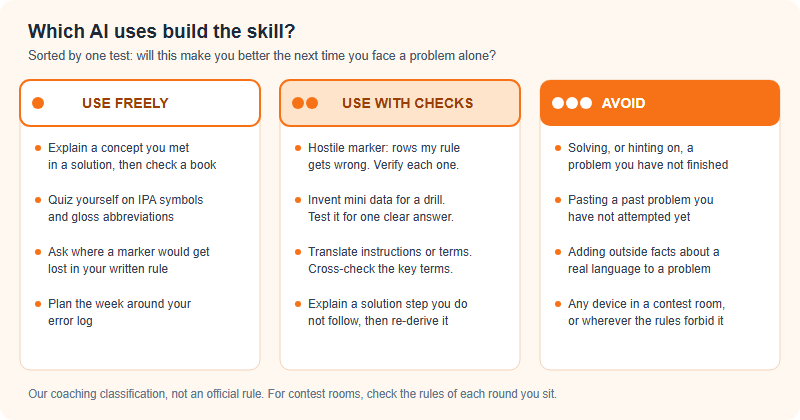
- Use freely: explanations of concepts you met in a worked solution, notation drills, and feedback on how clearly your written rule reads. Confirm any concept in a textbook, because a fluent definition can still be subtly wrong.
- Use with checks: the hostile-marker pass, invented drill data, translation of instructions and explanations of solution steps. Each needs a human check: verify every claimed counterexample against the actual row, test invented data for internal consistency and a single intended solution, and re-derive any explained step yourself. The 2025 study above treats puzzle generation as a research task in its own right, so do not assume a generated set is sound.
- Avoid: any request for a solution or a hint on a problem you have not finished, pasting past problems you have not yet attempted, and importing outside facts about a real language into a problem.
Five ways AI quietly damages practice
None of these feels like cheating from the inside, which is exactly why they are worth naming. They are the patterns we see most often when a student’s practice scores rise and their timed, unaided scores do not.
- The borrowed first hypothesis. The hardest move in any problem is producing the first testable guess from raw data. A “small hint” skips precisely that move, and that move is what the contest rewards.
- Fluency mistaken for correctness. A confident, well-organised explanation feels right, so students stop checking it against every row. A rule that fits most of the data is still a wrong rule.
- Imported facts. A chatbot may tell you what a real language actually does. In a problem, the data on the page is the only authority, and problems simplify deliberately: the 2026 Iquito problem tells solvers that the language has tones but that they are omitted for simplicity. A tool that helpfully describes Iquito tone is adding noise, not insight.
- Spent problems. Past problems are a finite stock, and each can serve as an honest unseen test only once. Ask a chatbot to explain one before you attempt it, and that test is gone for good.
- Hidden time. An AI-assisted solve hides how long you would really take. Six hours for five problems is about 72 minutes each, and you only learn whether you can work at that pace by timing yourself alone.
A solve-first protocol for the 2026-27 season
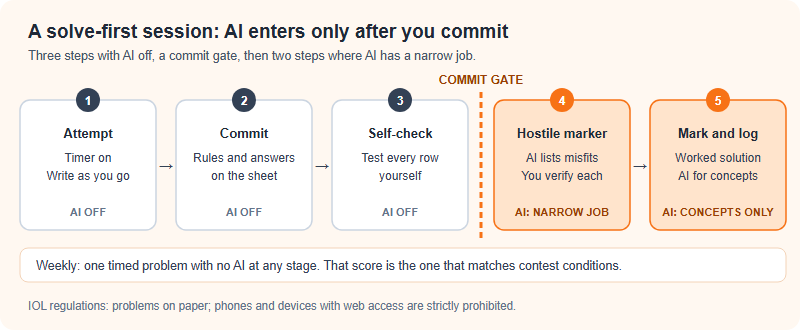
- Timer on, AI off. Attempt the problem to a committed, written answer, rules included. If you are stuck, park it, but write down your best current hypothesis first.
- Check your own coverage. Test your rule against every row yourself before anyone, or anything, else sees it.
- Run the hostile-marker pass. Give the tool the data and your rule with a narrow instruction, for example: “Here is the data and my rule. List any row my rule gets wrong, quoting the row. Do not suggest a new rule.” Then verify each claim against the data, and keep a running count of claimed counterexamples that turned out to be wrong. That count is a useful reminder of how far to trust the tool.
- Mark against a worked solution, not a chatbot. A human-written solution shows the intended reasoning. Our past-problems practice pack has worked solutions for some years rather than every year, so the exact contents follow what our teachers send you.
- Follow up on concepts. For any idea you lacked, ask for an explanation and an invented example, then confirm the concept in a textbook before you rely on it.
- Keep one unaided benchmark a week. One timed problem, with no AI at any stage. That score is the one that reflects contest conditions, and it fits naturally into the review days of our 12-week study plan.
Students sometimes ask whether this is slower. It is, for the first few weeks. After that, the hostile-marker pass tends to take a few minutes, and the time saved by not chasing a tool’s confident wrong answers more than pays for the discipline.
For parents: three signs the chatbot is doing the solving
Parents rarely see practice itself, only its outcomes, and outsourced solving distorts those outcomes in recognisable ways.
- Practice accuracy rises while timed scores stay flat. Untimed work at home improves, but the timed paper does not move.
- Clean write-ups with no scratch work. Real solving leaves crossed-out hypotheses and half-filled grids. A polished explanation with no trail behind it deserves a gentle question.
- Speed that does not match the contest. If problems that should take about an hour are routinely finished in fifteen minutes, ask your child to explain one rule aloud, straight from the data.
None of these proves anything on its own, and the conversation goes better as a question than an accusation. The simplest safeguard is structural: alongside the weekly unaided problem, one fully timed, unaided paper each month, with the scratch paper kept.
Questions students ask
Can AI solve linguistics olympiad problems?
Increasingly, yes. A study first posted in 2025 found models beating humans on most puzzle types, but not writing systems or understudied languages.
Can I use AI during the IOL?
No. The IOL regulations strictly prohibit phones, communication devices and anything with web access. National rounds set their own rules.
Is it cheating to use AI when practising?
Not in private practice, but it can waste the practice. Commit your own answer first, then use AI to check your rule, never to find it.
Should AI write my practice problems?
Only with checks. Test every invented data set for consistency and a single intended solution before you rely on it for practice.
IOL Club is an independent guide operated by Hanlin Education for China-based international-school students. We are not affiliated with, endorsed by, or sponsored by the IOL Board, and we have no connection with any AI developer or research group named here. Study findings are summarised from the published papers and describe the models tested at the time; contest regulations can change, so confirm current details on ioling.org and with your national organiser. If you spot an error, tell us and we will correct it within 7 working days.
Keep reading.
IOLC Consonant Digraphs: Why bh, mb and ng Stay Single Units in Rongga-Style Data
In the 2026 IOLC Newcomer/Junior Division Rongga problem note, bh, mb and ng are recorded as consonants. Learn a data-first method for…
IOLC Team Average: How Each Participating Member Changes the Score
Understand how the IOLC team average is calculated from the individual scores of actual participating members, how adding or removing a member…
IOLC 2027 Level Test: Run a 3-Hour, 4-Problem Mock Before March 7
Prepare for the IOLC 2027 Level Test (March 7) by simulating the latest source-backed 2026 regional format: three hours, four independent puzzles….