
Direct answer: In the 2026 IOLC Newcomer/Junior Division problem note involving Rongga, an Austronesian language of Indonesia, the prompt materials recorded bh, mb and ng as consonants, with é as a vowel. That does not mean every two-letter sequence in every problem is one sound. It means you should let the data decide before splitting or combining. The practical rule is: count consonant slots, test contrasts, and check whether a multi-letter sequence behaves as one unit in alternations or reduplication.
The source for the Rongga observation is Hanlin’s IOLC full-explanation note, published on 16 July 2026. That note records the 2026 IOLC Newcomer/Junior Division as including a Rongga data problem and states that é is a vowel while bh, mb and ng are consonants. The note also records Rongga as Austronesian, spoken by approximately 4,000 people in Indonesia. The exact contest wording should always be checked against the paper in front of you, but the teaching implication is stable: a sequence given as one consonant should not be split on English spelling intuition.
Why consonant digraph segmentation matters in IOLC phonology
Linguistics olympiad problems use unfamiliar orthographies to make you reason from distribution rather than from memorised vocabulary. A consonant digraph is a multi-letter sequence that functions as one consonant unit in a particular dataset. In English, sh in ship and th in thin are familiar examples. But English is not a reliable guide. In singer, ng corresponds to one nasal sound, while in finger, the same spelling corresponds to a nasal plus a g sound. If you import that English ambiguity into an IOLC dataset without evidence, you can destroy the pattern.
Segmentation errors affect more than transcription. They change syllable counts, reduplication patterns, allomorphy, minimal-pair contrasts and sound-change environments. If you segment mb as m plus b when the data treat it as one consonant, every rule that counts consonants or copies the first consonant will produce the wrong output. If you combine every adjacent pair into a unit, you will miss real clusters and invent contrasts that the data do not support. The goal is not to decide from spelling. The goal is to infer from evidence.
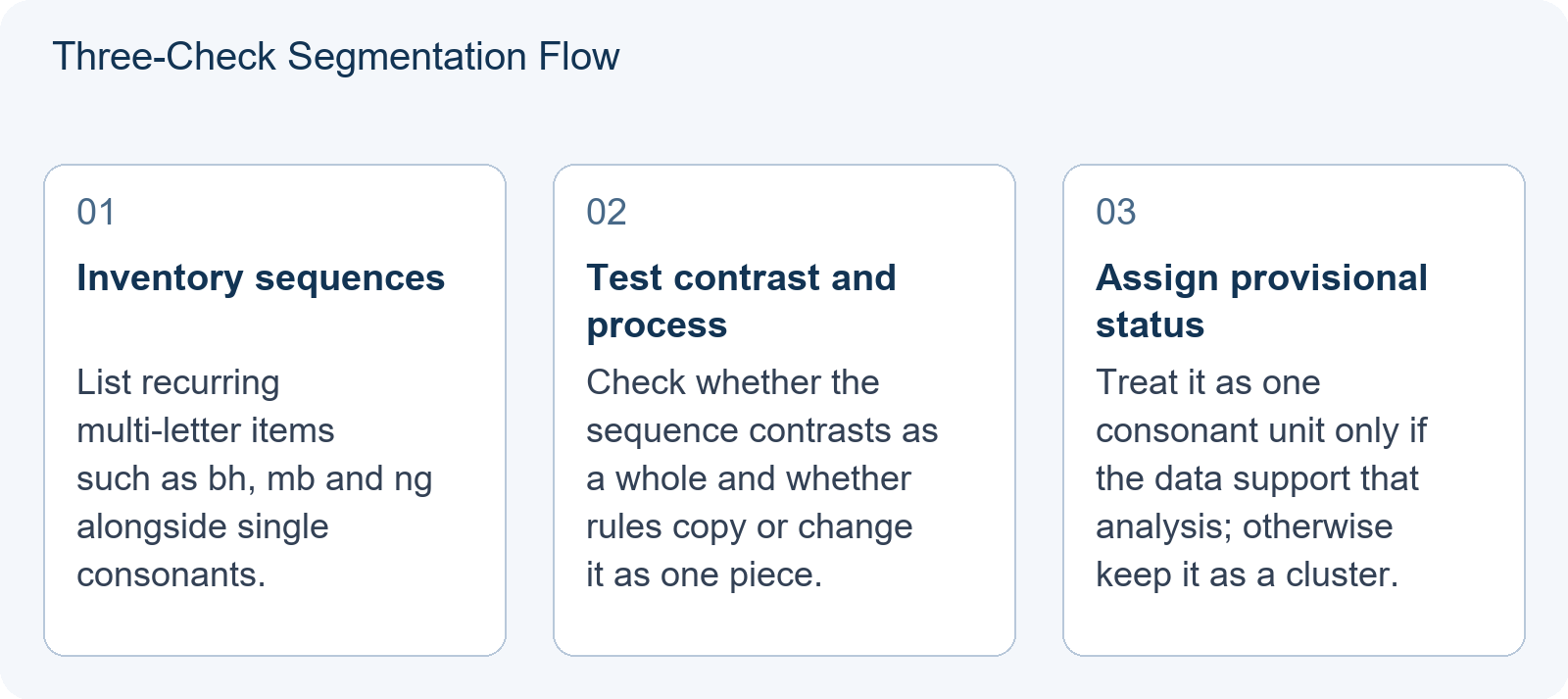
A three-check diagnostic for multi-letter consonant units
Before you split or combine bh, mb, ng or any other sequence, run these three checks. They are ordered from cheapest to most decisive.
| Check | Question | Evidence for a single unit | Evidence against a single unit |
|---|---|---|---|
| 1. Slot test | Does the sequence occupy a position where a single consonant can stand? | The sequence fills an onset, coda or root-consonant slot exactly where single consonants also appear. | The sequence always straddles a syllable boundary or behaves like two independently moving consonants. |
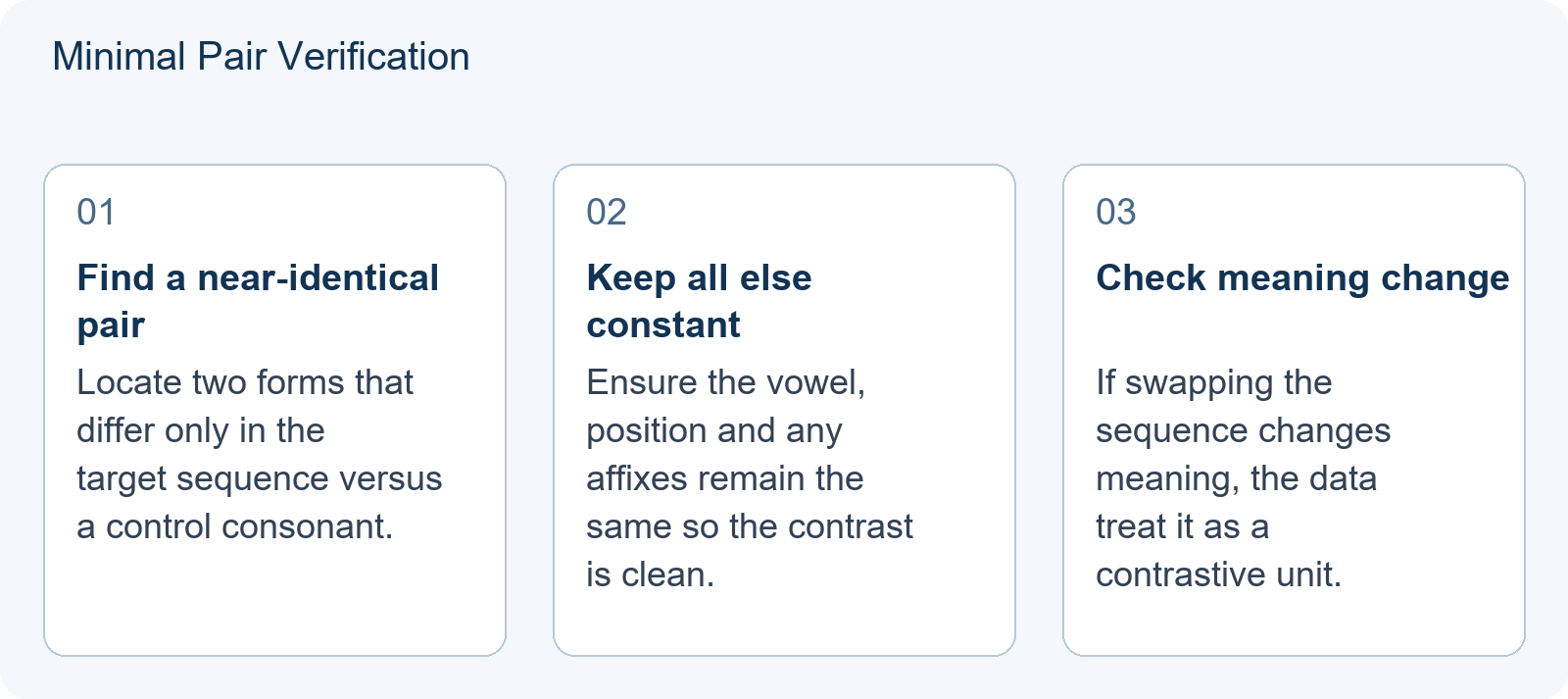
| 2. Contrast test | Does the sequence contrast as a whole with another consonant or sequence? | Two words differ only by the sequence versus a single consonant, and meaning changes. | The sequence never contrasts as a whole; its parts vary independently. |
| 3. Process test | Do rules copy, delete, assimilate or alternate the sequence as one piece? | Reduplication copies mb as mb, not m or b. A sound rule treats ng as one nasal unit. | Reduplication copies only the first letter, or a rule affects only one part of the sequence. |
The slot test is a first filter. If a sequence appears only where a single consonant may appear, that is suggestive but not conclusive. The contrast test is stronger because it shows that swapping the sequence for another consonant changes meaning. The process test is often the most powerful in olympiad data because a morphological rule reveals what the language treats as one unit.
One warning: do not use a simplistic independence test. If b and h can appear separately, that does not automatically make bh a cluster. English s and h both appear separately, yet sh is a digraph. Independence tells you that the letters are available individually; it does not tell you how the sequence behaves when it occurs. You need the process or contrast evidence.
Teaching illustration: an invented Rongga-style reduplication set
Note: the following is an invented teaching illustration, not an actual contest problem and not a claim about real Rongga forms. It is designed to show how a process test can settle segmentation.
Suppose an invented language forms plurals by copying the first consonant unit and adding a. The data below are consistent with that rule.
| Root | Gloss | Plural | Copied unit |
|---|---|---|---|
| bhata | mountain | bhabhata | bh |
| bata | river | babata | b |
| mbata | house | mbambata | mb |
| mata | eye | mamata | m |
| ngali | night | ngangali | ng |
| nali | day | nanali | n |
| gali | moon | gagali | g |
Now compare the predictions. If bh were a cluster of b plus h, the rule would copy only the first consonant, b, producing babhata. The data give bhabhata. If mb were m plus b, the rule would produce mambata. The data give mbambata. If ng were n plus g, the rule would produce nangali. The data give ngangali. The process treats bh, mb and ng as single copied units.
This is exactly the kind of evidence you should look for in a real IOLC problem. You do not need to know Rongga or any Austronesian language in advance. You need to notice that the rule copies one consonant slot, then ask what occupies that slot in each form. If the same sequence always occupies one slot, treat it as one unit until the data force a split.


Worked step: align vowels and consonants, then test a sound rule
When you meet a new dataset, build a simple alignment table. Write each word in orthographic form, then below it mark every vowel and every consonant unit. Do not guess hidden sounds yet. First mark what the prompt gives you.
For the invented set above, the alignment is straightforward:
| Word | V | C | C | V | C | V |
|---|---|---|---|---|---|---|
| bhata | bh | a | t | a | ||
| bhabhata | bh | a | bh | a t a | ||
| mbata | mb | a | t | a | ||
| ngali | ng | a | l | i |
The alignment is deliberately rough; the important point is that bh, mb and ng each fill a single onset slot. Once you have that, test a sound rule. For example, ask whether a nasal sequence becomes prenasalised before a voiced stop, or whether a consonant copy changes before certain vowels. If a rule applies to mb as a unit, changing the vowel after mb should not split it. If a rule applies only to m, you will see m behave separately in other words.
The safest habit is to write two competing analyses and compare their predictions. Analysis A says mb is one consonant. Analysis B says mb is m plus b. Which analysis predicts the observed plural forms? Which analysis predicts the observed minimal pairs? The one that survives more predictions is the better working hypothesis. You do not need to prove it forever; you need to use it consistently on the paper.
Common error: over-splitting versus over-combining
Over-splitting happens when you apply English or IPA habits too quickly. You see ng and split it into n plus g. You see mb and call it a cluster. You see bh and assume it must be two sounds because both letters are familiar. In a dataset where the prompt or the pattern treats those sequences as single consonants, every downstream rule breaks.
Over-combining is the opposite error. You notice that sh, ch and th are digraphs in English, so you treat every two-consonant sequence as a unit. But many languages have real clusters such as kl, tr or nd that behave as two consonants. If the data show k and l moving independently, or if reduplication copies only k, then kl is not a single unit in that dataset.
The cure is the same in both cases: use the data. Look for gaps in distribution. Look for contrasts. Look for processes that copy, delete or change consonants. If a sequence never splits under any rule, and it contrasts with single consonants as a whole, treat it as one unit. If it splits, or if only its first part is copied, treat it as a cluster.
For related practice, see Linguistics Olympiad Minimal Pairs: Finding the Contrast That Explains the Data. Minimal pairs are often the cleanest way to confirm that a multi-letter sequence is a distinct unit. For sound-rule environments, see Linguistics Olympiad Sound Changes: Test a Rule Across Every Matching Environment. For general data-reading habits, including IPA and diacritics, see How to Read Linguistics Olympiad Data: IPA, Diacritics and the Pinyin Trap (2026).
Practice routine for unfamiliar orthographies
Use a short, repeatable routine on every phonology problem.
Step 1: Inventory. List every distinct consonant symbol or sequence in the data. Do not decide yet. Put single letters and multi-letter sequences in the same list.
Step 2: Environments. For each item, note where it occurs: word-initial, word-final, before which vowels, after which consonants. Create a table. This exposes distributional gaps.
Step 3: Processes. Find one morphological or phonological rule and test how it treats each item. Reduplication, suffixation, vowel harmony and nasal assimilation are common process tests. If a rule copies or changes a sequence as a whole, mark it as a unit.
Step 4: Competing analyses. Write the two or three most plausible segmentations. Predict what each analysis would produce for an unseen form. Then check which prediction matches the data. Keep the analysis that survives the most predictions.
Reviewing solutions is part of this routine. When you compare your segmentation with the official analysis, do not just mark right or wrong. Ask which check you missed. Did you over-split because of English intuition? Did you over-combine because you saw two letters together? Adjust your inventory and environment tables next time.
How this helps your IOLC preparation
Consonant digraphs are a small topic with large consequences. A single segmentation decision can change a syllable count, a reduplication pattern or a sound rule. The 2026 IOLC Rongga note is useful because it shows that unfamiliar data may explicitly mark multi-letter consonants. Your job is not to memorise bh, mb and ng as universal digraphs. Your job is to build a diagnostic that works when the next language uses different symbols.
If you want to practise this systematically, work through past IOLC and IOL phonology problems with a segmentation log. For each problem, record the consonant inventory you inferred, the evidence for each multi-letter unit, and the error you would have made if you had trusted spelling intuition. Hanlin advisors can help you review those logs and decide whether your next block of preparation should focus on phonology, morphology or general data-reading strategy. No resource or score guarantee is implied; the aim is targeted practice on the pattern that is actually costing you marks.
General event background is available at International Linguistics Olympiad background.
This is an independent preparation guide, not affiliated with, endorsed by, or sponsored by the International Linguistics Olympiad.
Frequently Asked Questions
Does every two-letter sequence become one consonant?
No. A two-letter sequence is a single consonant unit only when the data treat it that way. Look for slot behaviour, contrast and processes such as reduplication. If the sequence splits under a rule, it is not a single unit in that dataset.
How do I know if ng is one sound or two?
Do not decide from English spelling. Check whether ng contrasts with n or g as a whole, whether it fills one consonant slot, and whether a rule copies or changes ng as one piece. If the data copy ng as ng, treat it as one unit. If a rule copies only n, treat it as two.
Should I use IPA symbols in my answer?
Only if the problem asks for transcription or if IPA is needed to show a contrast. Otherwise, use the orthographic units given in the prompt. Inventing IPA symbols can introduce distinctions the data do not support.
IOLC Team Average: How Each Participating Member Changes the Score
You’re reading the earliest bulletin.
Keep reading.
IOLC Team Average: How Each Participating Member Changes the Score
Understand how the IOLC team average is calculated from the individual scores of actual participating members, how adding or removing a member…
IOLC 2027 Level Test: Run a 3-Hour, 4-Problem Mock Before March 7
Prepare for the IOLC 2027 Level Test (March 7) by simulating the latest source-backed 2026 regional format: three hours, four independent puzzles….
How to Use a Linguistics Olympiad Training Guide Without Skipping Problems
Stop reading linguistics guides passively. Learn the solve-first protocol to turn a training guide into an active gap-filling tool for IOLC preparation.