
For students preparing for the How to Read Linguistics Olympiad Data: IPA, Diacritics and the Pinyin Trap (2026) or When Two Analyses Both Fit the Data: How to Choose, Test and Hedge at a Linguistics Olympiad (2026), one of the most persistent challenges in phonology problems is correctly identifying minimal pairs. A minimal pair consists of two words that differ by only one sound segment (phoneme) while all other segments remain identical. This difference reveals which sounds are distinct phonemes in the language rather than allophones. However, many learners struggle not with the definition, but with applying it rigorously when faced with complex, unfamiliar datasets. The pressure of competition conditions amplifies this difficulty, making systematic methodology essential rather than optional.
The Core Difficulty: Isolation vs. Assumption
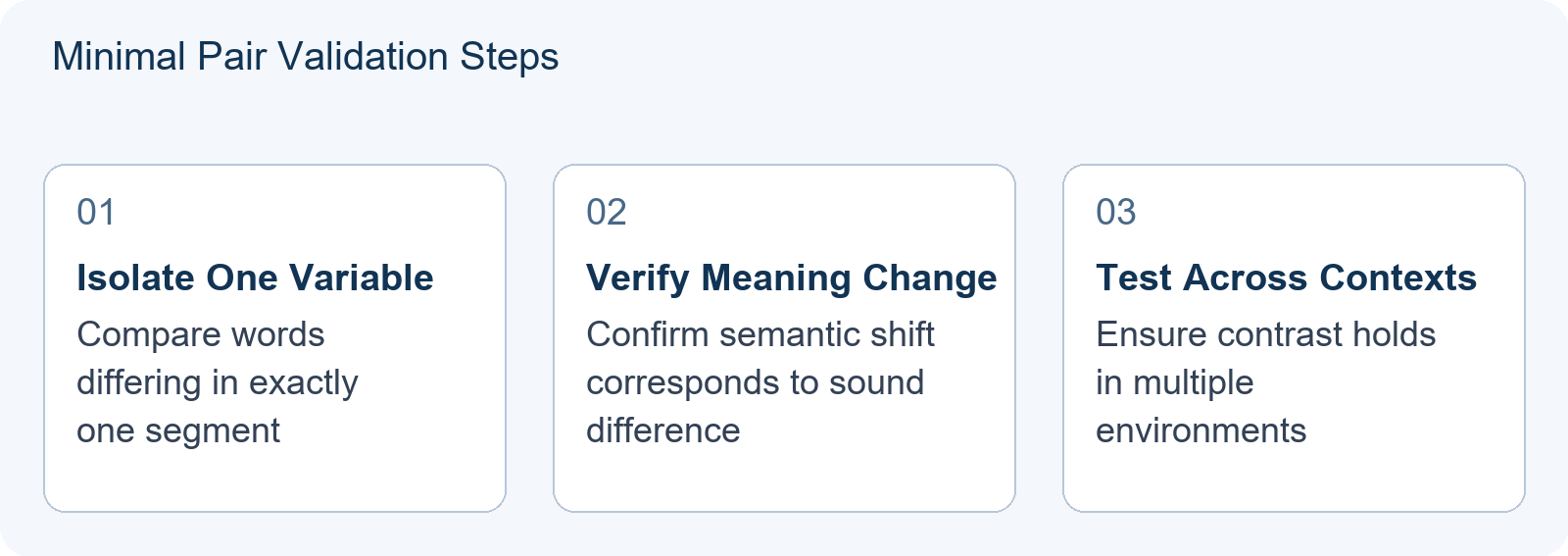
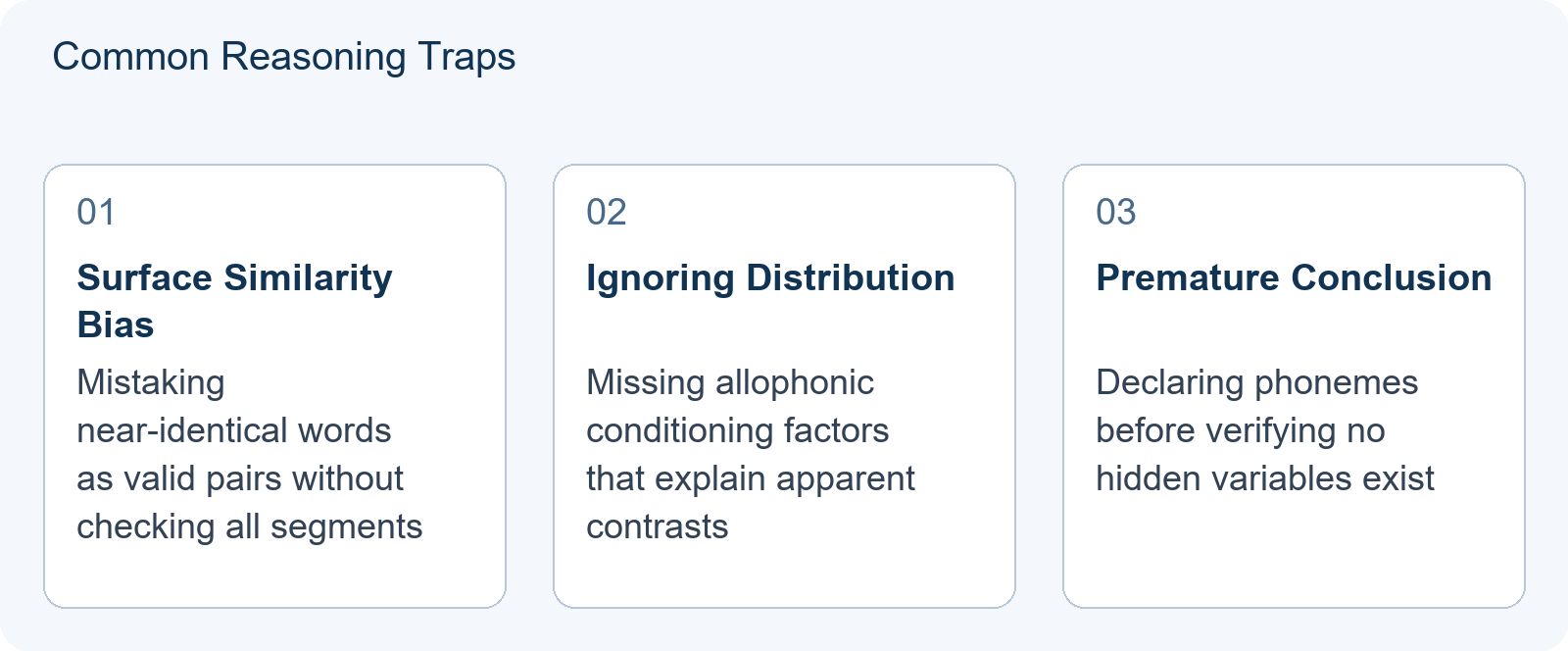
The primary pitfall is assuming a contrast exists without isolating the variable. In real competition problems, you might see two words that seem similar but differ in multiple places—vowel quality, consonant voicing, stress pattern, or syllable structure. If you jump to conclusions based on surface similarity, you may misidentify phonemic boundaries. The skill lies in systematically controlling variables: find pairs where every element except one is constant. Only then can you attribute meaning change to that single differing segment. This principle mirrors experimental design in the sciences, where confounding variables must be eliminated before drawing causal conclusions. In linguistics olympiad contexts, your experimental control comes from careful selection of comparison forms.
Teaching Illustration 1: Successful Isolation
Imagine a dataset from an invented language with these forms:
[taka]= ‘stone’[daka]= ‘water’[tapa]= ‘tree’[dapa]= ‘fire’
To determine if /t/ and /d/ are separate phonemes, we compare [taka] and [daka]. All segments except the initial consonant are identical (/a/, /k/, /a/). The meaning changes from ‘stone’ to ‘water’. Thus, /t/ and /d/ form a minimal pair and are distinct phonemes. Similarly, comparing [taka] and [tapa] shows /k/ and /p/ are also distinct. This clean isolation allows confident rule-building. Notice that we could not validly compare [taka] with [dapa] to establish anything, since two segments differ; any conclusion would be confounded. The discipline of finding true minimal pairs—rather than merely similar words—separates reliable analysis from hopeful guessing.
Teaching Illustration 2: When Apparent Minimal Pairs Mislead
Now consider another set where initial inspection seems promising:
[sina]= ‘bird’[zina]= ‘fish’[sinu]= ‘sky’[zinu]= ‘cloud’
A student might quickly conclude /s/ and /z/ are phonemes because [sina] and [zina] differ only in the initial consonant. However, suppose additional data reveals that vowel nasality is not consistently transcribed in the dataset:
[sina]= ‘bird’ (occurring before oral vowels /i/)[zĩna]= ‘fish’ (occurring before nasalized vowels /ĩ/)[sinu]= ‘sky’ (before oral /u/)[zĩnu]= ‘cloud’ (before nasalized /ũ/)
Here, [sina] and [zĩna] differ in two respects simultaneously: the initial consonant and the nasality of the first vowel. This is not a true minimal pair because two variables change at once. The student who stopped at surface similarity failed to control for the second variable. The correct approach requires finding a frame where only one element varies—such as comparing [sina] with a hypothetical [sĩna] (same initial /s/, different vowel nasality) to test vowel nasality independently, or [sina] with [zina] where both vowels are oral to test the s/z contrast cleanly. Without such controlled comparisons, any conclusion about phonemic status rests on unstable foundations.
Diagnostic Table: Common Errors and Corrective Strategies
| Error Type | Description | Corrective Strategy |
|---|---|---|
| Multi-variable change | Comparing words differing in more than one segment | Find true minimal pairs; use substitution tests |
| Context blindness | Ignoring positional constraints (e.g., word-final vs. word-initial) | Check distribution across all positions |
| Overgeneralization | Assuming allophonic variation is phonemic | Look for complementary distribution patterns |
Targeted Practice Sequence
To build this skill, follow this progression:


- Start simple: Use English examples like pat/bat, tip/dip to internalize the concept of single-segment difference.
- Add complexity: Introduce stress or tone differences alongside segmental ones, checking that only one property varies per comparison.
- Simulate competition conditions: Work through phonology sections from past papers, applying the strict minimal pair criterion to every proposed contrast.
- Cross-reference with systematic reading: Review How to Read Linguistics Olympiad Data: IPA, Diacritics and the Pinyin Trap (2026) to ensure accurate transcription underlies your analysis.
Connecting to Broader Analysis Skills
Minimal pair identification feeds directly into harder competition tasks. When you encounter situations where When Two Analyses Both Fit the Data: How to Choose, Test and Hedge at a Linguistics Olympiad (2026), your ability to rigorously test phonemic hypotheses through controlled comparison becomes essential for choosing between alternatives. Similarly, students balancing Linguistics Olympiad Alongside IB, A-Level or AP (2026-27): A Transfer Map for International-School Students can apply this variable-control discipline across analytical subjects, strengthening their overall problem-solving methodology.
What You Should Be Able to Demonstrate Next
After practicing, you should confidently identify whether any two given words constitute a valid minimal pair under strict criteria: identical environment except for one segment, with meaning change attributable solely to that segment. More importantly, you will recognize when insufficient data prevents definitive conclusions—such as when apparent contrasts involve multiple simultaneous differences—and know how to design the missing comparison. This precision in variable control supports reliable phonological analysis in competition settings and builds transferable analytical habits for complex problem-solving beyond linguistics.
Frequently Asked Questions
Do minimal pairs always prove two sounds are different phonemes?
Only if they occur in identical environments and show consistent meaning change. If sounds appear in complementary distribution elsewhere, they may still be allophones of a single phoneme.
How do I handle cases where no clear minimal pair exists?
Use substitution tests or examine broader paradigms. Sometimes indirect evidence from morphological alternations helps establish phonemic status when direct minimal pairs are absent.
Are minimal pairs relevant beyond phonology problems?
Yes—they help clarify distinctions in morphology too, such as identifying bound versus free morphemes through controlled comparison of related word forms.
Keep reading.
IOLC Consonant Digraphs: Why bh, mb and ng Stay Single Units in Rongga-Style Data
In the 2026 IOLC Newcomer/Junior Division Rongga problem note, bh, mb and ng are recorded as consonants. Learn a data-first method for…
IOLC Team Average: How Each Participating Member Changes the Score
Understand how the IOLC team average is calculated from the individual scores of actual participating members, how adding or removing a member…
IOLC 2027 Level Test: Run a 3-Hour, 4-Problem Mock Before March 7
Prepare for the IOLC 2027 Level Test (March 7) by simulating the latest source-backed 2026 regional format: three hours, four independent puzzles….