
When you encounter a Linguistics Olympiad problem involving sound changes, the temptation is often to spot a single pattern and immediately apply it as a universal rule. However, successful competitors know that a proposed rule is only valid if it holds true across every matching environment in the provided dataset—or if the exceptions themselves reveal a deeper generalization. This article explores the critical skill of testing phonological rules against all possible contexts, with the essential caveats that not all sound changes are conditioned by environment, and that the data you are given may underdetermine the correct analysis.
The Core Principle: Contextual Validity and Its Limits
In linguistics, sounds often change because of their surrounding context: a vowel might nasalize before a nasal consonant, or a stop might lenite between vowels. But not all changes are conditioned this way. Some sound changes are unconditional—they apply everywhere a sound appears, regardless of environment. Others are conditioned by specific contexts such as adjacency, syllable position, stress, or morphological boundaries. A third possibility is that multiple rules interact, with rule ordering or morphological exceptions producing apparent irregularities.
The primary challenge in IOL problems is not just identifying a change, but determining whether it is conditioned at all, and if so, defining the precise environment. If you propose a rule like “vowels become nasalized,” you must check if this happens everywhere (unconditional), only in specific positions (conditioned), or not at all (your initial generalization was wrong). Testing a rule across every matching environment means systematically verifying that no counter-examples exist—or if they do, that they point to a more nuanced analysis involving rule ordering, morphological domains, or lexical exceptions.
This principle becomes especially important given the IOL’s competition format. At the IOL international level, contestants face five problems over six hours, with problems drawn from languages that most students have never encountered—including endangered and understudied languages where the data may be sparse or subtly conditioned. Practise checking the full dataset rather than relying on a familiar-looking pattern.
Identifying Conditioning Environments
To test a rule effectively, you first need to categorize the environments present in the data. Common conditioning factors include:
- Adjacency: What sounds precede or follow the target segment?
- Syllable Position: Is the segment in an onset, nucleus, or coda?
- Stress: Does the change occur only in stressed or unstressed syllables?
- Morphological Boundary: Does the change happen at word edges or between morphemes?
For example, if you observe that /t/ becomes [d] in certain words, you must check if this happens after vowels, after nasals, or only in stressed syllables. By listing all instances where the change occurs and all instances where it does not, you can isolate whether the change is conditioned at all. If /t/ becomes [d] in every single environment, the change is unconditional. If it only happens in some environments, you must find what those environments share. If the pattern seems conditioned but has exceptions, consider whether rule ordering (applying one rule before another) or morphological structure might explain the outliers.
Teaching Illustration: Nasalization Patterns (Constructed Data)
Consider a constructed dataset from a hypothetical language. We distinguish underlying forms (the abstract representation, written between slashes) from realized forms (the actual pronunciation, written in square brackets):
| Underlying | Realized | Gloss |
|---|---|---|
| /ata/ | [a.ta] | water |
| /ana/ | [ã.na] | fire |
| /aka/ | [a.ka] | stone |
| /ama/ | [ã.ma] | earth |
| /apa/ | [a.pa] | wind |
| /ina/ | [ĩ.na] | fish |
| /uni/ | [u.ni] | tree |
| /anu/ | [ã.nu] | river |
Step 1: Check all vowels, including those following nasals. The vowels [a], [i], [u] appear in multiple positions. We must examine each one:
- Initial /a/ → [ã] before /n/ and /m/; [a] elsewhere (before /t/, /k/, /p/). In /anu/ → [ã.nu], the /u/ after /n/ remains oral.
- Initial /i/ → [ĩ] before /n/; no other initial /i/ environment is attested. In /ina/ → [ĩ.na], the /a/ after /n/ remains oral.
- Initial /u/ → [u] before /n/ in /uni/; /u/ does not nasalize. No initial /u/ before /m/ is attested.
- Vowels after nasals: in /ana/ → [ã.na], /ama/ → [ã.ma], /ina/ → [ĩ.na], and /anu/ → [ã.nu], the second vowel remains oral regardless of quality.
Step 2: Reject the overgeneral rule. A rule nasalizing every vowel before /m/ or /n/ predicts a nasalized /u/ in /uni/, contrary to [u.ni]. The attested nasalized vowels are initial /a/ and /i/ before a nasal; the final vowels after nasals stay oral. Any proposed rule must respect both the observed changes and the observed non-changes.
Step 3: Account for the exception or accept underdetermination. The /uni/ → [u.ni] form shows that not all vowels before /n/ nasalize. The data underdetermine what the correct condition is, because multiple hypotheses fit:
- (a) /a/ and /i/ nasalize before /m, n/ (an arbitrary class, unless a natural feature unites them),
- (b) all vowels except /u/ nasalize before /m, n/ (a broader vowel-class hypothesis), or
- (c) a word-specific rule accounts for the observed forms; this is less general and needs additional data before adoption.
Option (a) cannot be “non-high vowels” because /i/ is high yet nasalizes. The data do not support a single natural-class feature.
Additional data would be needed to distinguish these analyses. This is underdetermination: multiple hypotheses fit the same dataset. A complete answer would note this uncertainty and state what test would distinguish the options.
Step 4: Explicit hypothetical with unseen /ŋ/. Suppose we encountered a new form /aŋa/ with velar nasal /ŋ/. Our local rule for /m, n/ does not predict the outcome. Three explicit possibilities exist:
- If /aŋa/ → [ã.ŋa], initial /a/ also nasalizes before /ŋ/ in this form; this alone does not establish the behaviour of every vowel before every nasal.
- If /aŋa/ → [a.ŋa], extending the initial-/a/ pattern to /ŋ/ fails for this form; further data would test whether that restriction is general.
- If /aŋa/ → [ã.ŋa] but /uŋu/ → [u.ŋu], the pattern parallels /a/ vs. /u/ before /n/ and /m/—but /i/ before /ŋ/ would still need testing to determine whether the conditioning is based on vowel quality, place of articulation of the nasal, or an arbitrary lexical class.
We do not force /ŋ/ to fit by adding an ad hoc exception. We explicitly mark it as untested and note what would confirm or falsify each hypothesis.


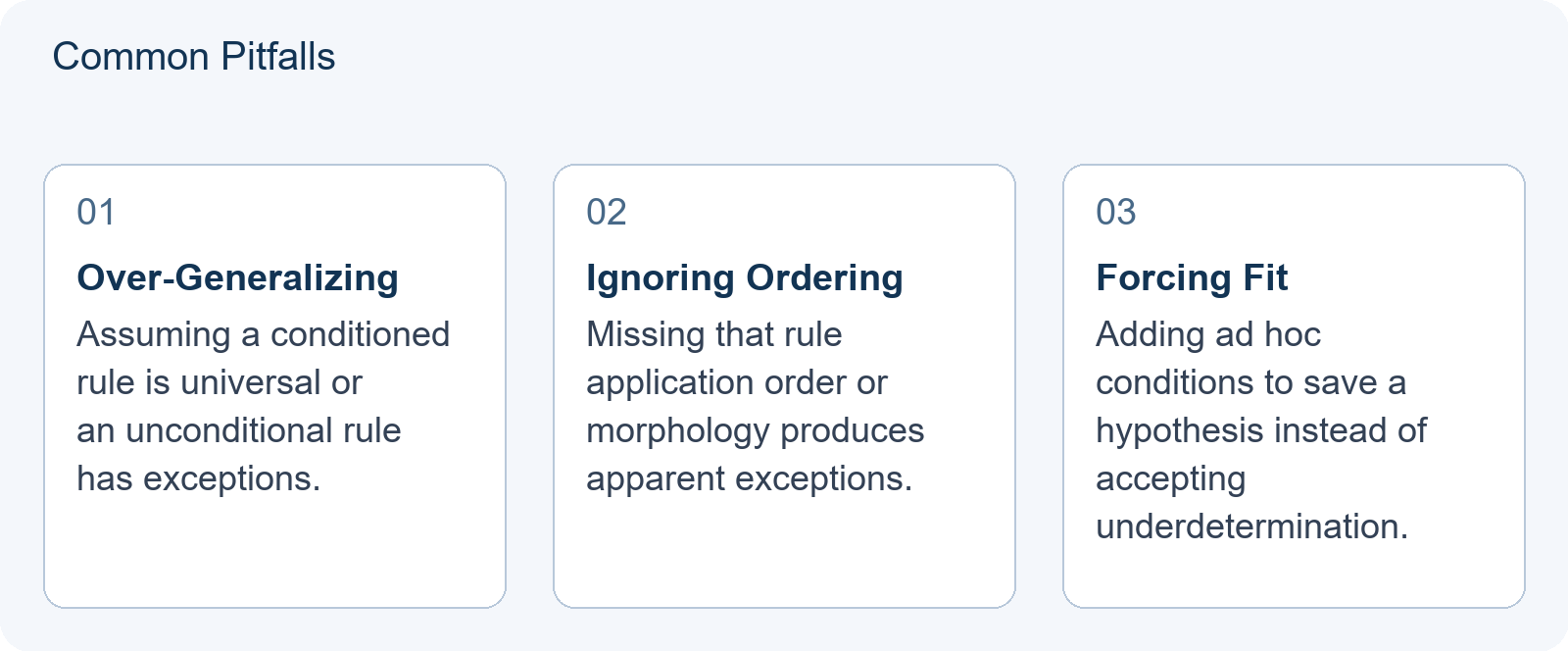
Contrasting Case: The Trap of Over-Generalization
A common failure mode is assuming a rule applies globally when it is actually restricted—or assuming it is conditioned when it is unconditional. Imagine a dataset where /k/ becomes [x] (a voiceless velar fricative) in some words but remains [k] in others:
| Underlying | Realized |
|---|---|
| /kala/ | [xa.la] |
| /kiki/ | [ki.ki] |
| /koko/ | [xo.ko] |
| /keke/ | [ke.ke] |
If an alternative dataset has /kala/ → [xa.la] but /kaka/ → [ka.ka], identical word-initial /ka/ environments yield different outputs. Following vowel and word position alone cannot explain that contrast. Stress, morphology or lexical differences would be hypotheses to investigate, not facts to invent. State the limitation and request contrasting data that could distinguish those explanations.
Systematic Verification Strategy
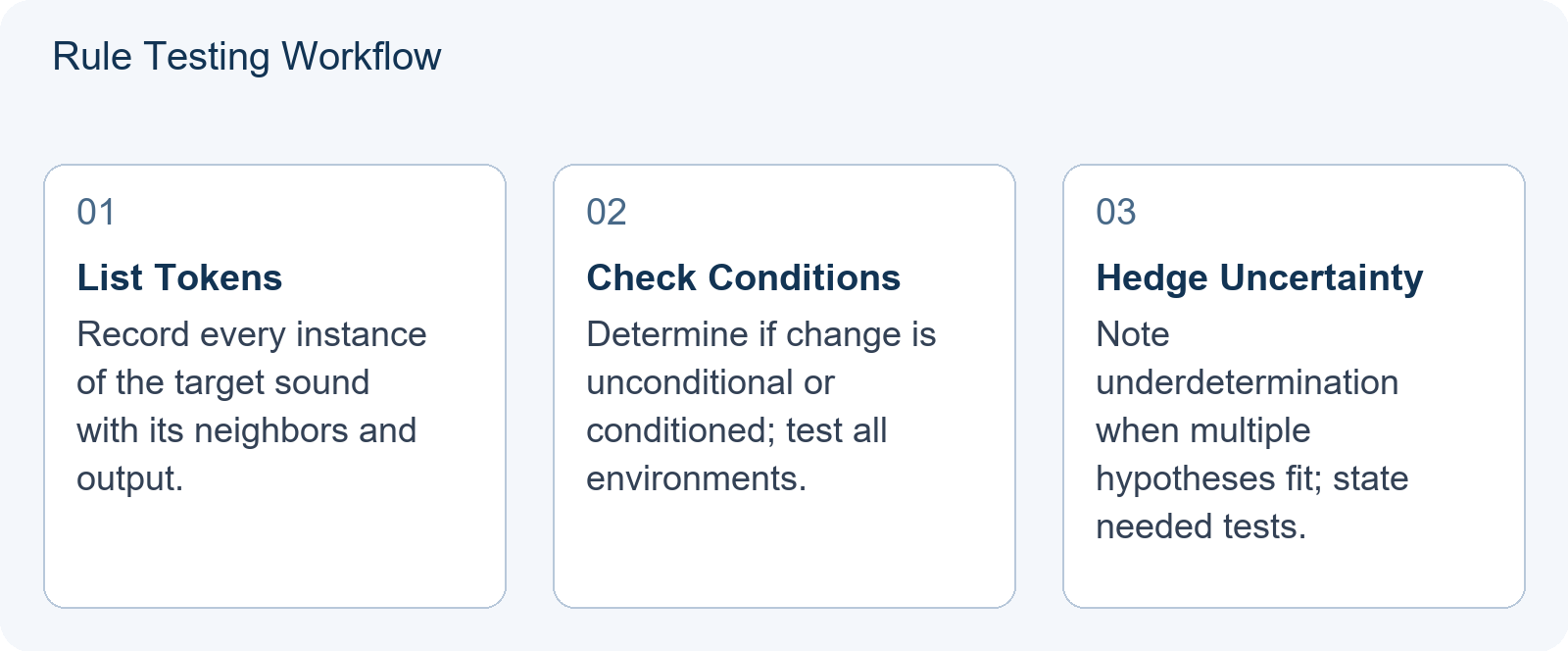
To ensure your rule is as complete as the data allow, follow this diagnostic process:
- List all instances of the target sound in the data, creating a table with the sound’s position, neighbors, and any output alternations.
- Categorize each instance by its left and right neighbors, stress, and syllable position. Determine whether the change is unconditional (applies everywhere) or conditioned (applies only in specific environments).
- Formulate the most specific hypothesis the data support. State whether the change is phonologically conditioned, morphologically conditioned, or unconditional.
- Search for counter-examples where the hypothesis predicts a change but none occurs, or vice versa. If you find one, consider whether rule ordering, morphological structure, or an exception class explains it—or whether your hypothesis is wrong.
- Explicitly note underdetermination if multiple hypotheses fit. State what additional data would distinguish them, rather than pretending certainty where none exists.
This method prevents premature conclusions and ensures that your solution accounts for all linguistic nuances presented in the problem. It also protects against the common error of proposing a universal phonetic rule when only a local, language-specific pattern is justified.
Implications for Competition Performance
IOL judges reward solutions that accurately capture the generalization present in the data, with appropriate hedging when the data are ambiguous. A solution that identifies the main trend but misses a conditioning environment is stronger than one that asserts an unconditional rule where exceptions exist. Conversely, proposing an unconditional change where the data show clear conditions also weakens your analysis. The most competitive answers explicitly test environments, note any uncertainty, and explain what would confirm or refute each hypothesis.
Systematic verification remains a genuine competitive advantage in competition conditions, where problems are drawn from languages that most students have never encountered and may involve sparse or subtly conditioned data.
Next Steps for Preparation
If you find yourself struggling to identify conditioning environments, practice with past papers focusing specifically on phonology sections. Look for patterns in how sounds interact with neighboring segments, but also watch for cases where a sound changes everywhere it appears—indicating an unconditional rule. Additionally, consider reviewing resources that explain basic phonetic features, such as place and manner of articulation, to better understand why certain changes occur.
For guidance on selecting the appropriate competition level, see our article on IOLC Junior or Senior? Choosing the Right 2027 Entry Level on the China Route. To develop complementary skills in handling incomplete datasets, explore Linguistics Olympiad Underdetermined Data: Knowing What Your Solution Has Not Proved. And for a broader perspective on whether linguistics competitions align with your academic goals, read Is Linguistics Actually Your Olympiad? An Honest Way to Choose Where to Spend Your Training Years.
Frequently Asked Questions
What if my rule has one exception?
First, check whether the exception is truly an exception or whether your conditioning environment was wrong. If the data genuinely show one form that violates an otherwise robust pattern, consider whether a morphological boundary, rule ordering, or lexical specification explains it. If no explanation is available, your analysis may be underdetermined: multiple rules might fit, and you should state what additional data would decide. Never force an exception to fit by adding an arbitrary condition without independent motivation.
Do I need to know IPA symbols perfectly?
While helpful, IOL problems usually provide enough context to deduce patterns without deep IPA knowledge. Focus on relationships between sounds—whether two segments share place, manner, or voicing—rather than memorizing charts. The competition tests reasoning about patterns, not transcription speed. Understanding the difference between underlying /slashes/ and realized [brackets] is more important than knowing every symbol.
How do I know when my rule is specific enough?
Your rule is specific enough when it generates all and only the forms in the dataset, or when you have explicitly noted where the data underdetermine the analysis. Test this by applying your rule to every underlying form; if it produces unattested outputs or fails to produce attested ones, refine or hedge. The goal is not uniqueness—multiple analyses may fit—but explicit coverage of all data with clear statement of what remains untested.
Keep reading.
IOLC Consonant Digraphs: Why bh, mb and ng Stay Single Units in Rongga-Style Data
In the 2026 IOLC Newcomer/Junior Division Rongga problem note, bh, mb and ng are recorded as consonants. Learn a data-first method for…
IOLC Team Average: How Each Participating Member Changes the Score
Understand how the IOLC team average is calculated from the individual scores of actual participating members, how adding or removing a member…
IOLC 2027 Level Test: Run a 3-Hour, 4-Problem Mock Before March 7
Prepare for the IOLC 2027 Level Test (March 7) by simulating the latest source-backed 2026 regional format: three hours, four independent puzzles….