
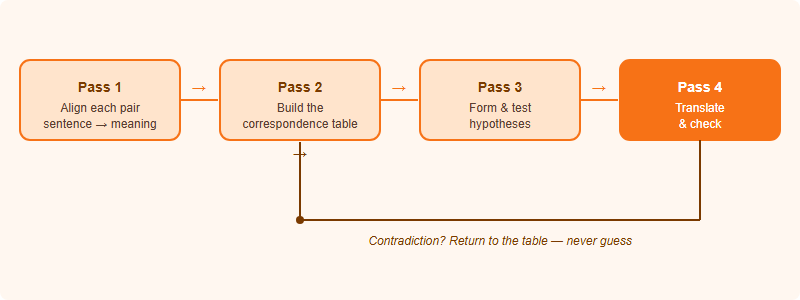
To solve a Rosetta-Stone (translation) problem at the International Linguistics Olympiad, work in four passes: align each foreign sentence with its English translation, build a word-and-morpheme correspondence table, form hypotheses about word order and grammar, then translate the test items and check every form against your table. You are decoding a system from evidence — no prior knowledge of the language is needed. The IOL individual round (ioling.org) gives five problems in six hours, so a repeatable method matters.
What a Rosetta-Stone problem actually is
The “Rosetta Stone” paradigm is the most common shape of an IOL translation problem. You are handed a small set of sentences in an unfamiliar, usually low-resource language, each paired with its English translation. The pairings may be given in order or scrambled. Your job is to reverse-engineer enough of the grammar and vocabulary to translate new sentences in both directions. The name is an analogy to the real Rosetta Stone, where the same text in three scripts let scholars crack Egyptian hieroglyphs — the data carries the key, you supply the reasoning.
This matters because the skill being tested is controlled inference under uncertainty, not language fluency. Per the official problems archive at ioling.org, every problem is built so that the data alone is sufficient — there is exactly one self-consistent solution. If you have read our explainer on what the International Linguistics Olympiad is, you already know the IOL bans outside knowledge: a contestant who happens to speak a related language gets no advantage, because the answer must be derivable from the table in front of you.
Translation problems are one family among several. To set expectations, here is how Rosetta-Stone translation work compares to the other problem types you will meet across the IOL and its national feeders.
| Problem type | What you are given | Core skill | Typical first move |
|---|---|---|---|
| Rosetta-Stone (translation) | Foreign sentences + English translations | Segment words/morphemes, infer grammar & word order | Align pairs, isolate shared words |
| Writing system / script | Unfamiliar script + transliterations | Map symbols to sounds or meanings | Count symbols vs. sounds |
| Phonology | Words with sound alternations or rules | State the rule for how sounds change | Compare minimal pairs |
| Number / counting systems | Number words + values | Find the base and arithmetic structure | Look for the base (often 10, 20) |
| Semantics / kinship / calendar | Terms + a relational system | Map relationships onto a structure | Draw a grid or family tree |
The four-pass method
Here is the loop we drill in our weekly cohort sessions. It is deliberately mechanical at the start — under exam pressure, a fixed routine stops you from staring at the data hoping for inspiration. The diagram below shows the full flow, including the back-arrow that most beginners skip: when a test item fails, you do not guess, you return to your table.


A worked mini-example (original, not an official problem)
The example below uses an invented language we will call “Tolu”. It is deliberately tiny and made up for teaching — it is not a real IOL past problem, and you should never train only on toy data. (For real, official material, browse the problem archive on ioling.org.) But the reasoning is exactly what scales to the genuine article.
Given data (Tolu → English):
- 1. kano lupi → the child sleeps
- 2. kano lupi-ta → the children sleep
- 3. mira kano boni → the child sees the dog
- 4. mira kano-ta boni → the children see the dog
- 5. mira boni kano → the dog sees the child
Pass 1 — align. Lay each Tolu sentence beside its meaning and circle words that recur. kano appears whenever “child/children” appears; boni tracks “dog”; mira appears only in sentences that contain “sees/see”; lupi only with “sleep(s)”. The suffix -ta shows up exactly when the noun is plural.
Pass 2 — build the correspondence table. Convert those observations into a table. Keep separate columns for the bare form and any affixes, because affixes are where most of the marks live.
| Tolu | Meaning | Category / note |
|---|---|---|
| kano | child | noun |
| boni | dog | noun |
| lupi | sleep | verb (intransitive) |
| mira | see | verb (transitive) |
| -ta | plural | suffix on the noun |
| (no word) | “the” | no article in Tolu |
Pass 3 — form and test hypotheses about structure. Now infer word order. Sentence 1 (kano lupi = “the child sleeps”) suggests Subject–Verb. Sentence 3 (mira kano boni = “the child sees the dog”) shows the verb first, then two nouns. Compare it with sentence 5 (mira boni kano = “the dog sees the child”): the verb is fixed at the front, and swapping the two nouns swaps who does what. So the order is Verb–Subject–Object, and role is marked purely by position, not by any case ending. Hypothesis: mira [SUBJECT] [OBJECT]. Note also from sentence 4 that the plural -ta attaches to whichever noun is plural, regardless of its position. Test this against every given sentence — it holds for all five.
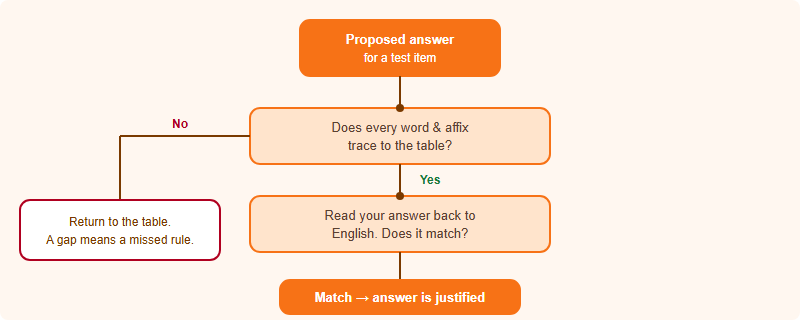
Pass 4 — translate the test items and check. Suppose the task asks you to render “The dogs see the children” into Tolu. Apply the rules: verb first (mira), then subject “the dogs” = boni-ta, then object “the children” = kano-ta. Answer: mira boni-ta kano-ta. Then reverse-check: read your own answer back to English using only the table — “see / dogs / children” in V-S-O = “the dogs see the children.” It matches, so the form is internally consistent. That reverse read-back is the single highest-value habit in the whole method, and the step beginners most often skip.
The decision diagram below captures what to do at the moment of choice in Pass 4 — the difference between a defensible answer and a lucky one.
Common traps — and what to do instead
In our cohort, the same handful of mistakes cost the most marks. Knowing them in advance is worth as much as any single technique.
- Assuming English word order. Many languages are not Subject–Verb–Object. Test order explicitly with a pair of sentences that differ only in who acts on whom (as Tolu sentences 3 vs. 5 do). Never import English grammar.
- Treating a word as one unit when it is two morphemes. If a “word” is longer when the meaning has more parts (plural, tense, possession), split it. Maintain a separate affix column from the very first pass.
- Stopping at the first hypothesis that fits one sentence. A rule must be consistent with every data line. One counter-example kills it — go back and revise, do not patch with exceptions.
- Skipping the reverse read-back. Translating into the language and never reading it back is how avoidable errors survive to the answer sheet.
- Spending unequal time across five problems. The individual round is five problems in six hours (ioling.org). Budget roughly an hour each, then bank leftover time for the hardest — do not sink three hours into one.
Translation problems are also the most “transferable” type: the table-then-hypothesis habit carries straight into script, phonology, and morphology problems. That is why we sequence them early in our 12-week study plan. The fastest way to internalise the loop is to run it on real past problems — and the cleanest on-ramp is your national olympiad. See our guide to the NACLO, UKLO and OzCLO calendars to find the next contest you can actually sit.
How translation problems fit the wider IOL
A little context helps you calibrate. The IOL has run annually since its first edition in Borovets, Bulgaria in 2003, which drew six countries. By the 22nd IOL in Taipei (2025) it had grown to 227 contestants on 57 teams from 42 countries and territories — figures published by ioling.org. The 23rd IOL is scheduled for Bucharest, Romania, from 26 July to 2 August 2026; always confirm current dates on the official site before you plan travel or registration.
There are two rounds. The individual contest is five problems in six hours, spanning phonology, morphology, syntax, semantics and more — translation problems appear here every year. Since the second IOL, the team contest has been a single, extremely hard problem solved by a team of four. Mastering the Rosetta-Stone method first gives you a foothold in both formats, because the underlying move — decode a system from its own evidence — never changes.
Frequently asked questions
Do I need to know the language in a translation problem?
No. IOL problems are self-contained: the data alone determines the answer. Outside knowledge gives no advantage, so beginners and native speakers start equal.
What is the single most important step?
Building an accurate correspondence table, then reading your final answer back into English to confirm every word and affix traces to that table.
How long should one problem take?
The IOL individual round is five problems in six hours, so roughly an hour each, banking spare time for the hardest. Confirm current rules on ioling.org.
Where can I find real Rosetta-Stone problems to practise?
The official archive at ioling.org has problems by year, sample puzzles, and solution slides. National contests (NACLO, UKLO, OzCLO) publish past papers too.
This is an independent community guide operated by Hanlin Education for China-based international-school students. It is not affiliated with, endorsed by, or sponsored by the IOL Board or the International Linguistics Olympiad. The “Tolu” example is invented for teaching and is not a real past problem. Always confirm current dates, rules and problem archives on the official site, ioling.org. We correct confirmed errors within 7 working days.
Next steps
- IOL competition format & medals — how the Olympiad is scored.
- Join the IOL Club WeChat cohort — weekly problem walkthroughs.
Keep reading.
From Three Hours to Six: What Actually Changes Between a National Round Paper and an IOL Paper
A national open round gives you roughly 25 minutes a problem; the IOL gives you over an hour. Four things that change…
How to Mark Your Own Linguistics Olympiad Practice Paper When There Is No Solution Sheet
Worked solutions do not exist for every past paper. A five-band self-marking rubric, the regeneration test, and the four ways students quietly…
The Deadline Before the Deadline: Planning a 2026-27 Linguistics Olympiad Autumn Backwards From the Sitting
Registration for the coming cycle is reported to close earlier than usual. An autumn planned backwards from the sitting, with compression options…