
Sign-language problems hand you data from a signed language — descriptions or drawings of signs paired with their meanings — and ask you to work out the system, then produce new signs or glosses. You do not need to know any signed language. Every one is built from a small set of physical parameters, and once you learn to read those parameters, these problems become as solvable as any spoken-language puzzle. Here is the method, step by step.
Why sign-language problems feel harder than they are
Most students who train for the International Linguistics Olympiad drill translation, phonology and morphology problems until the moves feel automatic. Then a signed-language problem appears and the familiar toolkit seems useless: there is no alphabet to align, no word order to spot, sometimes just a grid of stick-figure drawings or feature descriptions. Panic is common. It is also unnecessary.
The truth is that signed languages are full natural languages with their own grammar, and olympiad problems built on them reward exactly the same skill as every other problem: reading a system out of data using logic alone. Problems drawn from signed languages appear across the olympiad world, so it is worth being ready for one — confirm the scope and format of any particular contest on ioling.org. If you are still getting your bearings on how the competition works, start with our primer on what the IOL is and then come back here.
The key mental shift is this: a sign is not a single indivisible symbol. It is several physical choices made at the same time. Change one of those choices and you usually get a different word. That simultaneity is the whole game.
The five building blocks of any sign
Linguists describe signs using a handful of parameters. You do not need the technical labels to win, but knowing them turns a wall of drawings into a set of columns you can analyse.
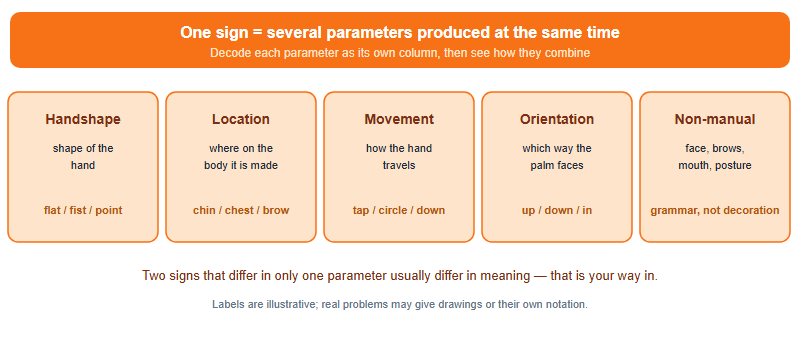
In plain terms, the five building blocks are:
- Handshape — the configuration of the fingers and palm (a flat hand, a fist, an extended index finger).
- Location — where on or near the body the sign is made (the chin, the chest, the forehead, or neutral space in front of the signer).
- Movement — how the hand travels (a short tap, a circle, a downward path, an outward push).
- Orientation — which way the palm and fingers point (up, down, toward the signer, away).
- Non-manual markers — the face, eyebrows, mouth shape, head tilt and posture, which frequently carry grammar such as questions, negation or topic.
When a problem gives you five signs, do not read them as five words. Read them as five rows in a spreadsheet whose columns are these parameters. Your job is to discover what each column encodes.


A four-step decoding method (with a worked mini-example)
The routine below mirrors the way you already attack a translation problem: build an inventory, hunt for minimal pairs, isolate what each variable does, then test. To keep the logic visible, here is a deliberately simplified, entirely invented mini-system — real signed languages are far richer, and olympiad problems use genuine data, but a toy system shows the moves cleanly.
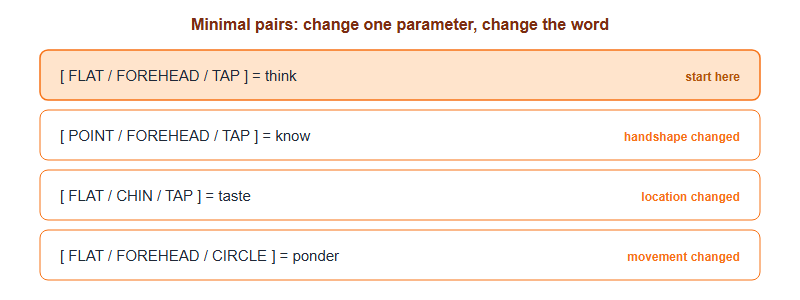
| # | Sign [ Handshape / Location / Movement ] | Meaning | What it tells you |
|---|---|---|---|
| 1 | [ FLAT / FOREHEAD / TAP ] | think | baseline reference sign |
| 2 | [ POINT / FOREHEAD / TAP ] | know | handshape alone carries meaning |
| 3 | [ FLAT / FOREHEAD / CIRCLE ] | ponder | movement alone carries meaning |
| 4 | [ FLAT / CHIN / TAP ] | taste | location alone carries meaning |
| 5 | [ POINT / CHIN / CIRCLE ] | ? (your prediction) | parameters combine compositionally |
Step 1 — Inventory the parameters. List every value that appears in each column. Handshapes here: FLAT, POINT. Locations: FOREHEAD, CHIN. Movements: TAP, CIRCLE. A tidy inventory instantly shows you how few moving parts there really are.
Step 2 — Find minimal pairs. A minimal pair is two signs that differ in exactly one parameter. Signs 1 and 2 differ only in handshape (FLAT vs POINT) and mean think vs know — so handshape is meaningful. Signs 1 and 3 differ only in movement and mean think vs ponder. Signs 1 and 4 differ only in location and mean think vs taste. Three clean minimal pairs, three proofs.
Step 3 — Isolate what each column encodes. Now read the pattern semantically. FOREHEAD signs are about the mind; the CHIN sign is about the mouth. FLAT looks like a broad, perceptual act; POINT looks specific and direct. TAP is a single act; CIRCLE suggests something ongoing. You are not guessing wildly — you are letting the data narrow the possibilities.
Step 4 — Build a rule and test it. Combine your findings to predict sign 5: POINT (specific) + CHIN (mouth) + CIRCLE (ongoing) should mean something like keep eating or chatter — a specific, mouth-based, ongoing action. If the problem's answer key confirms it, your analysis holds. If not, a counterexample forces you to revise, which is exactly how the best solvers work.
Traps that catch even strong solvers
Sign problems have their own failure modes. Watch for these:
- Reading iconicity too literally. Some signs look like what they mean, but you cannot assume a sign near the mouth must mean eating. Let the minimal pairs decide, not your intuition about pictures.
- Missing simultaneity. In a spoken language, sounds come one after another. In a sign, several parameters happen at once. If you analyse only movement and ignore handshape, you will lose half the information.
- Overlooking non-manual grammar. A raised eyebrow or a head tilt can turn a statement into a question or mark negation. If the problem describes facial features, they are almost never decoration — treat them as a real column.
- Ignoring classifiers and compounds. Signed languages build complex meanings by combining elements. If a sign seems to fuse two ideas, check whether it is a compound of simpler signs you have already decoded.
- Forgetting the two hands can differ. One hand may hold a base while the other moves. Track them separately when the data distinguishes them.
None of these require prior knowledge of any signed language. They require the discipline to treat every described feature as potential data — the same discipline the marking scheme rewards, which you can read more about on ioling.org.
How to practise a genre you can't drill every day
Because sign problems are rarer than translation problems, you cannot grind hundreds of them. Instead, build the underlying skill so you are ready when one appears:
- Practise parameter-thinking on everyday gestures. Pick any gesture and describe it in the five columns. It trains you to break a whole into simultaneous parts fast.
- Reuse the minimal-pair habit everywhere. The minimal-pair move is the same skill that cracks phonology and morphology problems, so every hour on those problems also strengthens sign work.
- Study any sign problems in the archives carefully. When you meet a genuine one, work it cold, then read the official solution and name every reasoning step. Our 12-week study plan shows how to structure that loop, and the past-problems pack points you to archived material.
Ready for a signed-language problem, you gain a quiet advantage: while other strong contestants freeze at the unfamiliar format, you calmly open your spreadsheet of columns and start finding minimal pairs. That composure, more than any single trick, is what separates finishers from panickers.
Quick answers
Do I need to know a signed language to solve these problems?
No. Everything you need is in the data. The problems reward logical analysis of parameters, not fluency in any sign language.
What are the parts of a sign I should analyse?
Handshape, location, movement, orientation and non-manual markers such as facial expression. Treat each as a separate column of evidence.
Are the examples here real olympiad problems?
No. They are original, simplified illustrations. For genuine problems and official solutions, see ioling.org and our past-problems pack.
How common are sign-language problems at the IOL?
They appear from time to time across the olympiad world; frequency varies by year, so confirm any specific contest's content on ioling.org.
This is an independent guide operated by Hanlin Education for China-based international-school students. It is not affiliated with, endorsed by, or sponsored by the IOL Board. Competition details change from year to year, so always confirm current facts on ioling.org. Spotted an error? We correct verified mistakes within 7 working days.
Keep reading.
From Three Hours to Six: What Actually Changes Between a National Round Paper and an IOL Paper
A national open round gives you roughly 25 minutes a problem; the IOL gives you over an hour. Four things that change…
How to Mark Your Own Linguistics Olympiad Practice Paper When There Is No Solution Sheet
Worked solutions do not exist for every past paper. A five-band self-marking rubric, the regeneration test, and the four ways students quietly…
The Deadline Before the Deadline: Planning a 2026-27 Linguistics Olympiad Autumn Backwards From the Sitting
Registration for the coming cycle is reported to close earlier than usual. An autumn planned backwards from the sitting, with compression options…