
A linguistics olympiad hands out two kinds of recognition. Score tiers — merit, distinction, medals — reward how much you got right. A Best Solution award rewards how you got there: an answer somebody thought was worth singling out. They are not the same ladder, and training for one is not automatically training for the other. This article separates them.
Two ladders, not one
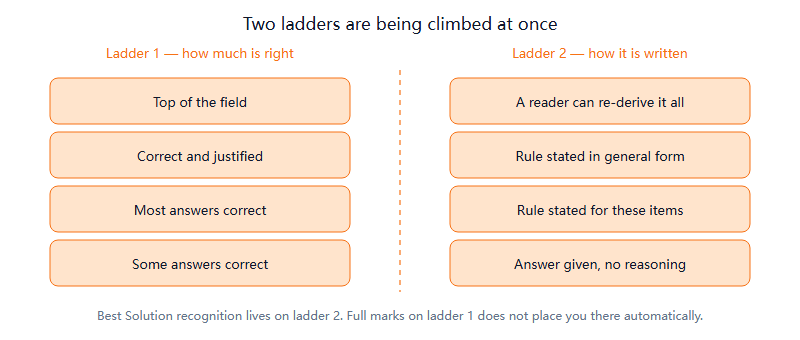
Almost every student assumes the awards list is a single ranking with prizes bolted on at intervals. It is closer to two independent measurements taken from the same script.
The first is quantity of correct output: how many of the required translations, forms and answers you produced, plus the credit your justifications earned along the way. That is the ladder that produces merit, distinction and medal tiers, and it is broadly cumulative — more right answers move you up.
The second is quality of exposition: whether your write-up states the system in a way another person can pick up and re-derive every answer from. This is the ladder a Best Solution award sits on, and it is not cumulative at all. You can be at the very top of ladder one and nowhere on ladder two, because the two are optimised by different behaviour under time pressure. Students who understand this early stop treating the write-up as an administrative chore.
What the IOL itself publishes
It is worth knowing exactly what the international body puts on the public record, because students routinely mix up three different things.
- A Best Solutions list. ioling.org maintains a Best Solutions page, organised by year and then by problem number (the individual contest, per the official FAQ, contains “precisely five problems”). Multiple contestants from different countries can appear against the same problem. Read that structure carefully: recognition is attached to a solution to one problem, not to an overall placing.
- A Hall of Fame. Also on the results section of ioling.org.
- A Solvers’ Choice Award. This one is not a contestant prize at all. The problems section of ioling.org describes it as going “to the authors of the most popular problem, determined by a survey of that year’s contestants.” If you see it in a results write-up, it is about who wrote the problem, not who solved it.
What ioling.org does not publish on those pages is a stated set of criteria for how a Best Solution is chosen. We are not going to invent one. If you want the definitive process, ask the organiser or confirm on ioling.org. What we can do is describe, from coaching experience, the features that reliably separate the write-ups that get singled out from the ones that merely score well — which is the practical question anyway.
Two other verified pieces of context matter here. The individual contest normally runs six hours across those five problems, and contestants qualify through a national contest run by an accredited national organisation — the FAQ is explicit that students cannot participate at the IOL unless they have qualified through an accredited national contest. So for almost every reader of this site, the award ladder that will actually apply to you first is a national one.
The national-round ladder, and one cohort’s shape
National rounds vary: some use named tiers, others award gold, silver and bronze. In the China round the tiers our students have been recorded against are High Distinction, Distinction and Merit, alongside separate Best Solution awards — and there is a novice division as well as the main field. The official definitions, cut-offs and division rules belong to the organiser; do not assume a threshold, and confirm the current structure through official channels before planning around it.
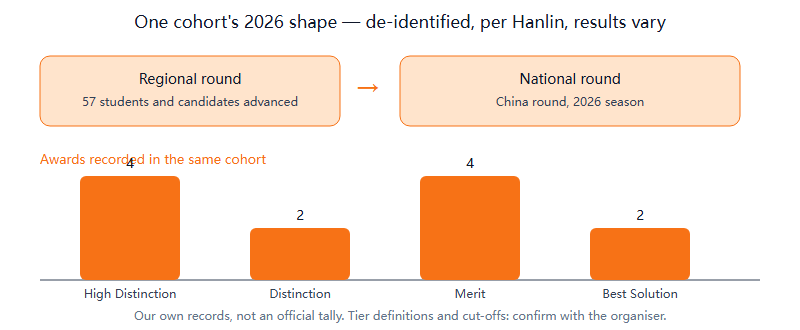
What we can share is the shape of one cohort’s season, de-identified. Per Hanlin’s own records for 2026, and with the standard caveat that individual results vary and past outcomes do not predict anyone’s:
| Stage | Recorded in our 2026 cohort | What it tells you |
|---|---|---|
| Regional round | 57 students and candidates advanced to the national round | The regional stage is a genuine filter, but a wide one — advancing is a realistic target for a prepared first-year solver |
| National round — High Distinction | 4, one of them a novice-division student who also took a top-12 individual placing | The top tier is small in absolute terms even from a large advancing group |
| National round — Distinction | 2 | Tier sizes are not smoothly graded; do not read the pyramid as evenly stepped |
| National round — Merit | 4 | A meaningful result, and the most common first-season outcome we see |
| Best Solution awards | 2 | Awarded alongside, not instead of, a score tier — and earlier years in our records also produced them |
Two honest readings of that table. First, the gap between “advanced to the national round” and “took a top tier” is large, which is the normal shape of any olympiad and not a sign that something went wrong for the many students who advanced without a listed award. Second, Best Solution awards are rare in absolute numbers but not rare in the sense of being unreachable — they are handed out per problem, so a student who writes one outstanding solution to one problem is in contention regardless of how the other four went.


What separates a full-marks answer from a best-written one
The following are our coaching judgements, not published criteria. But they describe consistently what a solution looks like when a marker stops and reads it twice.
- The rule is stated in general form, not item by item. “Item 4 adds -ta because it ends in a vowel” is a note. “Nouns ending in a vowel take -ta; nouns ending in a consonant take -a” is a rule. The second one predicts items the problem never showed you.
- Interactions are made explicit. When two processes both apply, saying which one runs first — and showing an item where the order is visible — is the single most distinguishing move in a write-up.
- The exception is handled, not hidden. Strong solutions name the item that resists the analysis and say something precise about it, even if that is “this form is irregular under my analysis; it would follow the rule if the stem were X”. Weak solutions quietly omit it and hope.
- Notation is economical and consistent. One symbol per idea, defined once, used the same way throughout. Inventing a new abbreviation halfway through costs a reader more than it saves you.
- Nothing requires the reader to guess your intention. Every answer in the answer section should be traceable to a stated rule. If a marker has to reconstruct why you wrote a particular form, you are relying on their generosity.
| Same content, two write-ups | Scores well | Reads like a best solution |
|---|---|---|
| Statement of rule | “The plural adds -ken.” | “Plural = stem + -ken; if the stem ends in n, the suffix surfaces as -en.” |
| Ordering | Not mentioned | “Suffixation applies first, then final-vowel deletion — visible in item 6, which would otherwise be *pota-ken.” |
| Exception | Silently skipped | “Item 9 is the only counterexample; it behaves as if its stem were consonant-final.” |
| Evidence | “See the data.” | “Compare items 2 and 5, which differ only in the final segment of the stem.” |
| Answer section | Bare forms listed | Bare forms listed, each with the rule number that produced it |
A worked contrast (illustrative)
Invented data, not a past problem. A language we will call Ruven forms plurals as follows: mota “hill” → motken “hills”; lasi “knife” → lasken “knives”; doran “river” → doranen “rivers”; kesun “path” → kesunen “paths”.
Write-up A. “Plural is formed with -ken, but after n it is -en. The final vowel drops.”
Write-up B. “The plural suffix is -ken. Two processes apply, in this order: (1) suffixation; (2) deletion of a stem-final vowel before the suffix. Stems ending in n take -en instead, and having no final vowel they are unaffected by rule 2. Evidence for the ordering: mota + -ken would give *motaken if deletion did not apply after suffixation; the attested motken shows it does. Predictions: a stem peru would give perken; a stem tolan would give tolanen.”
Both write-ups contain the same insight and would likely earn the same answer marks. B does three extra things: it names the processes separately, it points at the item that proves the ordering, and it makes falsifiable predictions about forms the problem never gave. That is the difference in kind, and it costs perhaps ninety extra seconds of writing. For the wider frame on how the contest is put together, our companion piece on how the contest is structured gives the wider frame.
How to train for it without chasing it
A blunt warning first: elegant prose about a wrong rule earns nothing. Correctness is the entry ticket, and any student who starts polishing before they have a working analysis has misunderstood the incentive. With that said, three habits move you onto the second ladder at almost no cost.
- Write the rule before the answers. Force yourself to state the generalisation in one sentence, then fill in the answer section from it. If you cannot fill the answers from your own sentence, the sentence is not yet a rule.
- Do a swap-and-derive drill. Hand your write-up to someone who has not seen the problem and ask them to produce the answers from your text alone. Every question they ask is a mark a marker had to award you charitably.
- Keep a “one extra sentence” rule. After every solution, add exactly one sentence: either the ordering evidence, the exception, or a prediction. One sentence per problem, five problems, six hours — the budget is trivial and the effect on readability is not.
Run these against real material rather than in the abstract. ioling.org publishes problem sets by year and, separately, an archive of solution presentation slides, and our past problems practice pack is organised so you can compare your write-up with a worked solution where we have one. Fit the drills into the review blocks of the twelve-week study plan rather than adding a new session — this is a refinement of existing practice, not extra work.
Frequently asked questions
Is a Best Solution award given for the whole contest or for one problem?
The IOL’s published Best Solutions list is organised by year and then by problem number, so recognition attaches to a solution to a single problem. Confirm details on ioling.org.
Are the criteria for a Best Solution published anywhere?
Not on the public Best Solutions page. Anything you read describing exact criteria — including this article’s markers — is interpretation, so treat the organiser as the authority.
Is the Solvers’ Choice Award a student prize?
No. ioling.org describes it as going to the authors of the most popular problem, decided by a survey of that year’s contestants.
Can I reach the IOL without winning a national round first?
No. The IOL FAQ states that students cannot participate unless they have qualified through an accredited national contest.
IOL Club is an independent guide operated by Hanlin Education for China-based international-school students. We are NOT affiliated with, endorsed by, or sponsored by the IOL Board. Award structures, tier names and cut-offs differ by contest and change over time: confirm current details on ioling.org and with your national organiser. Cohort figures are our own de-identified records, results vary, and no outcome is predicted or guaranteed. Errors reported to our editorial desk are corrected within 7 working days.
Keep reading.
From Three Hours to Six: What Actually Changes Between a National Round Paper and an IOL Paper
A national open round gives you roughly 25 minutes a problem; the IOL gives you over an hour. Four things that change…
How to Mark Your Own Linguistics Olympiad Practice Paper When There Is No Solution Sheet
Worked solutions do not exist for every past paper. A five-band self-marking rubric, the regeneration test, and the four ways students quietly…
The Deadline Before the Deadline: Planning a 2026-27 Linguistics Olympiad Autumn Backwards From the Sitting
Registration for the coming cycle is reported to close earlier than usual. An autumn planned backwards from the sitting, with compression options…