
The 2026 International Linguistics Olympiad concluded in Bucharest on 2 August 2026 with 255 contestants from 65 teams representing 46 countries and territories, and ioling.org now lists Bangkok, Thailand as the host of the 24th IOL. Exact 2027 dates are not yet published. That gap between “host announced” and “dates announced” is exactly where most students plan badly.
What ioling.org has actually confirmed about IOL 2027
Right now there are two categories of information, and confusing them is the single most common planning error we see in August. One category is published on the official site and you can build a year around it. The other is not published yet, and any specific number you find for it online is somebody’s guess.
Here is the honest status board as of this article. Treat the right-hand column as your instruction set.
| Item | Status | What you should do about it now |
|---|---|---|
| Host city, IOL 2027 | Published — Bangkok, Thailand | Nothing. It does not change your training. See below. |
| Edition number | Published — 24th IOL | Useful only for citing correctly in writing. |
| Exact contest dates | Not yet published | Do not book anything. Do not build a countdown. Check ioling.org. |
| Venue, daily schedule, excursions | Not yet published | Irrelevant to preparation. Ignore until released. |
| Your national contest dates | Set nationally, not by IOL | This is the date that actually governs your year. Find your organiser. |
| How your national team is selected | Set nationally, varies | Ask your national organiser directly. Do not assume another country's rules. |
The official site describes the IOL as an annual competition traditionally held between late July and mid-August. That is a description of past practice, not a confirmed 2027 date, and you should not treat it as one. It is useful for one thing only: knowing roughly which end of the year your summer will be busy, so you do not sign up for something that eats all of July before you know better.
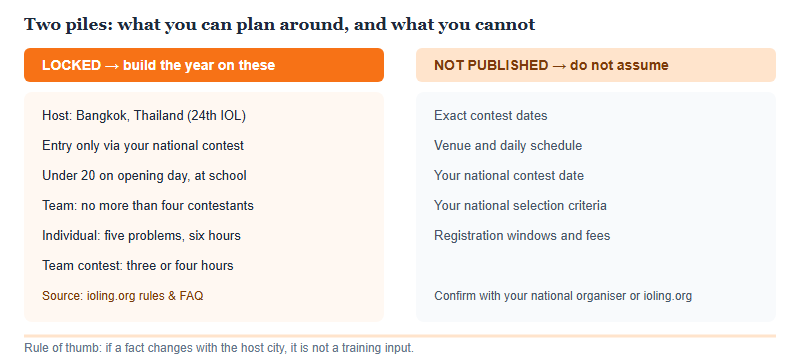
The parts of the IOL that do not change when the host city changes
Here is the useful insight that makes the announcement of Bangkok almost irrelevant to your training plan: nothing about how you prepare depends on the host city. The structural rules published by the organisers are stable, and they are the things worth memorising in August.
| Published rule | What it means for your plan |
|---|---|
| “You can only participate in the IOL by qualifying through your national contest.” Students cannot participate on their own — no exceptions. | Your first task this month is identifying which national contest you are eligible for, not drilling problems. No route, no Bangkok. |
| Contestants must be under 20 on the opening day of the IOL and must attend, or have only just finished attending, secondary school. | If you finish school in 2027, check carefully whether you still fall inside this. Ask your national organiser, not a forum. |
| Teams consist of no more than four contestants, accompanied by a team leader; each accredited country is entitled to send one team on the host's terms. | Seats per country are genuinely few. Plan for the national contest as the real event, not as a formality. |
| The individual contest is five problems in six hours. | Roughly 72 minutes per problem including write-up. Your practice sessions should eventually run at that length. |
| The team contest allows three or four hours at the Problem Committee's discretion, with the team working jointly on a single problem set. | Never rehearsed by most students. Worth one practice session per term, not per week. |
| Contestants receive problems in a language of their choice and write solutions in the same language; you need to know the language your national contest is in. | Check which language your national round runs in before you build an English-only vocabulary of technical terms. |
| Calculators, calendars, phones and any device with web access are prohibited. | Train on paper. If you have only ever practised with a laptop, you have never really practised. |
If you are new to all of this, start with our overview of what the International Linguistics Olympiad actually is before you touch a calendar. Plans built on a misunderstanding of the entry route are the ones that collapse in February.


Why you plan backwards from your national contest, not from Bangkok
Students consistently plan toward the international dates. That is the wrong anchor, and the rules explain why: the IOL is not something you enter, it is something you are sent to. The event you can actually enter is your national contest, and that date is set nationally — it is not on ioling.org, it does not move with the host city, and it is typically many months before the international week.
So the planning order inverts. Your real sequence is: find the route → meet the registration window → perform in the national contest → be selected → travel. Only the last step involves Bangkok, and by then the outcome is already decided. Every month you spend waiting for 2027 dates to be published is a month taken from the only stage you control.
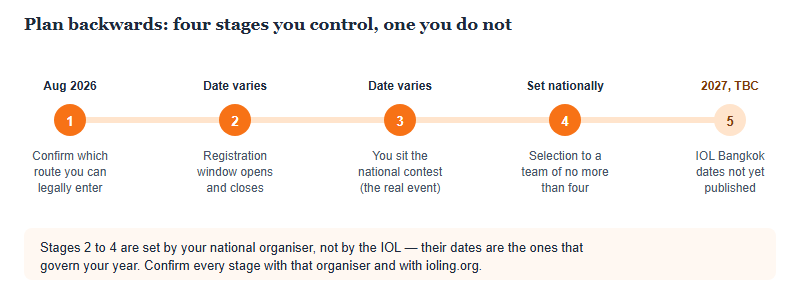
What August is actually for
August is not a training month. It is an administrative month, and treating it as one is the highest-leverage thing you can do this week. Two questions need answers before any study plan is worth writing.
Question one: which national contest can you legally enter? This is genuinely non-obvious for students at international schools in China, because eligibility usually depends on some combination of citizenship, country of residence and where you are enrolled — and it differs by contest. The official position is unambiguous: qualification runs through a national contest, students cannot participate on their own, and where no national contest exists and no serious effort is being made to start one, participation is not possible. Read the country list on ioling.org and then write to the organiser named there. An email in August beats a guess in January.
Two details are worth knowing before you send that email. First, the rules note that non-accredited delegations may be allowed to participate as guests for a limited time, at the discretion of the International Board in consultation with the local organisers, and for no more than two consecutive years — so “there is no contest here” is not automatically the end of the conversation, though it is not a route you can arrange by yourself either. Second, the FAQ states that you need to know the language your national contest is administered in, and at the international contest problems are provided in a language of your choice with solutions written in that same language. If you are at an English-medium school in China, do not assume the round you enter will run in English. Ask.
Four questions are usually enough for a first email: which contest am I eligible to enter given my citizenship, residence and school; when does registration open and close; in what language is the contest administered; and how is the national team selected afterwards. Short, specific and answerable — organisers are volunteers, and a focused email gets a reply.
Question two: what is your honest baseline? Not “have I read about linguistics olympiads” but “can I finish one problem, cold, on paper, with a written justification, inside 72 minutes?” Most students have never tested this. Do it once this month using our free past-problems practice pack and record the result. A baseline taken in August is what makes the difference between a plan and a wish.
Once those two answers exist, a structured block of preparation becomes worth starting — our twelve-week study plan is designed to be dropped in ahead of a national contest date rather than run continuously all year.
Three planning mistakes we see every August
- Planning around the international dates. Students build countdowns to a week they cannot enter directly, while the registration deadline they can enter passes unnoticed. If you only diarise one date this year, diarise your national contest's registration close.
- Assuming last year's rules carry over. Host country, local organiser and national selection procedures all change. The structural rules above have been stable, but the operational ones are re-published each cycle. Confirm rather than assume — and never import a rule from a different competition because it “usually works that way.”
- Starting the hardest training first. A student who has not yet confirmed eligibility but has already done thirty problems has optimised the wrong variable. Sequence: route, baseline, then volume.
There is one more thing worth saying plainly. With one team of no more than four contestants per accredited country, the number of international seats is small in every country — that is a published rule, not pessimism. The right way to read it is not “so why bother,” but “so the national contest is the competition.” Doing well nationally is a real, defensible achievement in its own right, and it is the outcome most of a year's training is genuinely aimed at.
Frequently asked questions
Where will IOL 2027 be held?
ioling.org lists Bangkok, Thailand as host of the 24th International Linguistics Olympiad. Exact dates were not published at the time of writing.
Can I register for the IOL myself?
No. The official FAQ states you can only participate by qualifying through your national contest, and that students cannot participate on their own — no exceptions.
How old can I be?
Contestants must be under 20 on the opening day of the IOL and must attend, or have only just finished attending, secondary school. Confirm the current wording on ioling.org.
Should I wait for the 2027 dates before starting?
No. The date that governs your year is your national contest date, set by your national organiser. Confirm your route first, then plan.
This is an independent guide operated by Hanlin Education for China-based international-school students. We are not affiliated with, endorsed by, or sponsored by the IOL Board, and this page is not an official source. Rules, dates, host arrangements and eligibility are set by the organisers and change between editions — confirm current details on ioling.org and with your national organiser before acting on anything here. Factual errors reported to our editorial desk are corrected within 7 working days.
Keep reading.
From Three Hours to Six: What Actually Changes Between a National Round Paper and an IOL Paper
A national open round gives you roughly 25 minutes a problem; the IOL gives you over an hour. Four things that change…
How to Mark Your Own Linguistics Olympiad Practice Paper When There Is No Solution Sheet
Worked solutions do not exist for every past paper. A five-band self-marking rubric, the regeneration test, and the four ways students quietly…
The Deadline Before the Deadline: Planning a 2026-27 Linguistics Olympiad Autumn Backwards From the Sitting
Registration for the coming cycle is reported to close earlier than usual. An autumn planned backwards from the sitting, with compression options…