
A linguistics olympiad problem rehearses roughly one corner of the subject: analysing structure in unfamiliar data. A linguistics degree contains that, plus experimental work, statistics, fieldwork, meaning, language change and computation. Some students find the rest even better than the puzzles. Others discover the puzzles were the only part they wanted — which is worth knowing before you apply, not after.
What the olympiad is a sample of — and what it is not
The competition gives you a very particular experience: a closed data set, a guarantee that a coherent system is recoverable, and a few hours to find it. That is a real and honest sample of one style of linguistic work — the analytical, puzzle-like core of morphology, phonology and syntax. If you enjoyed that, you enjoyed something the subject genuinely contains.
But three features of the competition do not survive into the discipline, and they are exactly the features that make it fun:
- The data is guaranteed sufficient. Real language data is messy, contradictory, and frequently not enough. A large part of research is deciding what additional data you need and how to get it.
- There is a correct answer. In the subject, competing analyses of the same facts coexist for decades. Learning to argue for one rather than find one is a different skill, and it is the one most first-year students find hardest.
- It is entirely armchair work. Much of linguistics is empirical: recordings, experiments, corpora, participants, statistics. People who wanted a pure puzzle sometimes find this a disappointment; people who wanted to study actual humans find it the point.
If you are still deciding whether the competition itself suits you, that is a different question and our overview of the IOL is the better starting point. This piece is for the student who already likes the problems and is now wondering what the subject behind them looks like.
The subfields, and how much the olympiad actually prepares you
Departments organise themselves differently, but the core divisions are broadly stable. Here is what each one studies and — honestly — how much transfer you get from competition training.
| Subfield | What it studies | Olympiad transfer |
|---|---|---|
| Phonetics | The physical speech signal: articulation, acoustics, perception | Low. Lab-based and measurement-heavy. The IPA familiarity helps; nothing else does. |
| Phonology | Sound systems and the rules governing them | High. Closest to competition problems, including the analytical style. |
| Morphology | Word structure, paradigms, alternations | High. Segmentation and paradigm reasoning transfer almost directly. |
| Syntax | Sentence structure and the theories accounting for it | Medium. The reasoning carries; the heavy theoretical apparatus is new. |
| Semantics & pragmatics | Meaning, reference, inference, context | Medium-low. Often uses formal logic. Surprises many entrants. |
| Historical linguistics | How languages change and how relatedness is reconstructed | Medium. Reconstruction is genuinely puzzle-like and often a favourite. |
| Sociolinguistics | Variation across communities, contact, multilingualism | Low. Empirical and statistical; a different intellectual temperament. |
| Psycho- / neurolinguistics | How language is processed and acquired in the mind and brain | Low. Experimental design and statistics dominate. |
| Computational linguistics / NLP | Modelling language computationally | Medium. The analytical habit helps; programming and maths are the real entry cost. |
The pattern is worth noticing. Competition training maps strongly onto two or three subfields and weakly onto the rest. That is not a warning — it is simply the shape of the thing. Most students who enjoy the olympiad also enjoy historical reconstruction and at least one empirical area once they meet it. But a student who enjoys only the puzzle aspect should know in advance that puzzles are perhaps a third of a typical degree.
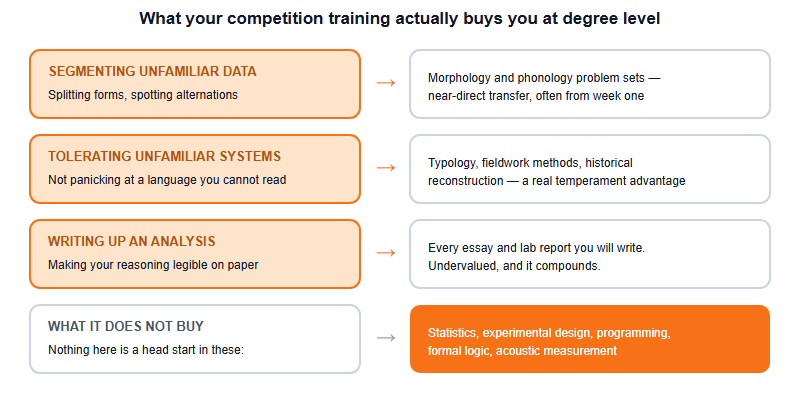


What a first year tends to contain
Structures differ substantially between institutions and countries, so treat this as a shape rather than a syllabus, and read the actual module list of any course you are considering. That said, a first year commonly includes an introductory survey across the subfields, a phonetics component with practical transcription, an early formal-analysis course in phonology or morphology, and — the part that catches people out — some quantitative methods.
The statistics component deserves a flag. Linguistics is an empirical science in most departments, and that means research methods, experimental design, and data analysis. Students who chose the subject as an escape from mathematics are regularly caught off guard. If you are strong at the olympiad, you almost certainly have the reasoning ability for this; the issue is expectation, not capacity.
The other common surprise is the volume of writing. In many departments a substantial share of the assessed work is essays arguing for a position against competing literature rather than formal analysis alone — check the assessment breakdown on any course page you are considering. This is why the writing habit you build in competition preparation — stating a system clearly enough that a reader can follow it — is a genuine long-term asset. If you have not been practising that, our twelve-week study plan builds it in alongside the solving.
Three routes students actually take
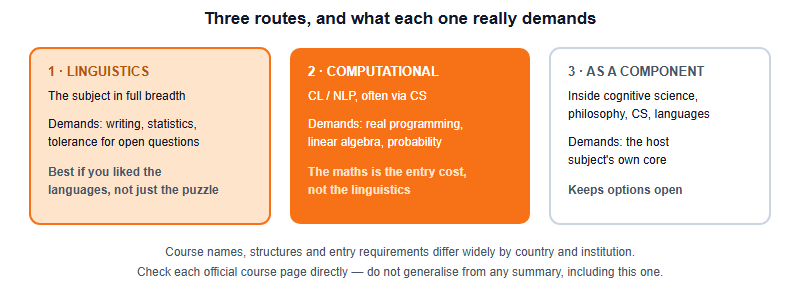
A note on route two, since it is where most of our students’ interest concentrates. Computational linguistics and NLP are not “linguistics with some coding attached”. At degree level they are mathematically serious — probability, linear algebra, optimisation — and the linguistics content is often lighter than students expect. Enjoying decipherment problems is a genuine signal of aptitude for the reasoning, but it says nothing about whether you will enjoy the mathematics, and the mathematics is what determines whether the route is comfortable. Find out now, while you can still change your maths courses.
Who should probably not choose this
Honesty is more useful than encouragement here, and none of the following is a judgement about ability:
- If you loved the puzzle and are indifferent to language itself. Consider mathematics, computer science or philosophy, where puzzle-like reasoning is the whole subject rather than a third of it. Plenty of former olympiad participants take exactly this route and are happier for it.
- If you want to become fluent in many languages. That is language learning, and a linguistics degree is not it. You will analyse dozens of languages and speak none of them any better.
- If you need a defined professional pipeline. Linguistics graduates go into a wide range of fields, but the route is not prescribed the way medicine or engineering is. Some people find that liberating and some find it stressful; know which you are.
- If you are choosing it as an admissions tactic. Choose a subject you want to spend three or four years inside. We will not advise on how any choice affects an admissions outcome, and anyone who tells you a subject choice guarantees anything is not being straight with you.
And the converse, which is genuinely common: students who came for the puzzles and stayed for something they had never heard of — a fieldwork course, a language-change module, a sign-language linguistics option. The subject is wider than its competition, which is precisely the argument for looking at it properly before deciding.
Frequently asked questions
Does the olympiad prepare me for a linguistics degree?
Partly. It transfers strongly to phonology and morphology, weakly to phonetics, sociolinguistics and psycholinguistics, which are empirical and statistical.
Will I learn to speak many languages?
No. A linguistics degree analyses languages rather than teaching fluency in them. Language learning is a separate pursuit.
Is computational linguistics the easy maths option?
No. At degree level it typically demands probability, linear algebra and real programming. The mathematics, not the linguistics, is the entry cost.
How do I check what a specific course contains?
Read that institution’s own module list and entry requirements. Structures vary widely by country and department; never generalise from a summary.
IOL Club is an independent guide operated by Hanlin Education for China-based international-school students. We are not affiliated with, endorsed by, or sponsored by the IOL Board, nor with any university named or implied here. Degree structures, module lists and entry requirements vary by institution and change yearly — verify everything against the official course page, and confirm current competition details on ioling.org. We make no claims about admissions outcomes. Errors reported to our editorial desk are corrected within 7 working days.
Keep reading.
From Three Hours to Six: What Actually Changes Between a National Round Paper and an IOL Paper
A national open round gives you roughly 25 minutes a problem; the IOL gives you over an hour. Four things that change…
How to Mark Your Own Linguistics Olympiad Practice Paper When There Is No Solution Sheet
Worked solutions do not exist for every past paper. A five-band self-marking rubric, the regeneration test, and the four ways students quietly…
The Deadline Before the Deadline: Planning a 2026-27 Linguistics Olympiad Autumn Backwards From the Sitting
Registration for the coming cycle is reported to close earlier than usual. An autumn planned backwards from the sitting, with compression options…