
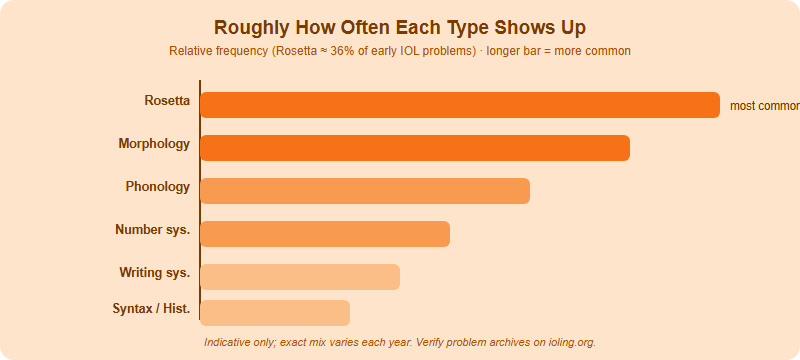
IOL problems fall into a handful of recurring types: Rosetta-style translation (the most common, about 36% of early IOL problems), phonology (sound patterns), morphology (how words are built), number and writing systems, and syntax/semantics. Every problem is self-contained — you need no prior knowledge of the language, only analytical reasoning. Learning to recognise the type fast is the single biggest speed gain on contest day.
The International Linguistics Olympiad (IOL) gives you five problems and six hours in the individual contest, so triage matters. If you can glance at a problem and think “this is a number system” or “this is a Rosetta translation,” you immediately know which moves to try first. Below is a working coach’s taxonomy of the main types, what each tests, and the concrete cues that give it away. For the bigger picture of the competition itself, start with our What Is the International Linguistics Olympiad primer; this article zooms into the puzzles. The 23rd IOL runs in Bucharest, Romania, from 26 July to 2 August 2026 (confirm current details on ioling.org).
The big picture: how IOL problems are built
Before the types, understand the shared DNA. The IOL’s own problem-setting principles require that each problem be self-sufficient — it must contain all information needed to solve it, expecting no knowledge beyond a normal secondary-school curriculum — and unambiguous, allowing only one plausible explanation of the data. That is why a Quechua or Inuktitut problem is fair even if you have never heard the language: the answer is recoverable purely by pattern analysis.
A single IOL problem can draw on several subfields at once — phonology, morphology, syntax, semantics, sociolinguistics, historical and comparative linguistics, writing systems, and more. So treat the “types” below as dominant flavours, not airtight boxes. A translation problem often hides a morphology engine; a number-system problem is really arithmetic encoded in morphology. Recognising the primary flavour just tells you where to push first.
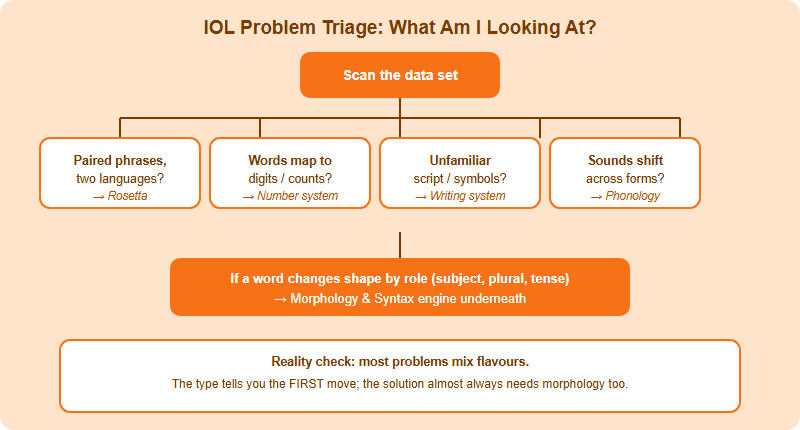
Type 1 — Rosetta-style translation (the backbone)
The “Rosetta Stone” problem is the IOL’s signature format and its most common. In academic analysis of the first ten IOLs, Rosetta-style problems accounted for 27 of 50 problems (36%) — by far the largest single share. The setup is simple to recognise: you get ordered, matching expressions in two languages (or a language and a symbolic system), some translations are given, and you must work out the rest in both directions.
What it tests: your ability to align units across languages, isolate which chunk carries which meaning, and build a mini-grammar from a handful of examples. The trap is word order — the target language rarely lines up one-to-one with English. How to recognise it: two parallel columns of phrases, a “translate these” task at the end, and no special script. First move: find a sentence pair that differs by exactly one element and diff them — that isolates a single morpheme or word. Repeat until the lattice is solved. Many of IOL’s named samples (Tupí and Guaraní, Aragonese, Persian) are Rosetta problems at heart.


Type 2 — Phonology, morphology, number and writing systems
These four are the specialist flavours that sit on top of the Rosetta backbone. Knowing their tells saves you from solving a sound-change problem as if it were pure vocabulary.
| Type | What it tests | Recognition cue | First move |
|---|---|---|---|
| Phonology | Sound patterns — how pronunciation shifts across words, forms or dialects | The “same” word appears with small consistent sound changes (p→b, k→g, vowel harmony) | List the alternations; ask what environment triggers each change |
| Morphology | How words are built from smaller parts (roots + affixes) | One root reappears with stacked prefixes/suffixes encoding tense, number, possession | Segment each word; tabulate which slice carries which meaning |
| Number systems | How a culture encodes counting (base, additive/multiplicative structure) | Words pair with quantities; longer words = bigger numbers; recurring sub-words | Find the base (look for where structure resets — often 5, 10, or 20) |
| Writing systems | How an unfamiliar script maps symbols to sounds or meaning | Non-Latin glyphs, braille dots, or syllabic blocks with a transliteration key | Match symbols to known sounds first; decide if it is alphabet, syllabary or abugida |
Phonology problems usually live inside a Rosetta frame: the alternations are the real puzzle. The classic move is to write every variant of a morpheme side by side and hunt for the conditioning environment — what sound comes before or after.
Morphology is the engine room of the IOL. Agglutinative languages (think Inuktitut, Turkish, Quechua, Guaraní) stack many meaningful pieces into one long word, so your job is clean segmentation. IOL’s hard samples like Guaraní Verbs and Manam are morphology-heavy.
Number systems are arithmetic dressed as language. IOL’s sample set includes Inuktitut Numbers and Basque Numbers; the skill is spotting the base and whether numbers are built by addition (“ten-and-two”) or multiplication (“two-twenties”). Writing systems problems — IOL lists Japanese Braille as a sample — give you an alien script plus a key; your task is to reverse-engineer the symbol-to-sound logic, then transliterate new items.
Type 3 — Syntax, semantics and the rarer flavours
Syntax problems foreground sentence structure: word order, agreement, case marking, how clauses nest. The cue is that the arrangement of words — not the words themselves — changes meaning. Semantics problems probe meaning relations: kinship systems (who counts as “uncle”?), spatial or colour terms, or invented “logical” languages. IOL’s samples Icelandic Kinship, Basque Kinship, Molistic and Toki Pona live here.
You will also meet historical/comparative problems (reconstruct an ancestor language or sound-change rules from related languages) and sociolinguistic or pragmatic twists. These are less frequent than Rosetta and morphology, but they reward students who have practised across the full range rather than drilling one type. Build that range deliberately with our 12-week IOL study plan, which rotates problem types week by week so no flavour catches you cold.
How problem types map to the contest format
Knowing types pays off because of how the IOL is structured. The individual contest has five problems to solve in six hours — that is roughly 70 minutes each, but strong solvers bank time on the type they read fastest and spend it on the hardest one. The team contest, since the second IOL, is a single, extremely difficult and time-consuming problem given to teams (generally four students) over three to four hours — almost always a deep morphology or translation challenge that rewards dividing the data and cross-checking.
Practical takeaway for your prep: do timed mixed sets, not single-type drills, so your eye learns to classify under pressure. Then layer national-round practice on top — the calendars for NACLO, UKLO and OzCLO are in our national olympiad calendar guide, and those rounds are the best supply of fresh, type-varied problems before the international stage. The IOL’s own past problems and samples remain the gold standard for honest practice.
Frequently asked questions
What is the most common IOL problem type?
Rosetta-style translation. In analysis of the first ten IOLs it was 27 of 50 problems (about 36%) — the single largest category, so it is worth mastering first.
Do I need to know the languages used?
No. Every IOL problem is self-contained: all information needed is in the problem itself, and no knowledge beyond a normal school curriculum is assumed.
How many problems are in the individual contest?
Five problems in six hours. The team contest is one very hard problem solved by a team (usually four) over three to four hours.
When and where is IOL 2026?
The 23rd IOL is in Bucharest, Romania, from 26 July to 2 August 2026. Always confirm current dates on ioling.org.
This is an independent IOL community guide operated by Hanlin Education for China-based international-school students. It is not affiliated with, endorsed by, or sponsored by the IOL Board. Problem-type descriptions are an editorial synthesis for learning purposes and do not reproduce any copyrighted problem text; always confirm current rules, dates and problem archives on the official site, ioling.org. Spotted an error? We correct confirmed mistakes within 7 working days.
Keep reading.
From Three Hours to Six: What Actually Changes Between a National Round Paper and an IOL Paper
A national open round gives you roughly 25 minutes a problem; the IOL gives you over an hour. Four things that change…
How to Mark Your Own Linguistics Olympiad Practice Paper When There Is No Solution Sheet
Worked solutions do not exist for every past paper. A five-band self-marking rubric, the regeneration test, and the four ways students quietly…
The Deadline Before the Deadline: Planning a 2026-27 Linguistics Olympiad Autumn Backwards From the Sitting
Registration for the coming cycle is reported to close earlier than usual. An autumn planned backwards from the sitting, with compression options…