
Is the IOL worth it for top computer-science and linguistics admissions? For the right student, yes — but as a signal, not a guarantee. The International Linguistics Olympiad rewards exactly the raw skill these programmes screen for: deductive reasoning over unfamiliar data, with no prior language knowledge required. A medal is rare and respected. But it works only when it is paired with a real project, a clear story, and grades that hold up. No single competition admits anyone.
What the IOL actually signals to admissions readers
Top CS and linguistics departments are not impressed by a line on a list. They read for evidence of how a student thinks. The IOL is unusually good at producing that evidence because of how the contest is built. According to the official body at ioling.org, the individual round gives competitors six hours to solve five problems, and “no prior knowledge of linguistics or languages is required” — the most useful ability is “analytic and deductive thinking,” with every solution requiring clear reasoning and justification.
That format maps almost one-to-one onto what selective computer-science and linguistics programmes want to see. You are handed a small, unfamiliar data set (a few sentences in a language you have never met), and you must infer the rules, test them, and prove your answer. That is, functionally, what a strong CS applicant does in an algorithms problem, and what a linguistics applicant does in a syntax or phonology exercise. If you have not yet read our explainer, start with What Is the International Linguistics Olympiad for the full mechanics.
The selectivity also carries weight. IOL 2025 in Taipei drew 227 contestants in 57 teams from 42 countries and territories. Each country sends only delegations of finalists from its national olympiad. Reaching the international stage at all means you survived a funnel that most strong students never enter. That scarcity is what a reader registers — far more than the word “olympiad” itself.
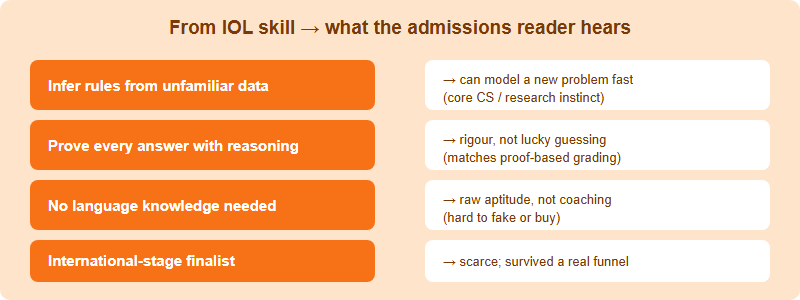
Why the skill set is genuinely respected
Linguistics olympiad problems are deliberately built on lesser-known languages so that no contestant can rely on prior fluency. The first IOL — held in 2003 in Borovets, Bulgaria, with just six countries — already used data from Egyptian Arabic, Basque, Adyghe and an invented alphabet system. The point has never been to test vocabulary. It is to test whether you can take structure you have never seen, find the pattern, and defend it.
That is why both computer-science and linguistics faculty respect it. A CS admissions reader sees the same cognitive muscle that powers competitive programming and research: pattern extraction, hypothesis testing, and formal justification. A linguistics reader sees a candidate who already enjoys the actual work of the field — morphology, phonology, syntax — before ever taking a university course. The overlap is the reason the IOL appeals to applicants in both directions, and why it pairs naturally with a maths or coding track in a double application.
The team round reinforces this. As described on the official site, teams of four tackle a single, extremely difficult problem over three to four hours — a small, public proof that you can reason under pressure and collaborate, not just grind alone. For students aiming at research-heavy programmes, that collaborative-analysis signal is worth more than most résumé lines.
| IOL fact (per ioling.org) | Detail | Why it matters for admissions |
|---|---|---|
| Founded | 2003, Borovets, Bulgaria — 6 founding countries | Long, credible track record; not a new pay-to-enter event |
| Individual contest | 6 hours, 5 problems, logic-based | Endurance + deep reasoning, the way university exams test |
| Team contest | Teams of 4, one very hard problem, 3–4 hours | Collaboration under pressure — a research signal |
| Prior knowledge | None required; based on unfamiliar languages | Reads as raw aptitude, hard to coach or buy |
| IOL 2025 (Taipei) | 227 contestants, 57 teams, 42 countries/territories | Reaching it = surviving a national funnel = scarcity |
| IOL 2026 | Bucharest, 26 July – 2 August | Current cycle to plan a realistic timeline around |


Where the honest limits are
Here is the part most marketing pages skip. The IOL is a strong supporting signal, not an admit button. Top programmes reject medallists every year and admit students who have never heard of the contest. Treating any olympiad as a guarantee is both factually wrong and a credibility risk in your application. Three honest limits to plan around:
- It cannot rescue weak fundamentals. A strong transcript and standardised results still do the heavy lifting. The IOL adds depth on top of a solid base; it does not replace one.
- Participation alone is thin. “I entered a linguistics olympiad” reads very differently from “I reached the international stage and here is the kind of problem I learned to solve.” Readers can tell the difference between a line and a story.
- It must connect to a direction. A medal that sits in isolation, unexplained, with no related project or essay, under-performs a smaller achievement that is woven into a coherent narrative about why you want to study CS or linguistics.
For students based at international schools in China, there is one extra reality: the path runs through national-level selection contests, and the calendars do not all line up. Knowing those windows before you commit is half the battle — our breakdown of the NACLO, UKLO and OzCLO calendars exists precisely so you can plan a feasible route rather than discover a closed door in January.
How to make it actually count
The students who convert an IOL result into real admissions value tend to do four things deliberately. None of them is about the medal itself.
First, they build a paired project. A linguistics olympiad result lands far harder next to evidence that you act on the interest — a small computational-linguistics script, a phonology write-up of a local dialect, a write-up that decodes a writing system. This is where CS and linguistics applicants diverge slightly: a CS-leaning student might ship code that solves a Rosetta-style decoding task; a linguistics-leaning student might document a real morphological analysis. Either way, the project turns “I competed” into “I think this way for fun.”
Second, they train methodically rather than cram. The contest rewards a small set of reusable problem types — translation/decoding, phonology, morphology, syntax, and writing- or number-system puzzles. Working through past problems by type, on a schedule, beats last-minute volume. Our 12-week study plan sequences this so the skill compounds instead of spiking and fading.
Third, they tell the story in their own voice. In essays and supplements, the strongest applicants spend more words on the moment they cracked a problem than on the award. Admissions readers remember a candidate who can show their thinking, not one who lists a trophy. Fourth, they keep the result honest and in proportion — reporting exactly what they achieved, never inflating “participated” into “won.” Overstatement is one of the fastest ways to lose a reader’s trust.
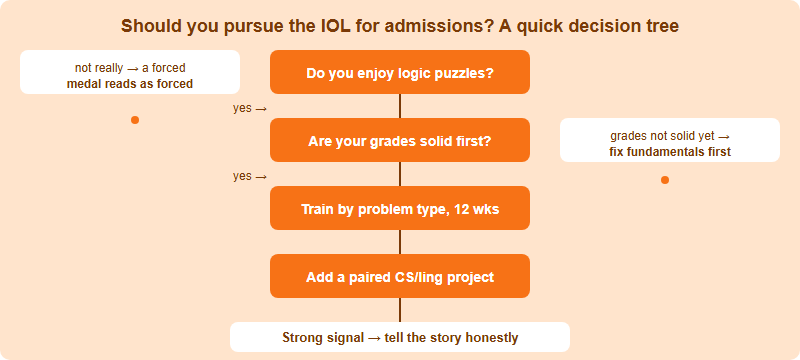
A realistic verdict for 2026 applicants
If you genuinely enjoy decoding unfamiliar systems and your academic base is already strong, the IOL is one of the best-fit signals available for top CS and linguistics applications — precisely because it is hard to fake, scarce, and built on the exact reasoning those programmes screen for. If you are chasing a line for a list, the return is poor and the time is better spent elsewhere. The contest rewards real interest, and so does admissions. The 2026 cycle culminates in Bucharest from 26 July to 2 August; the national selection windows that feed it come months earlier, so plan backward from those — and always confirm current dates and rules on the official site, ioling.org.
Frequently asked questions
Does an IOL medal guarantee admission to a top CS or linguistics programme?
No. It is a respected supporting signal, never a guarantee. Strong grades, a paired project and a clear story still carry the application.
Do I need to know many languages to do well at the IOL?
No. Per ioling.org, no prior language knowledge is required. Problems use unfamiliar languages and reward logical, deductive reasoning instead.
Is the IOL better for computer-science or for linguistics applicants?
Both. The reasoning skill maps onto CS problem-solving and onto core linguistics work, so it supports applications in either direction.
When and where is the IOL in 2026?
The 2026 IOL is in Bucharest, Romania, from 26 July to 2 August. National selection contests run earlier; confirm all dates on ioling.org.
This is an independent community guide operated by Hanlin Education for China-based international-school students. It is not affiliated with, endorsed by, or sponsored by the IOL Board. Competition formats, dates and rules change — always confirm current details on the official site, ioling.org. Confirmed errors are corrected within 7 working days.
Next steps
- IOL competition format & medals — how the Olympiad is scored.
- Join the IOL Club WeChat cohort — weekly problem walkthroughs.
Keep reading.
From Three Hours to Six: What Actually Changes Between a National Round Paper and an IOL Paper
A national open round gives you roughly 25 minutes a problem; the IOL gives you over an hour. Four things that change…
How to Mark Your Own Linguistics Olympiad Practice Paper When There Is No Solution Sheet
Worked solutions do not exist for every past paper. A five-band self-marking rubric, the regeneration test, and the four ways students quietly…
The Deadline Before the Deadline: Planning a 2026-27 Linguistics Olympiad Autumn Backwards From the Sitting
Registration for the coming cycle is reported to close earlier than usual. An autumn planned backwards from the sitting, with compression options…