
The IOL has two rounds: the famous solo contest, and a separate team contest where up to four contestants share one room and submit a single joint solution to one long, hard problem. It rewards a completely different skill from solving alone — not raw decoding speed, but how well four people divide a problem, share partial findings, and reconcile them into one clean answer under the clock. Per ioling.org, teams are “up to 4 people” and “only one solution per team is handed in.” Treat every other timing or scoring specific below as “confirm on the official site.”
Solo round vs team round: two different games
Most students prepare exclusively for the individual contest and walk into the team round having never practised it — a costly oversight, because the team problem is typically the hardest single puzzle of the whole olympiad and your whole delegation's collaborative result rides on it. If you are new to the event, start with our overview of what the International Linguistics Olympiad is, then come back here for the half almost nobody trains.
The two rounds differ on nearly every axis. The table below sets the confirmed facts (team size, single shared solution, no prior linguistics) against the structural contrasts; where the official site is the authority on exact figures, we say so rather than invent a number.
| Dimension | Individual (solo) contest | Team contest |
|---|---|---|
| Who works | One contestant, alone | Up to 4 contestants from the same country, together (per ioling.org) |
| What is submitted | Your own answer sheet per problem | One single joint solution for the team (per ioling.org) |
| Problem load | Five problems over six hours (per ioling.org) | Typically one long, demanding problem — confirm duration on ioling.org |
| Core skill | Personal decoding speed and accuracy | Division of labour, communication, reconciling partial work |
| Main failure mode | Running out of time on one problem | Four people duplicating effort or contradicting each other |
| Language | Your national-contest language (optionally another IOL language) | One chosen language for the whole team's problem set (per ioling.org) |
| Prior knowledge | None required — all in the text (per ioling.org) | None required — same principle |
The single most important line in that table is “main failure mode.” In the solo round you lose to the clock. In the team round you lose to yourselves — four strong solvers all attacking the same sub-task while another part of the problem goes untouched, or two people quietly building incompatible theories that collide in the final twenty minutes. Everything in this guide is about engineering that failure out.
What we actually know vs what to confirm
Because the team contest's exact timing and weighting can change year to year, it matters to be honest about which facts are stable and which you must verify for your edition. Here is the split, so you prepare on solid ground and check the rest.
- Confirmed by ioling.org: teams are up to four people; they work together in a shared space; only one solution per team is submitted; the problem set is provided in one chosen language; no prior linguistics knowledge is required.
- Confirm on ioling.org for your year: the exact duration of the team contest; how the team problem is weighted relative to the individual results; the precise marking scheme and any best-team recognition; the day of the schedule on which the team round falls.
This distinction is not pedantry — it is the fact-checking discipline that keeps a guide trustworthy. If a coaching resource quotes you a confident “the team round is exactly N hours and counts for X%,” ask where that came from; only the current official materials can settle it for your edition.


Four roles for four people: a division that scales
The biggest gain in the team round comes from agreeing, before you read the problem, who does what in the first ten minutes. We teach a four-role split that prevents both duplication and gaps. Roles are functions, not fixed seats — people flow between them as the problem reveals its shape.
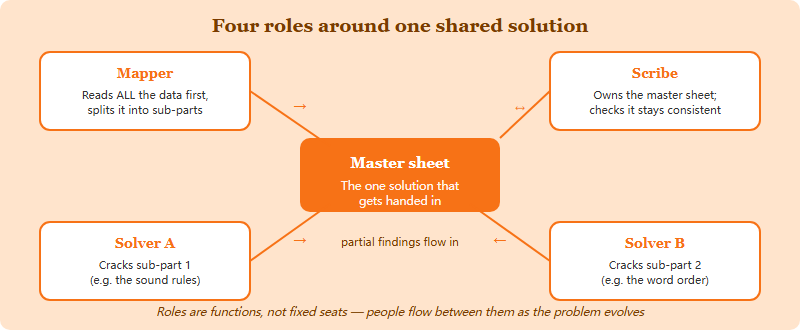
The Mapper reads the entire problem first — every data block, every question — before anyone starts solving, and proposes how to slice it. This is the most under-valued role: ten minutes of one person mapping the terrain saves an hour of four people wandering it. Solver A and Solver B each take an independent sub-part — for a layered problem that might be “you take the sound system, you take the word order” — so two fronts advance in parallel rather than four people piling onto the obvious first step. The Scribe owns the single master sheet, transcribes confirmed findings onto it, and continuously checks that Solver A's conclusions do not contradict Solver B's. Because only one solution is submitted, the Scribe's consistency-checking is not clerical — it is the role that wins or loses the round.
A shared-solution workflow (the hour, in phases)
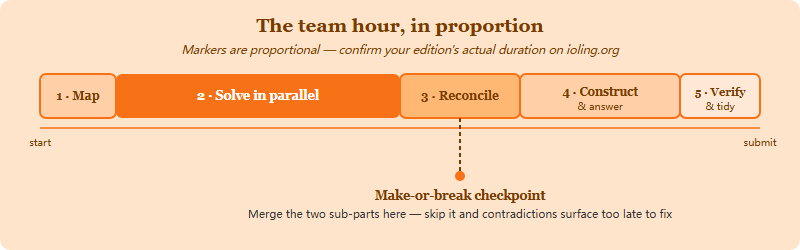
Knowing the roles is half of it; sequencing them is the other half. Below is the phased workflow we drill in mock team rounds. Adjust the minute markers once you confirm your edition's actual duration on ioling.org — the proportions are what matter.
| Phase | Roughly when | What happens | The trap it avoids |
|---|---|---|---|
| 1 · Map together | First ~10% | Everyone reads all the data; Mapper proposes the split; team agrees who owns what. | Four people racing into the same first sub-task. |
| 2 · Solve in parallel | Bulk of the middle | Solvers work their sub-parts; Scribe logs confirmed pieces to the master sheet only. | Unverified guesses polluting the shared answer. |
| 3 · Reconcile | ~Two-thirds in | Stop and merge: do the sub-parts fit? Resolve any contradiction now, not later. | Two incompatible theories colliding at the end. |
| 4 · Construct & answer | Following stretch | Use the merged system to answer every question, including “produce form X” tasks. | Leaving the highest-mark construction tasks unattempted. |
| 5 · Verify & tidy | Final ~15% | Scribe reads the whole sheet aloud; team re-tests against all data; fix presentation. | Losing marks to a sloppy, hard-to-mark final write-up. |
Three habits make this workflow pay off. First, only confirmed findings go on the master sheet — speculation stays on scratch paper, so the shared answer never has to be un-written. Second, the reconcile checkpoint is non-negotiable; teams that skip it discover at minute fifty that their two halves assumed different things, with no time to fix it. Third, the construction tasks are where the marks concentrate, exactly as in solo morphology and syntax, so never let the clock run out with “produce the word/sentence for X” left blank. The same verification reflex our 12-week study plan drills for solo problems — re-test against every data point — is what Phase 5 institutionalises for the team.
How to practise the team round (most people never do)
You cannot improvise collaboration on the day. The good news is that team practice is cheap to organise and improves fast, because the bottleneck is process, not talent. A few concrete drills:
- Run a real timed mock with one long problem. Take a single demanding practice problem, set a clock, and work it as a four with assigned roles. The first attempt will be messy — that is the point.
- Debrief on process, not just the answer. Afterwards, ask: did the Mapper's split hold? Where did effort duplicate? When did contradictions surface, and could the reconcile checkpoint have caught them earlier?
- Rotate roles across sessions. Everyone should be able to Map, Solve and Scribe, because on the day the role that fits the problem may not be the role you rehearsed.
- Practise the hand-off, not just the solving. The skill the team round tests most is transferring a half-finished insight cleanly enough that a teammate can build on it without re-deriving it.
Because IOL entry runs through accredited national contests — you cannot enter the international stage directly — the national rounds are where most students first meet timed, unfamiliar-language problems, and several offer team or pairs formats worth using as collaboration practice. Our guide to the NACLO, UKLO and OzCLO calendars shows when those rounds fall, so you can slot a team mock into your year before the international event. The IOL, founded in 2003 and now drawing dozens of nations annually (Taipei 2025 hosted 227 contestants from 42 countries, per ioling.org), runs both rounds at every edition — so the team skill is always worth its rehearsal time.
Frequently asked questions
How many people are on an IOL team?
Up to four, per ioling.org. They work together in a shared room and submit one single joint solution. Confirm the exact arrangements for your edition on the official site.
How long is the IOL team contest?
The team round is typically one long, demanding problem, but the exact duration can vary by year. We do not quote a fixed figure — confirm the current time limit on ioling.org.
Does the team contest need different skills from the solo round?
Yes. The solo round rewards individual decoding speed; the team round rewards dividing labour, sharing partial findings, and reconciling them into one consistent answer.
Can a team enter the IOL directly?
No. Per ioling.org, contestants qualify only through an accredited national contest; there is no independent entry. Confirm your country's route on the official site.
This is an independent IOL Club guide operated by Hanlin Education for China-based international-school students. It is not affiliated with, endorsed by, or sponsored by the IOL Board or any national linguistics olympiad. Team size and the single-solution rule are per ioling.org; team-contest duration and weighting vary by year and are not quoted here as fixed values. Contest structure, dates and eligibility change year to year — always confirm current details on the official site, ioling.org. IOL 2026 is in Bucharest, 26 July–2 August 2026. Confirmed errors are corrected within 7 working days.
Keep reading.
From Three Hours to Six: What Actually Changes Between a National Round Paper and an IOL Paper
A national open round gives you roughly 25 minutes a problem; the IOL gives you over an hour. Four things that change…
How to Mark Your Own Linguistics Olympiad Practice Paper When There Is No Solution Sheet
Worked solutions do not exist for every past paper. A five-band self-marking rubric, the regeneration test, and the four ways students quietly…
The Deadline Before the Deadline: Planning a 2026-27 Linguistics Olympiad Autumn Backwards From the Sitting
Registration for the coming cycle is reported to close earlier than usual. An autumn planned backwards from the sitting, with compression options…