
A syntax problem in the International Linguistics Olympiad (IOL) gives you a short set of sentences in an unfamiliar language with English translations, and asks you to work out the grammar — word order, agreement, case marking — then translate new sentences both ways. You are not tested on any language you already know; you reconstruct the rules from the data alone. This guide breaks down a repeatable method.
What a syntax problem actually tests
Unlike a Rosetta-stone translation problem (where the puzzle is mostly vocabulary and matching), a syntax problem centres on structure: how words combine into sentences, how the subject and object are signalled, and how the verb agrees with them. The official IOL position is that “no prior knowledge of linguistics or languages is required” and that the hardest problems “only require logical ability, patient work, and a willingness to think outside the box” (per ioling.org). Syntax problems are a clean example of that philosophy — everything you need is on the page.
Three grammatical signals do most of the work in syntax data sets:
- Word order — the default sequence of subject (S), verb (V) and object (O). English is SVO (“dogs chase cats”); many of the world’s languages are SOV (“dogs cats chase”) or VSO.
- Case marking — a suffix or particle attached to a noun that tells you its job in the sentence (who did it, to whom). When a language marks case, word order can move freely without changing meaning.
- Agreement — when the verb (or another word) changes shape to match the person, number or gender of the noun it relates to.
If you can pin down those three, you can usually translate anything the problem throws at you.
A 5-step method you can drill
The same workflow that powers our Tuesday walkthroughs applies to almost every syntax problem. Work it in order and resist guessing ahead.
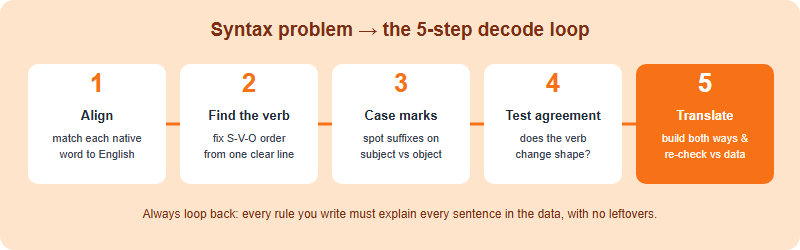
Step 1 — Align. Write the native sentence above its English translation and try to pair each native word with its English meaning. Words that recur across several sentences are your anchors.
Step 2 — Find the verb and fix the order. Locate one sentence where you are confident which word is the action. Its position relative to the subject and object reveals whether the language is SVO, SOV, VSO, and so on.
Step 3 — Hunt for case marking. Compare the subject form of a noun with its object form. A consistent extra piece (a suffix or particle) that appears only on objects, or only on subjects, is a case marker.
Step 4 — Test agreement. Hold the verb constant and change the subject from singular to plural, or from “I” to “they”. If the verb’s ending shifts, you have agreement, and you must encode it in your rule.
Step 5 — Translate and verify. Produce the new sentences in both directions, then run every rule back against the original data. If one line breaks, your rule is incomplete — not the data.
An illustrative mini-example
Here is a small invented data set (not a real IOL problem — we never reproduce past papers). Say a made-up language “Velar” gives you:
| Velar sentence | English |
|---|---|
| tomo-ka velu-n rega | The hunter sees the bird |
| velu-ka tomo-n rega | The bird sees the hunter |
| tomo-ka velu-n mira | The hunter hears the bird |
Decoding it: rega = “sees”, mira = “hears”. The verb comes last, so the order is SOV. The subject always carries -ka and the object always carries -n — those are case markers. Notice that in line 2 the words physically swap, yet meaning is controlled entirely by the suffixes, not by position. That is exactly the kind of insight a real syntax problem rewards: once you isolate the markers, you can translate “the bird hears the hunter” as velu-ka tomo-n mira even though that sentence never appeared.
This is also why syntax problems pair so well with morphology work — the markers you find here behave like the affixes you segment in a morphology task. If that side of the puzzle is new to you, our complete guide to what the IOL is sets out how the problem families relate.


Adding a second dimension: agreement and possession
Real syntax problems rarely stop at subject and object. Once you have the basic frame, the data usually introduces a second axis that interacts with it — most commonly agreement, possession, or number. The skill the IOL is probing here is whether you can keep two rules straight at once and see how they combine, rather than treating each new sentence as a fresh mystery.
Continuing the invented “Velar” language, suppose later lines add plurals and a possessor:
| Velar sentence | English | What it adds |
|---|---|---|
| tomo-ka velu-n-tu rega | The hunter sees the birds | plural object: suffix -tu stacks after the case marker |
| tomo-ka-sa velu-n rega | The hunters see the bird | plural subject: -sa stacks after -ka |
| tomo-vi velu velu-n rega | The hunter's bird sees the bird | possession: -vi marks the owner, who precedes the owned noun |
Two lessons fall out of this. First, order of suffixes is itself a rule: the case marker sits next to the noun and the number marker stacks outside it (velu-n-tu, not velu-tu-n). Getting the ordering right is often worth credit on its own. Second, possession introduces a new positional rule — the possessor comes before the owned noun — that you must state separately from the main word order. Students who try to force everything into a single rule usually break on lines like the third; students who layer two clean rules translate them effortlessly.
When you meet this in practice, resist the urge to abandon your earlier findings. The base frame (SOV, subject -ka, object -n) still holds; you are extending it, not replacing it. This is also why your written working should be organised as a short list of rules rather than prose: when a new sentence type appears, you add a rule to the list and re-check, instead of rewriting everything from scratch.
The traps that cost students marks
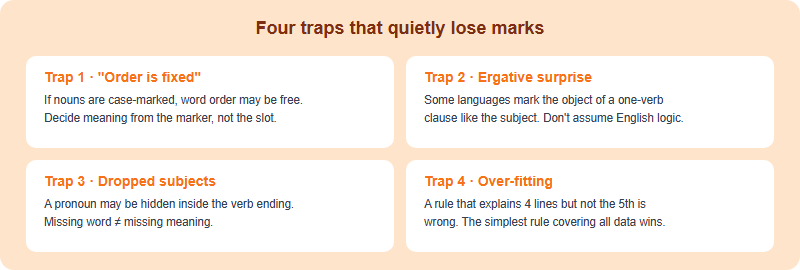
Beyond these four, the most frequent self-inflicted error is presentation. In the IOL, you generally have to show the rule you used, not just the final translation — partial credit often rewards a correctly stated generalisation even when one sentence slips. The exact marking weighting varies by year and by problem, so confirm the current scoring conventions on ioling.org rather than assuming.
How to build syntax fluency before Bucharest
IOL 2026 will be the 23rd edition, held in Bucharest, Romania, from 26 July to 2 August 2026 (per ioling.org). National rounds such as NACLO, UKLO and OzCLO run months earlier and are where most international-school students first meet syntax problems — see our breakdown of the national olympiad calendars to plan backwards from those dates.
A practical training rhythm:
- Volume first. Syntax intuition is built by pattern exposure. Work through a wide range of past national-round problems (publicly archived on official sites) and always write out your rule before checking the answer.
- Time the second pass. Once a problem type feels familiar, redo it under realistic time pressure so you learn to commit to a rule quickly.
- Keep a “marker bank”. Note every case and agreement pattern you meet. Languages reuse a small toolkit of strategies, so your bank compounds.
If you want a structured ramp, our published 12-week study plan sequences problem families so that syntax sits on top of the morphology and translation skills it depends on.
FAQ
Do I need to know grammar terminology to solve syntax problems?
No. Terms like “case” or “agreement” are useful labels, but the IOL states no prior linguistics knowledge is required — you reconstruct the patterns purely from the data given.
How is a syntax problem different from a Rosetta-stone problem?
Rosetta problems lean on vocabulary matching; syntax problems centre on sentence structure — word order, case and agreement — and on translating sentences you have not seen before.
Will the IOL test ergative or other unusual systems?
It can. Problems are deliberately drawn from diverse languages, so expect structures unlike English. The fix is to trust the data over your native-language instincts.
Where can I confirm the contest format and marking?
The official source is ioling.org. Exact problem counts, durations and marking weights vary by edition, so verify the current rules there before relying on any specific figure.
This is an independent community guide operated by Hanlin Education for China-based international-school students. It is not affiliated with, endorsed by, or sponsored by the IOL Board. Competition formats, dates and rules change year to year — always confirm current details on ioling.org. We correct any errors within 7 working days of notification.
Keep reading.
From Three Hours to Six: What Actually Changes Between a National Round Paper and an IOL Paper
A national open round gives you roughly 25 minutes a problem; the IOL gives you over an hour. Four things that change…
How to Mark Your Own Linguistics Olympiad Practice Paper When There Is No Solution Sheet
Worked solutions do not exist for every past paper. A five-band self-marking rubric, the regeneration test, and the four ways students quietly…
The Deadline Before the Deadline: Planning a 2026-27 Linguistics Olympiad Autumn Backwards From the Sitting
Registration for the coming cycle is reported to close earlier than usual. An autumn planned backwards from the sitting, with compression options…