
You do not need to speak many languages, or major in languages, to do well at the International Linguistics Olympiad (IOL). The official position is blunt: “no prior knowledge of linguistics or languages is required” (per ioling.org). What the IOL really tests is structured logical reasoning applied to unfamiliar data — which is why strong maths and computer-science students often thrive. This guide is an honest fit-check for international-school students deciding whether to try.
The myth: “IOL is for language people”
The name misleads. Linguistics is not the study of speaking many languages; it is the study of how language works as a system. IOL problems hand you a small data set in a language you have never seen — say, a few sentences with translations — and ask you to deduce the rules and apply them. The skill being measured is pattern-finding under constraints, not vocabulary or fluency.
This is why the contest is open to students from every academic background, and why a strong maths competitor with no special interest in languages can place well. If you enjoy the moment a confusing puzzle suddenly clicks into a clean rule, you are the target audience — regardless of your favourite subject. For the full picture of the contest, start with our complete guide to what the IOL is.
What background actually helps
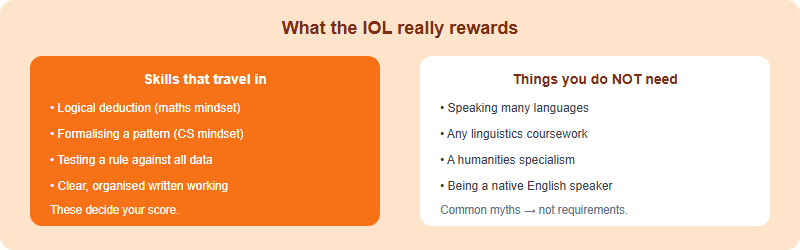
“No prerequisites” does not mean “no transferable skills”. Some habits genuinely give you a head start. The table separates what matters from what does not.
| Helps a lot | Helps a little | Surprisingly optional |
|---|---|---|
| Comfort with logical deduction and proof-style reasoning (often from maths) | General curiosity about how languages differ | Speaking several languages |
| Spotting and formalising patterns (often from competitive programming) | Exposure to a non-native script or writing system | Any formal linguistics coursework |
| Patience to test a hypothesis against every data point | Strong English reading (problems are in English) | A “languages” or humanities specialism |
| Careful, organised written working | Familiarity with grammar terminology | Being a native English speaker |
Notice the left column is dominated by maths/CS-style thinking, while the right column lists exactly the things people assume you need. That mismatch is the single most useful thing to understand before you decide.
Three student profiles — and an honest verdict
Below are composite profiles we see often among China-based international-school students. They are illustrative, not guarantees — anyone can improve with practice.
- The maths/CS competitor. Already does AMC, olympiad maths or competitive programming, but has never thought about language. Verdict: strong fit. Your deduction and pattern-formalising skills transfer almost directly; the main new work is learning the problem families and how to write up rules.
- The humanities all-rounder. Loves languages, reading and writing; less confident with formal logic. Verdict: good fit, with a gap to close. Your curiosity and reading help, but you will need to build the disciplined “test every hypothesis” habit that maths students bring. That is learnable.
- The undecided explorer. Strong general student, no clear specialism yet. Verdict: ideal fit. The IOL is a low-prerequisite way to discover whether you enjoy this style of thinking — and it signals breadth to universities precisely because it is not your obvious subject.
The common thread: the question is not “what subject am I?” but “do I enjoy reverse-engineering a system from limited evidence?” If yes, your starting subject barely matters.


How the IOL sits alongside maths and CS olympiads
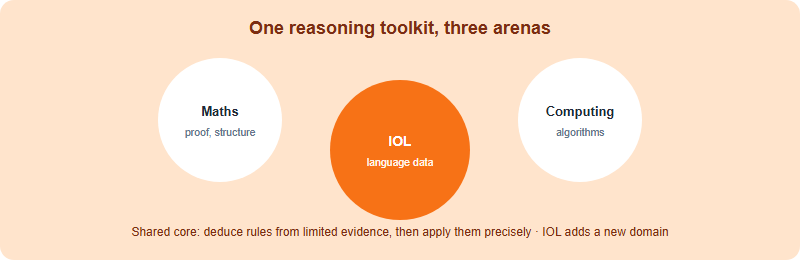
For students already building an olympiad profile, the IOL is a complement, not a competitor. It draws on the same reasoning muscles as maths and computing contests but applies them to a fresh domain, which makes it a credible breadth signal for selective CS, linguistics, cognitive-science and related applications. The honest framing is that it is one strong signal among several — useful evidence of how you think, not a guaranteed admissions outcome.
If your motivation is partly admissions, our dedicated post on what the IOL is and the national-round planning in our national olympiad calendars will help you weigh the commitment against your other activities.
What the first month of trying really feels like
The honest reason most eligible students never start is not lack of ability — it is that the first few problems feel impossible, and they conclude “this isn’t for me” before the skill has had a chance to develop. Knowing the normal learning curve in advance prevents that premature exit.
Here is what a realistic first month looks like for a student with no linguistics background:
| Stage | What it feels like | What is actually happening |
|---|---|---|
| First 1–3 problems | Overwhelming; you stare at the data with no idea where to begin | You have not yet learned to align data and look for recurring forms. This is universal, not a verdict on you. |
| Problems 4–8 | You start seeing one pattern per problem, but run out of time or miss a second rule | Your pattern-spotting is switching on. Speed and multi-rule handling come later. |
| Problems 9–15 | You recognise problem families and have a method to attack each | You have built a toolkit. From here, improvement comes from volume and timed practice. |
The key insight is that the difficulty you feel on problem one is information about your experience, not your aptitude. Almost everyone — including eventual medallists — finds the first problems baffling. The students who succeed are simply the ones who keep going long enough to reach the “patterns click” stage, usually somewhere around the tenth problem.
This also reframes how to judge your fit. Do not ask “could I solve this problem right now?” — for a beginner the answer is usually no, and that tells you nothing. Ask instead: “when I finally see the rule, do I feel satisfaction or relief-to-be-done?” Satisfaction means the contest suits how your mind likes to work, and that is the durable predictor of who sticks with it.
A second practical point: progress in linguistics olympiads is unusually self-directed. Because the prerequisite knowledge is near zero, you are not waiting on a teacher to cover material — you improve almost entirely by working problems and reviewing your reasoning. That makes it an excellent fit for motivated self-starters, and it is why a structured sequence of problems matters more than any single lesson.
Eligibility and getting started
The IOL is for secondary-school students, and 2025 saw 227 contestants from 57 teams across 42 countries and territories compete (per ioling.org). Most students reach the IOL by first qualifying through a national round such as NACLO, UKLO or OzCLO. Crucially, the exact age limits, grade eligibility, registration steps, deadlines and any fees differ by country and by national body — confirm the rules that apply to you on ioling.org and your national-round site; do not assume they match another competition you have done.
A low-risk way to test your fit this week:
- Open one publicly archived sample problem and give it a genuine 30-minute attempt — no notes, no help.
- Notice your reaction. Frustration that turns to satisfaction when a rule emerges is the signal you want.
- If you are hooked, follow a structured ramp such as our 12-week study plan, and aim your timeline at IOL 2026 in Bucharest, 26 July – 2 August 2026 (per ioling.org), working backwards from your national round.
No background disqualifies you, and no background guarantees a result. The IOL rewards students who are willing to sit with a hard puzzle and reason it out — start there, and let your subject label fall away.
FAQ
Do I need to speak several languages to do the IOL?
No. The IOL states no prior knowledge of languages or linguistics is required; problems are solved by logical reasoning from data, not by knowing the languages involved.
Are maths or computer-science students at an advantage?
Often, yes — the contest rewards logical deduction and pattern-formalising, which those students practise heavily. But humanities students do well too once they build the hypothesis-testing habit.
Who is eligible to compete?
The IOL is for secondary-school students, usually reached via a national round. Exact age, grade and registration rules vary by country, so confirm on ioling.org and your national-round site.
Will the IOL help my university application?
It can be a credible signal of how you reason, especially for CS, linguistics and cognitive science, but it is one factor among many and never a guarantee of admission.
This is an independent community guide operated by Hanlin Education for China-based international-school students. It is not affiliated with, endorsed by, or sponsored by the IOL Board. Eligibility, dates and rules differ by country and change year to year — always confirm current details on ioling.org. We correct any errors within 7 working days of notification.
Keep reading.
From Three Hours to Six: What Actually Changes Between a National Round Paper and an IOL Paper
A national open round gives you roughly 25 minutes a problem; the IOL gives you over an hour. Four things that change…
How to Mark Your Own Linguistics Olympiad Practice Paper When There Is No Solution Sheet
Worked solutions do not exist for every past paper. A five-band self-marking rubric, the regeneration test, and the four ways students quietly…
The Deadline Before the Deadline: Planning a 2026-27 Linguistics Olympiad Autumn Backwards From the Sitting
Registration for the coming cycle is reported to close earlier than usual. An autumn planned backwards from the sitting, with compression options…