
Once a student qualifies for the International Linguistics Olympiad (IOL), the event itself is a week-long trip, not a single exam. The 23rd IOL runs in Bucharest, Romania, from 26 July to 2 August 2026 (per ioling.org). Across that week there is an individual contest, a team contest, an opening and closing ceremony, and a cultural programme. This guide walks through what the week looks like so a first-time delegate and their parents know what to prepare for.
First, how a student gets there at all
You do not register for the IOL directly. Students reach the international final by placing well in their national linguistics olympiad, and each country sends a delegation selected through that national round (per ioling.org). For students in international schools, the realistic routes are contests such as NACLO (North America), UKLO (United Kingdom) and OzCLO (Australia) — we compare these in our guide to national olympiad calendars, and the exact eligibility for each is set by that contest, so confirm on its official site.
If you have not yet qualified, the week described below is the goal you are training toward. If you are new to the competition entirely, start with our complete guide to what the IOL is, then come back to this once you understand the problem types.
The shape of the week: two contests, one experience
The competitive core of the IOL is two separate contests held on different days, with the rest of the week given over to ceremonies, excursions and rest. The precise schedule is published by each year’s host, so treat the outline below as the general structure and confirm the 2026 timetable on the official Bucharest event pages.
| Phase | What happens | Who takes part |
|---|---|---|
| Arrival & opening | Delegations arrive, register on site, and attend the opening ceremony | All contestants and team leaders |
| Individual contest | Each contestant works alone on a set of linguistics problems under exam conditions | Contestants only |
| Team contest | A country’s contestants work together on one large, hard problem | Contestants in national teams |
| Cultural programme | Excursions and activities in and around the host city | Everyone |
| Closing & awards | Results announced; medals and honourable mentions presented | Everyone |
The key mental model: the individual contest is where personal medals are decided, and the team contest is a separate event with its own results. We break down the team round in depth in our IOL overview and related guides; here the point is simply that both exist, and a delegate experiences both in the same week.
What a “delegation” actually is
Countries attend as delegations, not as lone students. Understanding the three roles helps a first-timer picture how the week is organised and who is responsible for what.
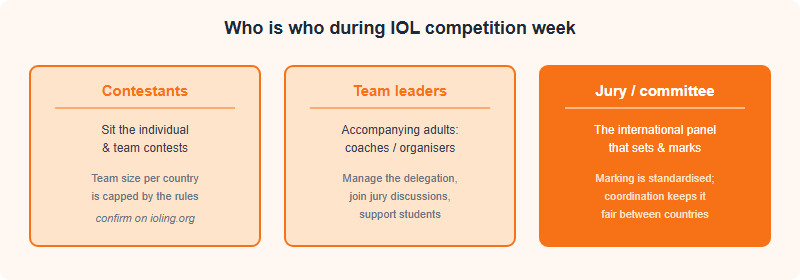
For a student from a Chinese international school, this usually means travelling with your national contingent (the one whose olympiad you qualified through), under the care of that delegation’s leaders. The IOL is a supervised, structured event; families are not expected to accompany contestants into the contest itself. That structure is reassuring for parents sending a teenager abroad for the first time: there is a named adult responsible for the delegation throughout the week, and the contest environment is tightly run.
It also explains why the qualifying route matters beyond just “getting in.” The delegation you join, the leaders who coach you, and even the working language of your contest papers all flow from which national olympiad you came through — one more reason to choose that route deliberately, as we discuss in the calendars guide.


Contest day: what the room is like
The individual contest is a long, quiet, exam-style session. You are given a booklet of problems in several of the recurring families — translation (Rosetta), phonology, morphology, syntax, and problems built on number, writing or meaning systems — and you work through them alone.
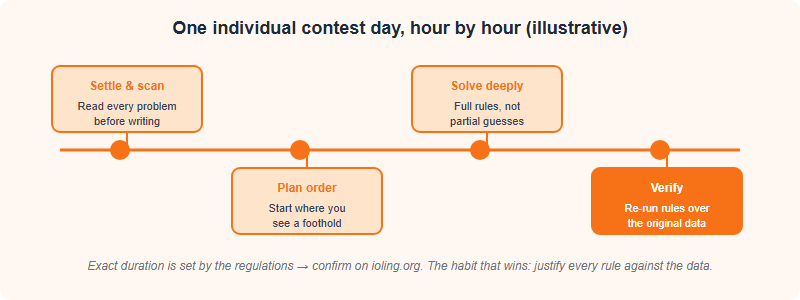
A few practical realities catch first-timers off guard. The room is silent for hours, so build stamina in practice by sitting full-length mock papers. You must justify your answers, not just state them — partial credit rewards a clearly explained rule even if a final translation slips. And there is no penalty for the language being one you have never heard of; that is the point. The problem-solving discipline you drill in our 12-week study plan is exactly what carries you through the day.
Beyond the contest: the part students remember
Ask returning delegates what stayed with them, and it is rarely the problems — it is the people. The cultural programme and the shared experience of meeting linguistics-obsessed students from dozens of countries are, for many, the real prize.
- An international peer network. You spend a week with students who find the same puzzles fascinating. Those connections often outlast the medals.
- Exposure to the field. Being around the jury — working linguists — and hearing how problems are constructed is a genuine window into the discipline.
- A cultural week abroad. Excursions around the host city and country are part of the official programme, giving structure and rest between the two contest days.
This is worth flagging to parents weighing the cost and travel: the IOL is an educational and cultural experience, not only a competition. Whether the wider investment pays off for a specific student is a judgement call — we lay out the trade-offs candidly in our discussion of whether the IOL is worth it for admissions, and the honest answer is that the network and the intellectual exposure are as valuable as any line on a résumé.
The team contest: a different kind of pressure
The team contest is often the surprise of the week for first-timers. Instead of working alone on several short problems, a country’s contestants collaborate on a single large, hard problem under time pressure. The skills are different: division of labour, communicating a half-formed idea clearly, and trusting a teammate’s partial rule enough to build on it.
Students who have only ever practised alone can find the switch jarring, which is why it helps to do at least some group practice before the event. The habit that transfers best is the same one that powers the individual contest — stating a rule precisely so a teammate can test it — but applied out loud, at speed, with four people building one answer. If your national olympiad offers any team-format practice, take it; if not, simulate it by cracking a hard problem with friends and forcing yourselves to narrate every deduction.
Crucially, the team result is scored and awarded separately from individual medals. A student can have an average individual day and still share in a strong team placing, or vice versa. Treating the two contests as genuinely distinct events — with different preparation — is the mark of a delegate who understands the week.
A short preparation checklist for a first-time delegate
If a student has qualified for Bucharest 2026, here is a grounded list of what to sort out — with the reminder that logistics are governed by your national delegation and the host, so confirm specifics with them rather than guessing.
| Area | What to check |
|---|---|
| Travel & visa | Romania entry requirements for your passport; travel arranged with your national delegation — confirm on official channels |
| Consent & forms | Any medical, dietary and parental-consent paperwork your delegation requires |
| Permitted materials | What you may bring into the contest (pens, etc.) — confirm against the current regulations on ioling.org |
| Contest stamina | Sit full-length mock papers in advance so a long silent session feels familiar |
| Language of the contest | Problems are provided in a working language; confirm which language versions are available for your delegation |
Frequently asked questions
Q: When and where is the IOL in 2026?
The 23rd IOL runs in Bucharest, Romania, from 26 July to 2 August 2026, per ioling.org. Confirm the day-by-day timetable on the official event pages.
Q: Do parents attend the competition with the student?
Students travel as part of a national delegation supervised by team leaders. The contest itself is a supervised, exam-style session; families are not expected to accompany contestants into it.
Q: Is the IOL just one exam?
No. It is a week with an individual contest and a separate team contest, plus opening and closing ceremonies and a cultural programme.
Q: How do students qualify to attend?
Through a national linguistics olympiad such as NACLO, UKLO or OzCLO. Each contest sets its own eligibility and selection, so confirm on that contest’s official site.
This is an independent community guide operated by Hanlin Education for China-based international-school students. It is not affiliated with, endorsed by, or sponsored by the IOL Board. Competition facts change year to year, so confirm current details on ioling.org. Errors are corrected within 7 working days of notice.
Keep reading.
From Three Hours to Six: What Actually Changes Between a National Round Paper and an IOL Paper
A national open round gives you roughly 25 minutes a problem; the IOL gives you over an hour. Four things that change…
How to Mark Your Own Linguistics Olympiad Practice Paper When There Is No Solution Sheet
Worked solutions do not exist for every past paper. A five-band self-marking rubric, the regeneration test, and the four ways students quietly…
The Deadline Before the Deadline: Planning a 2026-27 Linguistics Olympiad Autumn Backwards From the Sitting
Registration for the coming cycle is reported to close earlier than usual. An autumn planned backwards from the sitting, with compression options…