
With IOL 2026 opening in Bucharest on 26 July, the final two weeks are not the time to learn new theory — they are the time to sharpen what you already have. This 14-day plan splits the fortnight into three phases: full-set simulation and triage (days 14–8), write-up quality drills (days 7–3), and a deliberate taper (days 2–0). It works whether you are travelling to Romania or treating the fortnight as a benchmark cycle at home.
Why the last fortnight rewards sharpening, not cramming
The International Linguistics Olympiad is a reasoning contest, not a knowledge contest. Every problem is self-contained: the data on the page is, in principle, everything you need. That has a direct consequence for the final stretch — there is no syllabus left to “finish”. You cannot memorise your way to a better score in fourteen days, but you absolutely can raise your score by improving three trainable things:
- Selection speed — how quickly you identify which problem types suit you and in what order to attack a set.
- Error hygiene — how reliably you catch your own broken hypotheses before they eat an hour.
- Write-up quality — how clearly you state the rules you found, because at the IOL a correct answer with no visible reasoning routinely earns less than a clean, justified one.
If you are new to the contest’s overall shape, skim our complete guide to what the IOL is first; this article assumes you already know the individual and team formats and have been training for months, ideally on something like our 12-week study plan. Think of the fortnight below as the final module that plan deliberately leaves open.
The three-phase structure at a glance
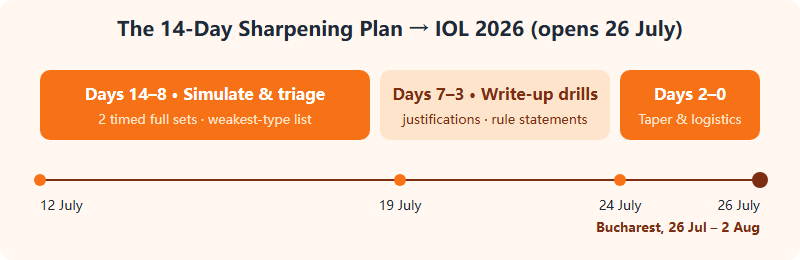
Days 14–8: two full simulations and a ruthless triage
The core of the first week is two timed, full-length individual simulations, spaced roughly three days apart. Build each set from official past papers — our IOL past problems pack collects them with a proven usage method — and pick years you have not already dissected, so the simulation is honest. The individual contest has traditionally given contestants a small number of long problems over roughly six hours; confirm the exact 2026 format and schedule on ioling.org rather than assuming it.
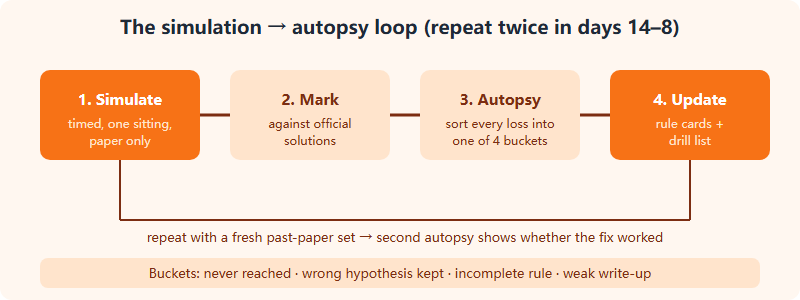
Run the simulation under real constraints: one sitting, paper only, no dictionary, no phone in the room, a printed answer booklet. Then — and this is the part most students skip — spend the next full day on the autopsy, not on new problems. For every mark you dropped, classify the loss into one of four buckets:
- Never reached it — a time-allocation problem, not a linguistics problem.
- Wrong hypothesis, never revisited — an error-hygiene problem: you needed a checkpoint habit.
- Right idea, incomplete rule — a depth problem: you stopped generalising one step too early.
- Right analysis, weak write-up — a communication problem: the grader could not see your system.
After two simulations you will have a two-line triage verdict, something like: “I bleed marks on morphology segmentation under time pressure, and my rule statements are vague.” That sentence, not a pile of new practice, is what the remaining nine days are built around. If a single problem family keeps failing, drill that family in 60–90 minute focused blocks on days 10–8 — one block per day is enough at this stage.


Days 7–3: turn correct thinking into scoring write-ups
IOL marking rewards explicit, justified solutions — graders award partial credit for correctly identified rules and correspondences even when the final answers are imperfect. In the middle phase, stop chasing new problems and start rehearsing the act of writing solutions. A drill that works well for our study groups:
- Take a problem you have already solved in training.
- Rewrite the solution from a blank page in 25 minutes, as if for a grader: state each rule as a general statement (“the plural suffix assimilates in voicing to the final consonant of the stem”), then show one line of supporting data per rule.
- Swap write-ups with a training partner and try to reconstruct each other's system only from the write-up. Anything your partner cannot reconstruct, the grader cannot credit.
Do one such rewrite drill daily on days 7–5. On days 4–3, run one final half-length simulation (two or three problems, strict clock) purely to keep timing instincts warm. Resist the urge to schedule a third full six-hour set inside the last week; the marginal training value is small and the fatigue cost is real.
Days 2–0: taper, logistics and the travel checklist
The final 48 hours are about arriving sharp. For students flying to Romania, note that Bucharest is five hours behind Beijing time in summer; if you can, shift your sleep schedule one to two hours earlier for a few nights before departure and prioritise daylight exposure on arrival. Your team's travel, accommodation and registration are handled through your delegation's leaders — follow their instructions and the official ioling.org announcements for anything procedural, and do not rely on second-hand summaries (including ours) for logistics.
| Day | Main session | Secondary | Off-limits |
|---|---|---|---|
| 14 | Full timed simulation #1 | Light review of notation habits | New theory |
| 13 | Autopsy day: classify every dropped mark | Build weakest-type list | New problems |
| 12–11 | Focused blocks on weakest type (60–90 min) | One easy confidence problem | Marathon sessions |
| 10 | Full timed simulation #2 | — | Late nights |
| 9–8 | Autopsy #2; compare against #1 | Update rule-card notes | Doom-scrolling results forums |
| 7–5 | Daily 25-min write-up rewrite drill | Partner reconstruction swap | Six-hour sets |
| 4–3 | Half-length timed set | Pack / re-check documents (travellers) | Cramming |
| 2–1 | Rest, light reading, sleep shift | One familiar warm-up problem | Anything heavy |
| 0 | Arrive / settle | Walk, hydrate, early night | Practice |
The simulation–autopsy loop, visualised
If you are not going to Bucharest this year
Most readers of this site are not on a 2026 delegation — and the fortnight is still worth running. Treat the two simulations as your season benchmark: score them, autopsy them, and file the results. When IOL 2026's problems are eventually published on ioling.org (past sets have been made freely available after each olympiad), you will have a fresh, unseen set to measure yourself against, and a clean baseline to compare with. That turns late July from a spectator fortnight into the first data point of your 2027 qualifying campaign — whichever national route (NACLO, UKLO, OzCLO or another) you plan to take.
FAQ
Should I learn new problem types in the last two weeks before the IOL?
No. Deepen the types you already handle and fix write-up quality. New types learned under pressure rarely convert into marks and often crowd out the sharpening work that does.
How many full six-hour simulations should I run in the final fortnight?
Two, both in days 14–8, each followed by a full autopsy day. Add one half-length set on day 4 or 3 for timing. More than that risks arriving fatigued.
What should the last 48 hours before IOL 2026 look like?
Rest, light review of your own rule cards, sleep-schedule adjustment for Bucharest time if travelling, and at most one familiar warm-up problem. No new material.
Can I use this plan if I'm not competing in 2026?
Yes — run the same fortnight as a benchmark cycle, then re-test on the 2026 problems once they are published on ioling.org to measure real progress.
IOL Club is an independent guide operated by Hanlin Education for China-based international-school students. We are not affiliated with, endorsed by, or sponsored by the IOL Board. Contest dates, formats and logistics change — always confirm current details on ioling.org. If you spot an error, we correct verified issues within 7 working days.
Keep reading.
From Three Hours to Six: What Actually Changes Between a National Round Paper and an IOL Paper
A national open round gives you roughly 25 minutes a problem; the IOL gives you over an hour. Four things that change…
How to Mark Your Own Linguistics Olympiad Practice Paper When There Is No Solution Sheet
Worked solutions do not exist for every past paper. A five-band self-marking rubric, the regeneration test, and the four ways students quietly…
The Deadline Before the Deadline: Planning a 2026-27 Linguistics Olympiad Autumn Backwards From the Sitting
Registration for the coming cycle is reported to close earlier than usual. An autumn planned backwards from the sitting, with compression options…