
No, the IOL never rewards knowing a particular language — every problem is self-contained, and the data on the page is all you need. But growing up between Mandarin and English quietly shapes how you solve: bilingual students often walk in with sharper instincts for tone, classifiers and writing systems, and with one predictable blind spot around heavy inflection. This article maps both sides honestly, then shows how to train each into marks.
First, the ground rule: the IOL tests reasoning, not vocabulary
The International Linguistics Olympiad — held since 2003, with IOL 2026 running in Bucharest from 26 July to 2 August — is deliberately designed so that speakers of any language compete on equal footing. Problems use languages almost no contestant has met, the organisers work hard to avoid data that favours one linguistic background, and problem sheets are prepared in contestants' working languages (see ioling.org for how the multilingual arrangements work in a given year). So if you are hoping “I speak Chinese and English, therefore I have an unfair edge,” the honest answer is no — and our complete guide to the IOL explains why the contest is built that way.
What a bilingual upbringing does give you is a set of pre-installed intuitions. A student who has lived inside two very different grammatical systems has already experienced, from the inside, many of the phenomena IOL problems ask you to discover from the outside. The trick is knowing which intuitions transfer, which mislead, and which gaps need deliberate drilling.
Four real advantages Mandarin-English bilinguals bring
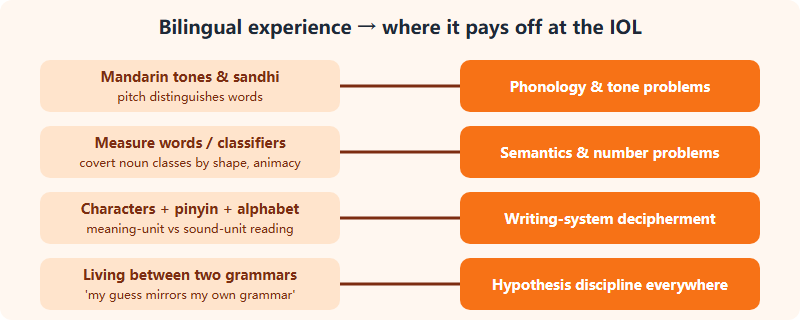
1. Tone is already real to you. Phonology problems sometimes involve tone systems — pitch distinguishing word meanings. For many European-language monolinguals, tone is an abstract diacritic they must consciously remember to track. If you grew up with Mandarin's four-tone system (plus the neutral tone and sandhi effects like the third-tone change in nǐ hǎo), the idea that pitch is contrastive — and that tones can shift in context — is lived experience, not theory. You are less likely to ignore tone marks in the data and more likely to hypothesise tone-change rules early.
2. Classifier intuition maps onto semantics problems. Mandarin requires a measure word between a number and a noun — 一本书, 一条鱼, 一张桌子 — and the choice encodes semantic classes like flat things, long flexible things, bound volumes. Many languages in IOL-style semantics and number problems organise nouns into similar covert classes. A solver who has spent a lifetime unconsciously sorting nouns into classifier categories tends to spot “these nouns pattern together because they share a shape or animacy feature” faster.
3. Writing-system flexibility. You already read a morphosyllabic script (characters mapping to morphemes and syllables) alongside an alphabet, and you learned pinyin as a bridge between them. That triple perspective — meaning-unit, sound-unit, romanisation — is exactly the mental toolkit that script-decipherment problems demand: deciding whether an unknown symbol encodes a sound, a syllable or a meaning is a question you have implicitly answered thousands of times.
4. Transfer awareness. Bilinguals get corrected between systems constantly — English articles that Mandarin lacks, Mandarin word orders that English forbids. Years of that builds a reflex monolinguals must learn painfully: my first guess reflects my own grammar, not the target's. That reflex is the beginning of good hypothesis discipline.
The predictable blind spot: heavy inflection feels alien
Here is the honest cost side. Mandarin is a strongly analytic language: words rarely change form, and grammar is carried by word order and particles like 了, 的 and 吗. English inflects only lightly. But a large share of IOL-style problems are built on languages that pack whole sentences of information into a single word — case endings stacking on number endings, verbs agreeing with subject and object, vowels harmonising across a word.
Students trained mostly in Mandarin and English often report the same first reaction to such data: the words look like unanalysable blobs. The instinct to slice a long word into a stem plus an ordered stack of affixes — obvious to a speaker of, say, Turkish or Hungarian — has to be built deliberately. A related trap is gloss literalism: translating an unfamiliar sentence too directly through English word order, or assuming that because Mandarin marks aspect rather than tense, a marker in the data is “probably aspect”. Each of these is fixable, but only if you name it and drill it.
Two drills close the gap efficiently. First, oversample morphology-heavy problems for a few weeks — the segmentation sets in our past problems pack are the natural source, and the pack's method notes show how to grade your own rule statements. Second, force full morpheme-by-morpheme glossing on paper: for a made-up illustrative word like talu-ka-n “for the two houses”, write house-DUAL-DATIVE under it rather than jumping straight to the translation. The gloss line is where analytic-language speakers convert their disadvantage into ordinary, trainable technique.


Feature by feature: where each language background points
| Linguistic feature | Your Mandarin/English experience | IOL problem relevance | Verdict for you |
|---|---|---|---|
| Tone & tone change | Native (Mandarin four tones + sandhi) | Tonal phonology problems | 🟢 Head start — trust it, but still write the rules out |
| Noun classification | Native (measure words) | Semantics, kinship, number systems | 🟢 Head start |
| Script types | Characters + pinyin + alphabet daily | Writing-system decipherment | 🟢 Head start |
| Word order as grammar | Both languages rely on it | Syntax problems with rigid order | 🟡 Neutral — helps reading, can bias you toward order-based solutions |
| Rich inflection (case, agreement) | Minimal in both languages | Morphology segmentation — a core IOL skill | 🔴 Blind spot — drill deliberately |
| Vowel harmony | Absent in both | Common in phonology/morphology data | 🔴 Blind spot — learn to scan vowel columns first |
| Articles & definiteness | English yes, Mandarin no | Occasional semantics/syntax factor | 🟡 Neutral — your bilingual contrast is actually a useful lens |
Working languages and exam English: one practical note
The IOL is unusually multilingual as an event: problem sheets are prepared in the working languages of the contestants, and the organisers publish details of these arrangements each year — check ioling.org for how this is handled for 2026 rather than assuming. For most students at China-based international schools, the practical working language in training and at national qualifiers (NACLO, UKLO and similar contests are run in English) will be English. The good news: IOL problem English is plain and formulaic — “translate the following”, “fill in the blanks”, “explain your rules” — and nowhere near as linguistically demanding as, say, an English literature paper. If you can read this article comfortably, contest English will not be your bottleneck; segmentation speed and write-up clarity will be.
Turning the audit into a training plan
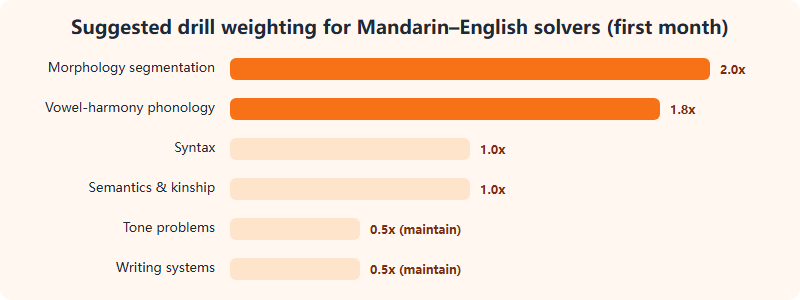
The point of the table above is allocation. Generic study plans give every problem type equal time; your bilingual profile says you should not. A sensible weighting for a typical Mandarin-English student following our 12-week study plan is to keep the plan's structure but tilt the elective sessions: roughly double weight on morphology segmentation and vowel-harmony phonology for the first month, normal weight on syntax and semantics, and maintenance-only weight on tone and writing systems — revisiting your strong areas just often enough to keep them sharp. Re-run the audit after each timed mock: the 🔴 rows should migrate to 🟡 within six to eight weeks of targeted drilling, and that migration — not any innate bilingual magic — is what actually shows up in scores.
FAQ
Do I need to know Chinese, English or any specific language to compete at the IOL?
No. Every problem is self-contained and designed so no particular language background gives direct answers. Reasoning from the data is the whole game.
Is being bilingual an actual scoring advantage at the IOL?
Not directly. It pre-installs useful intuitions — tone, noun classes, script flexibility — but scores come from trained technique. Monolinguals close the gap fast with practice.
What is the biggest weakness of Mandarin-English solvers?
Heavy inflection. Both languages barely inflect, so segmenting long agglutinative words feels alien at first. Targeted morphology drills fix this within weeks.
Will my English level be a problem at international-style contests?
Contest instructions use plain, formulaic English, far simpler than school literature texts. For working-language arrangements at the IOL itself, check ioling.org.
IOL Club is an independent guide operated by Hanlin Education for China-based international-school students. We are not affiliated with, endorsed by, or sponsored by the IOL Board. Contest formats and working-language arrangements change — always confirm current details on ioling.org. If you spot an error, we correct verified issues within 7 working days.
Keep reading.
From Three Hours to Six: What Actually Changes Between a National Round Paper and an IOL Paper
A national open round gives you roughly 25 minutes a problem; the IOL gives you over an hour. Four things that change…
How to Mark Your Own Linguistics Olympiad Practice Paper When There Is No Solution Sheet
Worked solutions do not exist for every past paper. A five-band self-marking rubric, the regeneration test, and the four ways students quietly…
The Deadline Before the Deadline: Planning a 2026-27 Linguistics Olympiad Autumn Backwards From the Sitting
Registration for the coming cycle is reported to close earlier than usual. An autumn planned backwards from the sitting, with compression options…