
Most points at a linguistics olympiad are lost in the first fifteen minutes, not the last. Before you translate a single line, run a fixed routine: inventory the data, build an alignment grid, write down one rule that could be proven wrong, then decide at minute fifteen whether to commit or park. This article gives you that routine and a worked mini-example you can drill this week.
Why the opening minutes decide a six-hour paper
According to the official IOL FAQ, the individual contest contains “precisely five problems” and “the time for the individual contest is normally six hours” (confirm current details on ioling.org). Divide it out and you have roughly seventy minutes per problem — and that seventy minutes has to cover reading, solving, writing the answers, writing the justifications, and checking.
Seventy minutes is not a small budget. Students rarely fail because they solve slowly. They fail because they spend forty of those minutes elaborating a hypothesis that was wrong at minute six, and they only discover it when the data stops cooperating near the end. By then there is no time to rebuild.
Triage is the fix. The purpose of the first fifteen minutes is not to solve the problem. It is to buy information cheaply — to find out, as fast as possible, which structure the language is actually using, so that the forty minutes you spend afterwards are spent on the right idea. If you are new to how the contest is put together, start with our overview of what the International Linguistics Olympiad is, then come back to this method.
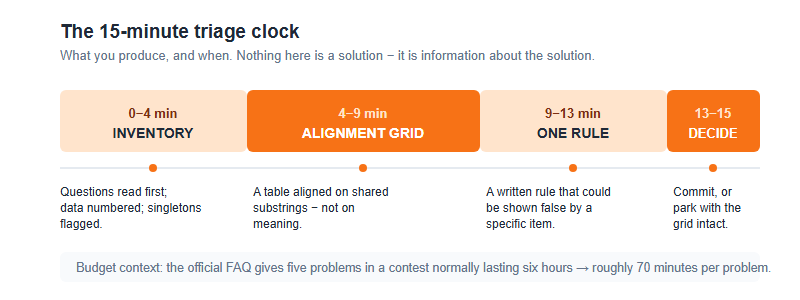
Step 1 (minutes 0-4): inventory before you translate
The instinct of almost every new solver is to look at line one and start guessing what the words mean. Resist it for four minutes. Do this instead:
- Read the questions first. They tell you which direction the problem runs. “Translate into English” and “translate into the language” demand different amounts of certainty — producing a form requires you to know the rule in full, recognising one often does not.
- Number every data item if the problem has not numbered them. You will refer to items constantly, and “item 7 contradicts item 3” is a thought you cannot have without numbers.
- Mark what varies. Underline the parts that change from item to item and the parts that repeat unchanged. The repeats are your anchors; the variation is the actual puzzle.
- Flag the singletons. Any element that appears exactly once cannot be tested against anything. It is either the trap or the key, and either way you should not build your main rule on it.
- Read the header line. The language name, family and region given above the data are real information about what kind of system to expect — but they are context, never evidence. The IOL FAQ is explicit that “all you need to solve the problem is found in the text given to you.”
Step 2 (minutes 4-9): build the alignment grid
Now put the data into a table. The single most important habit here: align on what is shared, not on what you think things mean. Two forms that share a substring are cheap, hard evidence. A meaning you have guessed is expensive, soft evidence.
The grid shape depends on the data you were given:
- Glossed sentences? Make a word-index: every distinct word in the unknown language gets a row, and you record every English gloss it ever co-occurs with. Words that always appear with the same English element are your first vocabulary.
- Isolated word forms? Split each form into a candidate stem and candidate affixes, and put the pieces in separate columns. Do not commit to a split — write two possible splits side by side if you cannot tell.
- Numerals? Re-sort them by numerical value rather than the order printed. Sorted numerals expose the base and the arithmetic almost immediately.
- Scripts or symbols? Sort by shape features and count how many symbols there are before assuming what each one does.
Grid discipline is what makes the difference between a strong solver and a fast guesser: a guesser holds the pattern in their head, a solver holds it on paper where it can be checked against item 11 four minutes later.


Step 3 (minutes 9-13): write one rule that can be proven wrong
A hypothesis you cannot test is not a hypothesis. “There is some kind of plural marking” cannot be attacked. “The suffix -ka marks plural and attaches to the verb, not the noun” can be attacked by a single item — which is exactly why it is useful.
Here is the drill, on a deliberately tiny invented fragment. This is a made-up language written for teaching purposes, not a real IOL problem.
| # | Invented language | English |
|---|---|---|
| 1 | molu ravi | the boy runs |
| 2 | molu ravika | the boys run |
| 3 | senu ravi | the girl runs |
| 4 | senu ravika | the girls run |
| 5 | molu tapi | the boy sleeps |
| 6 | senu tapika | question: ? |
Hypothesis A (the English-shaped guess): plural is marked on the noun. This predicts something like moluka ravi for “the boys run”. Item 2 shows molu ravika instead. Hypothesis A is dead in one move — and it took ten seconds to kill, because it was written in a falsifiable form.
Hypothesis B: -ka marks plural and attaches to the verb; the noun does not change for number. Items 1-4 all fit. Item 6 then reads “the girls sleep”.
Two further lessons are hiding in that fragment, and both generalise:
- tapi appears exactly once. It is a singleton, so any rule about how tapi behaves is unsupported. The disciplined move is to reuse the attested form verbatim and change only the part you have evidence for — here, the suffix.
- The marker was not where an English speaker expects it. Whenever you find yourself thinking “but that is not how it works”, note the thought, then check whether it is a fact about the data or a fact about English. In practice it is usually the second.
Keep a hypothesis log in the margin: one line per hypothesis, with a strike through it and the item number that killed it. This costs seconds and stops you re-testing a dead idea at minute fifty — a genuinely common way to lose a problem you had already half-solved.
Step 4 (minutes 13-15): commit or park
At minute fifteen you make an explicit decision, in writing. Not a feeling — a decision.
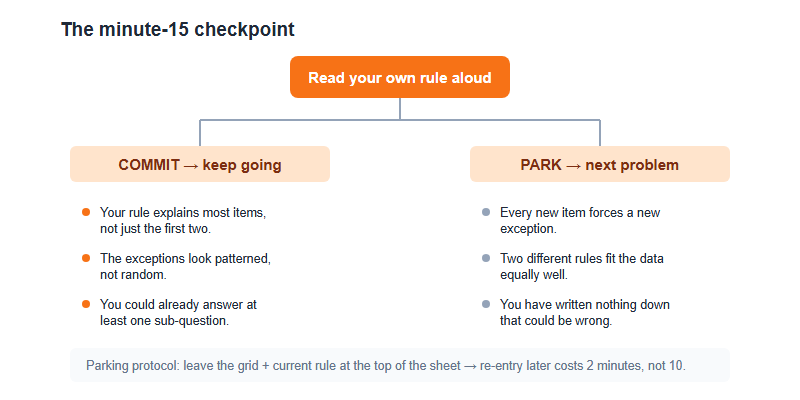
Parking well is a skill in itself. A parked problem should be left with the grid drawn, the live hypothesis written at the top of the page, and the dead ones struck out. When you return an hour later, you resume in two minutes instead of re-reading everything from zero. Students who park badly effectively pay the fifteen-minute triage cost twice.
One more habit worth building at this stage: as soon as you commit, start writing the justification alongside the answer rather than promising yourself you will add it later. Explaining a rule while it is fresh is faster and clearer than reconstructing it at minute sixty-five, when time pressure is highest.
How to drill the routine (without solving anything)
The routine is trained separately from solving, which is what makes it fast to acquire. Take three problems from our free IOL past problems practice pack and run this drill:
| Drill | What you do | What you score yourself on |
|---|---|---|
| Triage-only sprint | Set a timer for 15 minutes. Produce the grid and one written rule. Then stop — do not solve. | Was the minute-15 rule still standing when you checked the full solution later? |
| Kill-list | Write three hypotheses in the first 10 minutes and try to kill each with a named item number. | How many did you kill with evidence rather than intuition? |
| Cold re-entry | Park a problem, do something else for 30 minutes, then resume from your own notes only. | Time to get back to full speed — target under 3 minutes. |
Because you are scoring the quality of your reasoning rather than the final answer, you get useful feedback even on problems that are still far above your level — which is precisely when most students give up. Fold the drill into a broader schedule using our twelve-week study plan: triage sprints in the first half of each week, full-length problems at the weekend.
The one-page summary
If you remember nothing else: read the questions first, put the data in a grid before you assign meanings, write a rule that a specific item could disprove, and make an explicit commit-or-park decision at minute fifteen. That routine does not make hard problems easy. It makes sure that when you spend an hour on a problem, you spend it on the right idea — which, in a six-hour paper with five problems, is worth more than any single technique you can learn.
FAQ
Q: Is fifteen minutes an official rule?
No. It is a training default we use. The official framework is five problems in a contest normally lasting six hours — confirm on ioling.org.
Q: What if I finish triage in five minutes?
Excellent — commit early and bank the time. The clock is a ceiling on uncertainty, not a minimum you must spend.
Q: Should I really park a problem I might solve?
Yes, if your rule keeps needing new exceptions. A parked problem with a clean grid is far easier to finish later than a rushed one.
Q: Do I need linguistics knowledge for this method?
No. The official FAQ states that everything needed to solve a problem is found in the text given to you.
This is an independent guide operated by Hanlin Education for China-based international-school students. We are not affiliated with, endorsed by, or sponsored by the IOL Board. Contest structure, eligibility and dates change; please confirm current details on the official site, ioling.org. Any factual error reported to our editorial desk is corrected within 7 working days.
Keep reading.
From Three Hours to Six: What Actually Changes Between a National Round Paper and an IOL Paper
A national open round gives you roughly 25 minutes a problem; the IOL gives you over an hour. Four things that change…
How to Mark Your Own Linguistics Olympiad Practice Paper When There Is No Solution Sheet
Worked solutions do not exist for every past paper. A five-band self-marking rubric, the regeneration test, and the four ways students quietly…
The Deadline Before the Deadline: Planning a 2026-27 Linguistics Olympiad Autumn Backwards From the Sitting
Registration for the coming cycle is reported to close earlier than usual. An autumn planned backwards from the sitting, with compression options…