
The linguistics olympiad asks your child to work out the rules of a language they have never seen, using only the data printed in front of them. There is nothing to memorise and no vocabulary to learn. For most families the real questions are simpler: how many hours a week does this take, what does it actually signal to universities, and how do you help without taking over?
What your child is actually doing
The most common misunderstanding is that this olympiad rewards students who already speak many languages. It does not, primarily. The official IOL FAQ is direct on the point: prior linguistics knowledge is “not technically” required, and “all you need to solve the problem is found in the text given to you.”
A problem gives a small set of data — perhaps a dozen sentences in an unfamiliar language with their English translations — and asks the student to reverse-engineer the system well enough to translate new material and explain the rule they found. It is closer to a logic puzzle or a cryptography exercise than to a language exam. The skills being tested are pattern recognition, hypothesis testing, working carefully under time pressure, and writing a clear justification for a conclusion.
Two structural facts, per the official FAQ, help set expectations: the individual contest contains “precisely five problems”, and “the time for the individual contest is normally six hours”. That is a serious sitting for a teenager — endurance and self-management matter as much as cleverness. If you want the full picture of the competition itself, our overview of what the International Linguistics Olympiad is covers the structure and the pathway.
The honest weekly time budget
Families almost always ask about cost in money first and cost in hours second. It should be the other way around. Here is a realistic view of the time commitment at each stage — presented as planning figures from working with school-age groups, not as requirements set by anyone official.
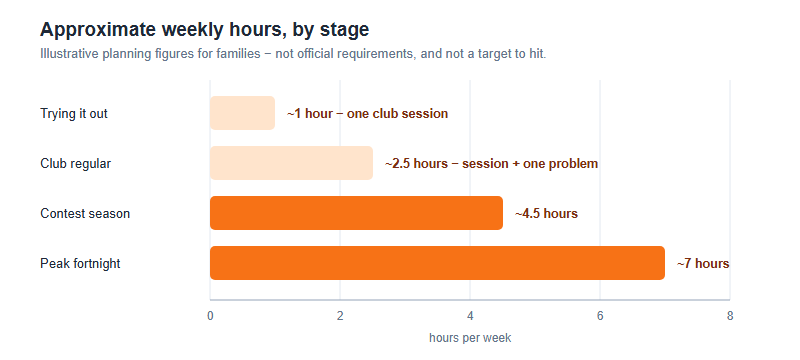
Compared with most competition tracks, that profile is unusually forgiving. There is no equipment, no laboratory access, no travel until a student qualifies for something, and — importantly — no accumulating syllabus. A student who takes two months off has not fallen behind a curriculum; they have simply lost some fluency in a skill that returns quickly. That makes it one of the few activities that fits alongside a demanding IB or A-Level year without displacing it.
The one number to watch is not the weekly average but the peak. If preparation is eating into sleep in the fortnight before a paper, the schedule was wrong two months earlier. A structured plan such as our twelve-week study plan exists mainly to move effort away from that final fortnight.
What it can and cannot do for university applications
Be direct with yourself here, because the marketing around competitions rarely is.
What no competition can do: guarantee admission anywhere. No olympiad, at any level, secures a place at any university, and any programme that implies otherwise is selling something it cannot deliver. Admissions offices do not publish weightings for individual activities, and outcomes depend on the whole application.
What it can plausibly do: provide evidence. A student who has sat a six-hour analytical paper, worked through unfamiliar formal systems, and can talk about a problem they solved has something concrete to write about — particularly for computer science, linguistics, cognitive science, philosophy and mathematics-adjacent applications, where the reasoning style is directly relevant. It is a credible signal of intellectual character, not a credential that converts into a place.
| Reasonable expectation | Unreasonable expectation |
|---|---|
| Genuine material for a personal statement or supplement, in the student’s own words | A line on a form that “counts for” a specific number of points |
| Evidence of analytical stamina and self-directed learning | Compensation for weak grades or test scores |
| A clearer sense of whether the student actually enjoys formal reasoning about language | A guaranteed outcome at any named university |
| Transferable habits — hypothesis testing, working under time limits, written justification | An advantage that persists if the student cannot discuss what they did |
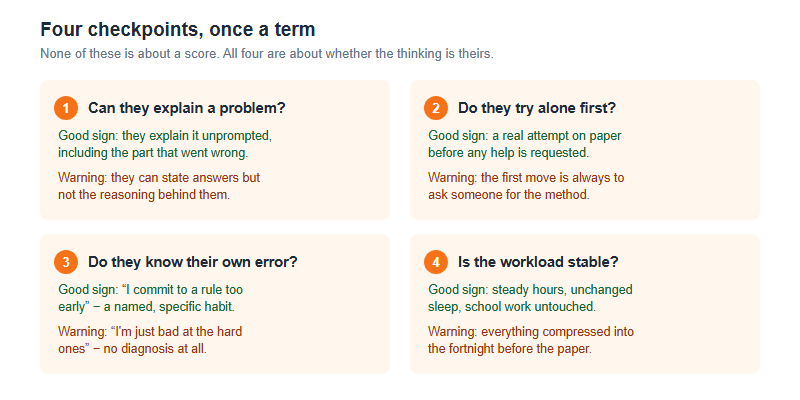
A practical test: if your child cannot spend three minutes explaining one problem they solved and why it was hard, the activity has not yet produced anything an application can use — regardless of what result they got.


Four checkpoints: is this working?
Rather than asking “how is it going?” every week, check four specific things once a term. They tell you far more than a score.
How to help without hovering
The support that helps is mostly logistical and emotional; the support that harms is usually intellectual.
- Do protect the hour. A weekly session that survives family schedules, tutoring and travel is worth more than any resource you can buy.
- Do ask them to teach you one problem. Five minutes, no comment on whether they got it right. Explaining to a non-expert is genuinely the fastest way to consolidate a method — you are useful precisely because you do not know the answer.
- Do treat a bad paper as information. The correct follow-up question is “which type of problem cost you the most time?”, not “what was your score?”
- Do not solve problems for them, or hire anyone who will. A worked answer supplied by an adult removes the exact experience the activity exists to give.
- Do not buy a programme that promises results, rankings or admission. No preparation, ours included, can promise a placing or a university outcome; self-study with good problems is a legitimate route, and many students take it. Judge any option on whether it makes the student explain their own reasoning.
- Do not let it become the only thing. This works best as one of two or three sustained interests, not as a replacement for everything else.
The calendar and the rules worth knowing
A few facts help you have a grounded conversation about what is realistic.
- Eligibility. Per the official FAQ, contestants “must be under 20 years old on the opening day of the IOL, and must attend (or have only just finished attending) secondary school.” A student starting in grade 8 or 9 therefore has several seasons ahead of them.
- The route. Also per the official FAQ: “You can only participate in the IOL by qualifying through your national contest.” The international olympiad does not select individuals directly, so the near-term goal for any student is their national or regional contest, not the IOL itself.
- Team size. Per the IOL Regulations (ioling.org/regulations), a team is no more than four contestants accompanied by a team leader; a second team is possible only at the country’s own expense and at the local organisers’ discretion.
- Scale. At IOL 2025 in Taipei, 227 contestants in 57 teams from 42 countries and territories competed. The competition began in 2003 in Borovets, Bulgaria, with six countries.
- This year. The 23rd IOL takes place in Bucharest from 26 July to 2 August 2026.
Registration windows, fees and eligibility for the national contests vary by contest and change year to year, so confirm those details on the relevant contest’s own site and on ioling.org rather than relying on last year’s information — including anything you read here.
Is it a good fit for your child?
The students who stay with this tend to share a temperament rather than a subject background: they are comfortable being stuck for twenty minutes, they enjoy noticing patterns, and they are not distressed by a task with no worked example. Strength in mathematics, computer science, languages or music can all correlate with early progress, but none is a prerequisite.
A low-cost test is available and takes one evening. Sit down with a single problem from our free IOL past problems pack, give your child an hour with no help, and watch what happens when they get stuck. If they lean in, you have found something worth an hour a week. If they disengage entirely, you have learned that cheaply — and that is a perfectly good outcome too.
FAQ
Q: Does my child need to speak several languages?
No. The official FAQ states that everything needed to solve a problem is in the text provided; prior linguistics knowledge is not technically required.
Q: How many hours a week is realistic?
Around two to three for most of the year, rising in the weeks before a paper. Steady hours beat a last-fortnight sprint.
Q: Will this help my child get into a top university?
No activity guarantees admission. It can provide credible evidence of analytical ability — if your child can explain what they did.
Q: How does a student actually get to the IOL?
Only by qualifying through their national contest, per the official FAQ. Check routes, eligibility and dates on ioling.org.
This is an independent guide operated by Hanlin Education for China-based international-school students. We are not affiliated with, endorsed by, or sponsored by the IOL Board. Contest structure, eligibility and dates change; please confirm current details on the official site, ioling.org. Any factual error reported to our editorial desk is corrected within 7 working days.
Keep reading.
From Three Hours to Six: What Actually Changes Between a National Round Paper and an IOL Paper
A national open round gives you roughly 25 minutes a problem; the IOL gives you over an hour. Four things that change…
How to Mark Your Own Linguistics Olympiad Practice Paper When There Is No Solution Sheet
Worked solutions do not exist for every past paper. A five-band self-marking rubric, the regeneration test, and the four ways students quietly…
The Deadline Before the Deadline: Planning a 2026-27 Linguistics Olympiad Autumn Backwards From the Sitting
Registration for the coming cycle is reported to close earlier than usual. An autumn planned backwards from the sitting, with compression options…