
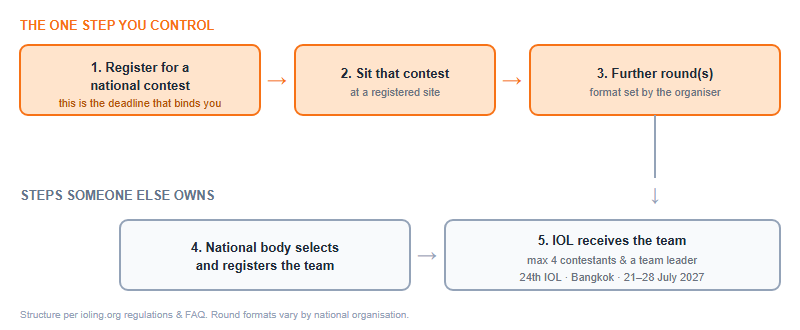
There is no sign-up page for the International Linguistics Olympiad. The IOL’s own FAQ is blunt: students “CANNOT PARTICIPATE unless they have qualified through an accredited national contest,” and “schools cannot directly apply to go to the IOL without a national/territory-wide contest.” So the deadline that actually binds you belongs to a national contest, sits months earlier, and is run by a different organisation.
The registration that binds you is not the IOL’s
Most students who ask us when registration opens are picturing a single portal with a countdown on it. That is not how this competition works, and the misunderstanding costs people whole cycles.
The IOL regulations describe an event that receives teams, not entrants. Each accredited country sends a team of “no more than four contestants” accompanied by a team leader; a second team “may participate at their own expense if the local arrangements allow it.” Qualification is explicit in the FAQ: “Participants compete in teams representing their countries. They qualify by winning a national contest, organised by an accredited national organisation.”
Read that as a chain of custody. You register with a national organisation. That organisation runs a contest. That contest produces a ranking. The organisation selects and registers a team. The IOL receives the team. You touch exactly one link in that chain — the first one — and it is the only one with a deadline you can personally miss.
The best-documented example of the pattern is NACLO in North America: an Open Round whose registration opens each October and is sat the following January over three hours with roughly six to eight problems at a registered site, then an Invitational Round in March over four hours of mostly written reasoning, from which the top four to eight in the United States and the top four in Canada form the respective IOL teams. There is a red line worth stating plainly, because we are asked every year: NACLO is for citizens of, or students enrolled at schools in, the United States or Canada. If you attend a school in mainland China, you cannot enter it. Its value to you is its public past problems as practice material — nothing more.
Which national contest can actually send you depends on your citizenship and where you are enrolled. Confirm that with the organisation itself before you build a calendar around it. If you are still working out what the competition involves before worrying about routes, start with our overview of the IOL.
What has to be true before you can register at all
Registration is not a form. It is the last step of an admin chain, and each earlier link has its own lead time. Students miss deadlines not because they forgot the date, but because something upstream was not ready on the day.
| What must already be true | Who owns it | Our planning estimate | What it costs you if left late |
|---|---|---|---|
| You are under 20 on the IOL opening day and still attending — or have only just finished — secondary school | IOL regulations | Two minutes to check | You train a full cycle for an event you were never eligible for |
| A national contest exists that you are entitled to enter | The accredited national organisation | Minutes to confirm; weeks if the answer is no | You discover in week ten that the route you studied for is closed to you |
| A registered sitting site — your school, or an approved centre | Your school, plus the organisation | Two to six weeks if your school has never hosted | Registration opens and closes while the school is still deciding |
| A named supervising teacher who will invigilate | Your school | One to three weeks | No supervisor, no site; no site, no sitting |
| Your name spelled exactly as it appears on your passport | You | Five minutes | Trivial now; painful once results, certificates and travel documents exist |
| Guardian consent and any data-handling forms | You and your family | A few days | The unsigned form is the classic reason a ready student does not sit |
The lead-time column is our own operational planning estimate for China-based international schools, not an official figure from any organiser — treat it as a prompt to start early rather than a promise. The eligibility row, by contrast, is regulation: the IOL FAQ states contestants “must be under 20 years old on the opening day of the IOL, and must attend (or have only just finished attending) secondary school.”
Two rows deserve special attention in an international-school context. First, the sitting site: a school that has never hosted a linguistics contest has no process for it, and the request has to travel through a head of department, an exams officer and sometimes a timetabling committee. Start that conversation before registration opens, not after. Second, the supervising teacher: this is usually a favour someone does you, and favours asked in a panic get refused.


A deadline we are told is moving — and why your plan should not depend on it
Our operator briefings this cycle report that registration for the next cycle is closing earlier than it has in previous years. We are passing that on because it changes what you should do this month, but we want to be exact about its status: this is our own operational information, not an announcement. The organising body’s own registration page is the authority. If what you read there disagrees with what you read here, the organiser wins, and we will correct this page.
Here is the useful part. A plan that only works if the deadline lands where you guessed is a bad plan. A plan built backwards from the sitting rather than the deadline is robust either way — because the sitting is what your preparation is actually aimed at, and because being registration-ready three weeks early costs you nothing.
So separate the two tracks and run them in parallel:
- The admin track is short, front-loaded, and finishes early. Its goal is that on the morning registration opens, the form takes you forty-five minutes and nothing is blocking.
- The preparation track is long and paced to the sitting. Its goal is that you arrive having already sat several full-length papers under real conditions.
Students conflate these, wait for the registration date to be confirmed, and lose a month of preparation to an administrative question. Do not wait. Nothing about the admin track gates the preparation track.
The backwards runway: sixteen weeks from a sitting date
Count backwards from whenever your national contest is sat. If the sitting falls in January, sixteen weeks puts your start in late September, so the foundations phase overlaps the month NACLO opens its registration, the one window we can point to, though your own contest may differ — convenient, and part of why we set the runway at this length.
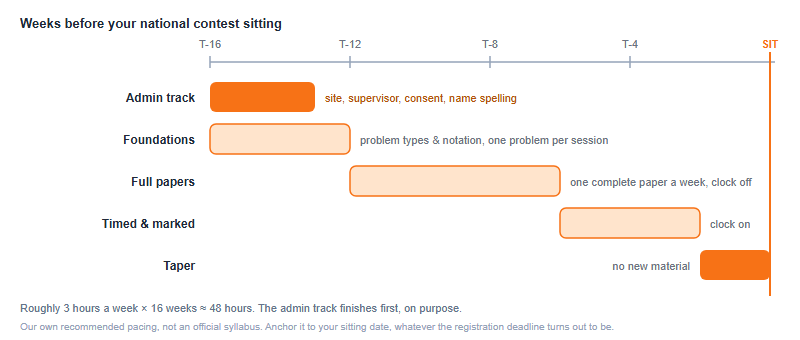
Three details separate a runway from a wish list. First, full-length before timed. Sit complete papers without a clock for several weeks before you add time pressure, or you will train yourself to abandon hard problems rather than crack them. Second, mark everything you sit. An unmarked paper teaches almost nothing; the diagnosis is where the learning lives. Third, taper honestly. The last fortnight is for consolidating what you already do, not for meeting a problem type for the first time.
The middle phase needs a steady supply of complete papers. We keep our own compiled pack of past problems, with worked solutions for some years rather than every year — scan the QR in the site footer to request it. If you want the week-by-week version of the pacing above rather than just its shape, our twelve-week study plan drops neatly into the middle of this runway.
The forty-five minute admin sprint
When registration opens, this should be a short evening, not a project. Do these in order, and do as many as possible before the window opens.
- Confirm eligibility against the organiser’s own page, not against a summary — including ours. Citizenship, enrolment and age rules are the ones that end cycles.
- Get the site question answered in writing. One email to your school naming the contest, the likely month, the room requirement and the supervision requirement. Written answers survive staff changes; corridor conversations do not.
- Assemble the identity details once. Full name exactly as printed in the passport, date of birth, the school’s official English name, year group. Keep them in one file so every future form is copy-and-paste.
- Sort consent before it is urgent. If a guardian signature is needed, get it in the same week you decide to enter.
- Set two reminders — one for the day registration opens, one for seventy-two hours before it closes. Register on the first, not the second.
- Screenshot the confirmation. If anything goes wrong later, the confirmation page and its timestamp are the only evidence you will have.
None of this is intellectually interesting, which is precisely why capable students skip it and then lose a year. The preparation is the hard part. The registration is merely the part that is easy to fail.
Questions we get asked
Can I register for the IOL directly if my country has no contest?
No. The IOL FAQ states students cannot participate unless they qualified through an accredited national contest, and that schools cannot apply directly.
How old is too old?
Contestants must be under 20 on the IOL opening day, and must attend or have only just finished attending secondary school. Check your own dates on ioling.org.
Do I need to have studied linguistics first?
No. The IOL FAQ says formal training is not expected, and knowledge of English or any other language is not mandatory for participants.
Is the earlier registration close confirmed?
It is our own operational information for this cycle, not an announcement. Confirm the date on the organiser’s registration page, which is the authority.
This is an independent guide operated by Hanlin Education for China-based international-school students. We are not affiliated with, endorsed by, or sponsored by the IOL Board. Competition dates, eligibility rules and formats are set by the organisers and can change — confirm current details on ioling.org and with your national organisation. Errors reported to our editorial desk are corrected within 7 working days.
Keep reading.
From Three Hours to Six: What Actually Changes Between a National Round Paper and an IOL Paper
A national open round gives you roughly 25 minutes a problem; the IOL gives you over an hour. Four things that change…
How to Mark Your Own Linguistics Olympiad Practice Paper When There Is No Solution Sheet
Worked solutions do not exist for every past paper. A five-band self-marking rubric, the regeneration test, and the four ways students quietly…
The Deadline Before the Deadline: Planning a 2026-27 Linguistics Olympiad Autumn Backwards From the Sitting
Registration for the coming cycle is reported to close earlier than usual. An autumn planned backwards from the sitting, with compression options…