
Most students solve far more problems than they mark, which in our coaching experience is why scores plateau after a few months. The marking is where the learning happens: it is the only step that tells you whether what you actually wrote down would have earned anything. Worked solutions do not exist for every past paper, so you need a method that works without one. Here is ours.
Why marking, not solving, is the bottleneck
A typical self-study week looks like this. You attempt a problem, you get somewhere, you look at the clock, you feel reasonably good about it, and you move on. Nothing in that loop tells you whether your written analysis was worth marks, so nothing in it can correct you. Six weeks later you are faster at the same partial understanding.
The reason this matters more in this competition than in most is the format. The IOL regulations set an individual contest of “a set of five problems… the duration is six hours”, with no break, and prohibit “artificial aids such as pocket calculators and calendars” along with “all mobile phones or other communication devices or devices with access to the WWW”. Six hours across five problems is over an hour each. Nobody spends seventy minutes on a problem and hands in a single word. What lands on the marker’s desk is a page of your written reasoning — and the regulations note that contestants receive problems “in a language of their choice and will write the solutions in the same language”, so a human being is reading your prose. National rounds work the same way: NACLO’s Invitational Round runs four hours and consists mostly of written reasoning, though you should confirm the current format on naclo.org.
If a person is reading your explanation, then the object you should be marking is your explanation. Almost nobody does. They check the answer.
The regeneration test: how a paper marks itself
The objection to self-marking is obvious — how can you grade an analysis when you do not know the right one? The answer is that a linguistics problem is unusually self-checking, in a way that a history essay is not. The data you were given is the mark scheme, because a correct analysis has to regenerate it.
So: state your rule in one sentence. Then run it forwards over every single line of the original data, including the lines you were not asked about. If it produces all of them, your analysis is at least internally consistent and you have earned real credit. If it fails on one line, your rule is wrong — even if the answer you submitted happened to be right.
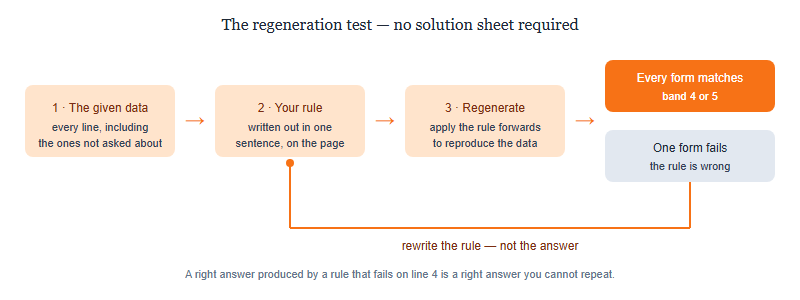
This is also why the regeneration test is worth doing in the exam, not only in practice. It is the cheapest available insurance: two minutes spent checking your rule against the lines you were not asked about will catch the analysis that was going to cost you a whole problem.


A worked mini-example
Here is a small invented language — our own illustration, not a past problem — to show what “right answer, no credit” looks like in practice.
| Form | Meaning |
|---|---|
| nira | he sees |
| niram | he saw |
| niras | he will see |
| kelo | she walks |
| kelum | she walked |
| kelus | she will walk |
| bito | they sleep |
| ? | they slept |
The answer is bitum. Nearly everyone gets it, by matching kelo / kelum and copying the shape across. Now compare three scripts, all of which submit bitum:
- Script A. “bitum”. Nothing else. The marker can see that you produced the form; there is no evidence you know why.
- Script B. “bitum — the past tense ending is -um.” This is confident, wrong, and it produces the right answer anyway. Run the regeneration test: the rule predicts nira plus -um, which is not niram. One line of the given data kills it.
- Script C. “bitum. Past is -m and future is -s. A stem-final o becomes u before a suffix; a stem-final a does not change. This generates niram, niras, kelum, kelus and bitum, and it predicts bitus for ‘they will sleep’.”
Script C is not longer because it is padded. It is longer because it contains three separate claims a marker can award: the suffix inventory, the conditioned vowel change, and a prediction that goes beyond the data. Script B is the interesting one, because it feels like understanding and is not. Without the regeneration test, the student who wrote B marks themselves correct and repeats the mistake in the exam, where the stem happens to end in a vowel that does not cooperate.
A five-band rubric you can apply without a solution sheet
This rubric is ours, developed for practice marking. It is not an official mark scheme, and no organiser has endorsed it — award schemes are set per contest and per problem, and the paper itself will usually tell you what it wants, so read the instructions on the paper before you decide what a full answer looks like. Use this to score practice consistently over time, not to predict a real result.
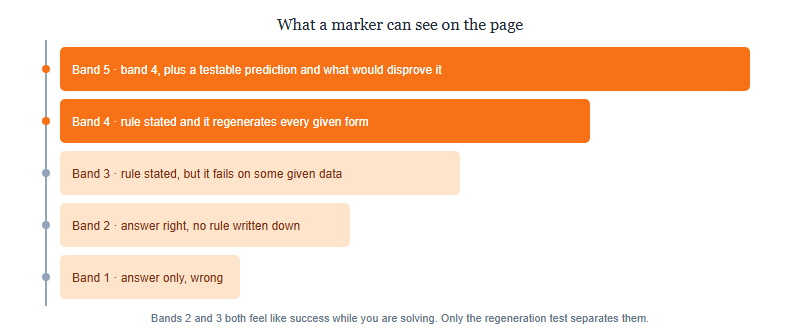
| Band | What is actually on your page | How you verify it without a solution | What to do next |
|---|---|---|---|
| 0 | Nothing usable; blank or abandoned | Trivially | Log the minutes spent before you gave up — that is the real finding |
| 1 | An answer, and it is wrong | Regeneration fails immediately | Re-segment the data before touching the question again |
| 2 | The right answer, no rule stated | You cannot verify it — there is nothing to test | Write the rule now, from memory, then test it. This is the highest-value ten minutes in the week |
| 3 | A rule, but it contradicts at least one given form | Regeneration fails on a specific line | Find the line that broke it and ask what distinguishes it |
| 4 | A rule that reproduces every given form | Regeneration passes | Check the rule is stated in the answer, not just in your head |
| 5 | Band 4, plus a prediction beyond the data and a named falsifier | Regeneration passes and the prediction is explicit | Nothing — repeat this shape on the next problem |
The four ways students over-mark themselves
Self-marking fails in four predictable ways, and each has a mechanical fix. None requires a teacher.
| Failure mode | What it sounds like | Why it inflates your score | The fix |
|---|---|---|---|
| Marking generously | “I basically had that.” | Credits reasoning that exists in your head, not on the page. A marker cannot read your head | Credit only what is written. If it is not in ink, it scored nothing |
| Marking the output | “My answer matched, so full marks.” | Script B above scores full marks under this method and is wrong | Run the regeneration test before you award anything |
| Marking after reading the solution | “Yes, that’s what I was thinking.” | Hindsight makes a half-formed analysis feel complete. Every score drifts upward | Mark first, in full, then read the solution. Never the other way round |
| Marking only what you attempted | “I got two out of two.” | Ignores the three problems you never opened, which score zero in a real sitting | Score out of the whole paper, always |
The third one deserves emphasis because of how it bears on our own compiled past-paper pack, which has worked solutions for some years rather than every year — a gap worth treating as an asset rather than a defect. A paper with no published solution forces the regeneration test, which is the skill you actually need. If you want papers to work through, the pack is here — scan the QR in the site footer to request it — and our suggestion is to deliberately reserve the solution-free years for full timed sittings.
One mechanic closes three of those four holes at once, and it is the one students resist: the blind second pass. Do not mark on the day you solve. Put the script away for at least twenty-four hours, then mark it cold, from the paper alone, as though a stranger had written it. If you cannot tell from the page what the rule was meant to be, neither could a marker — and that is a band 2, however clever the thinking was at the time.
Keep the results somewhere fixed. A log of six lines per problem is enough, and after eight weeks it will tell you something no single session can: whether your bands are rising, or only your speed. Record the paper, minutes spent, band awarded, whether regeneration passed, and one sentence on the single thing to change. That last column is the only part you will reread.
This slots into the middle of a season rather than replacing it — the marking method is what makes the practice hours count, and our twelve-week study plan is where those hours live. If you are earlier than that and still working out what the competition demands in the first place, start with the overview of what the IOL actually is.
A closing calibration, so the bands are not read as predictions. The IOL awards gold, silver and bronze “approximately in the ratio 1:2:3”, with total medals “between one quarter and one third of the number of contestants”, and contestants at or above the median without a medal receive an Honourable Mention. Those bands are set by the field on the day, not by your practice scores. What consistent self-marking buys you is not a predicted medal; it is that the thing you improve is the thing that gets marked.
Questions we get asked
How do I mark a paper with no official solutions?
Run your rule back over the data you were given. A correct analysis regenerates every given form; one failure means the rule is wrong.
Do I lose marks for a right answer with no explanation?
You generally earn less than a fully explained answer. Papers commonly ask for reasoning — read what the paper itself requires.
How soon after solving should I mark my own paper?
Wait at least a day, then mark from the script alone. Marking immediately credits reasoning you never actually wrote down.
Should I read the solution before marking?
No. Mark first, then read. Hindsight makes a half-formed analysis look complete and quietly inflates every score you record.
This is an independent guide operated by Hanlin Education for China-based international-school students. We are not affiliated with, endorsed by, or sponsored by the IOL Board, and we are not affiliated with NACLO or any national organiser. The five-band rubric above is our own practice tool and is not an official mark scheme; award criteria are set per contest and per problem and can change — confirm current details on ioling.org. The language data used as an illustration is invented for this article and is not taken from any past paper. Errors reported to our editorial desk are corrected within 7 working days.
Keep reading.
From Three Hours to Six: What Actually Changes Between a National Round Paper and an IOL Paper
A national open round gives you roughly 25 minutes a problem; the IOL gives you over an hour. Four things that change…
The Deadline Before the Deadline: Planning a 2026-27 Linguistics Olympiad Autumn Backwards From the Sitting
Registration for the coming cycle is reported to close earlier than usual. An autumn planned backwards from the sitting, with compression options…
How to Write About the Linguistics Olympiad in a University Application (2027 Entry)
Where the olympiad belongs in the three UCAS questions and a 150-character activity line, how to describe an award honestly, and four…