
The date that governs your season is not the one printed on a contest page. Behind every sitting stand two earlier deadlines you do not control: the date a school or site must be registered, and the internal cut-off your teacher quietly works to before that. Our operational information is that registration for the coming cycle is closing earlier than usual — so plan backwards from the sitting, not forwards from today.
What we are hearing, and why it should not change your plan
Two internal briefings this summer, on 9 July and 24 August, reported the same thing: for the coming cycle, registration windows are closing earlier than students and school coordinators have got used to. We are passing that on because it is actionable, but we want to be exact about what kind of claim it is. This is our own operational information. It is not an announcement by any organiser, and we are not in a position to publish a date on their behalf. The organiser’s own page is the authority — for the international contest that is ioling.org, and for whichever national round you are eligible for, it is that contest’s own site.
Here is the useful part: it does not much matter whether the window has moved by three weeks or has not moved at all. A season planned backwards from the sitting is correct either way. Planning forwards from today — “I’ll start when registration opens” — is what breaks when a date shifts, because it makes every downstream step depend on a number you do not yet know.
So there is exactly one thing worth doing this week, and it takes twenty minutes: find the real date, from the real organiser, and write it down somewhere you will see it. Everything below is arithmetic performed on that number.
The three deadlines stacked behind one sitting
Start from a fact that surprises most families: there is nothing for an individual student to register for at the international level. The IOL’s own participation page states that “each participating country sends 1–2 teams of four contestants each”, and that “the methods of choosing these contestants and composing the teams differ from country to country; in most cases a country’s contestants are chosen from the winners of their national Linguistics Olympiad”. That page publishes no student deadline, because at that level there is no student deadline to publish. Every date that binds you belongs to a national organiser or to your own school.
Which means the calendar you are actually racing has three layers, and only the middle one is published anywhere you would think to look.
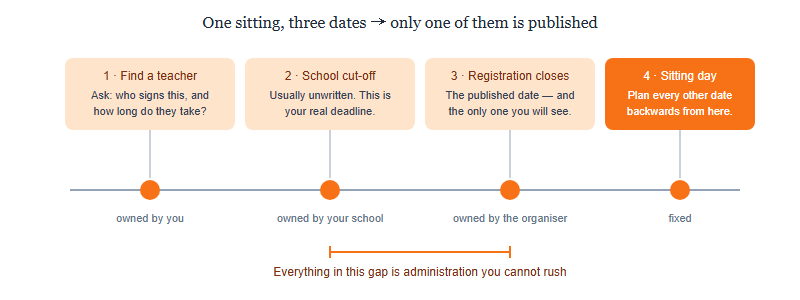
The dependency worth naming out loud is the adult. National rounds are typically sat at a registered site with a named member of staff responsible for it, and if your school has never run one, that person has to be recruited before anything else can happen. Recruiting a teacher in October is a two-to-three-week job in a school with a full timetable and a stack of reports due, not a two-day job. Students consistently under-budget this step and over-budget the studying.
The practical rule: your personal deadline is the organiser’s deadline minus your school’s administrative turnaround. That turnaround is knowable. Ask in September who signs off an external competition entry and how long they usually take. Nobody has ever been annoyed by that question.


An autumn planned backwards from a January sitting
The calendar shape used below puts the open paper in January, with registration opening the previous October. NACLO, the North American contest, is structured that way: its Open Round registration opens each October and is sat the following January over three hours with roughly six to eight problems at a registered site, with an Invitational Round in March over four hours consisting mostly of written reasoning. Confirm the current cycle’s dates on naclo.org rather than on this page.
One eligibility line first, because it decides which calendar applies to you. NACLO is for citizens of, or students enrolled at schools in, the United States or Canada. A student at a mainland Chinese school who does not hold US or Canadian citizenship cannot enter it — and no amount of good planning changes that. If that is you, the calendar below still works; the sitting you plan backwards from is your own country’s national olympiad, and ioling.org maintains the list of those. NACLO’s value to you is different and still real: its published past problems are first-class practice material.
| Weeks out | If the sitting is in January | What has to have happened | Who owns it |
|---|---|---|---|
| T−16 | Early September | Confirm which contest you are actually eligible for; identify a member of staff; ask what the school’s approval turnaround is | You |
| T−14 | Late September | Baseline: sit one full past paper under timed conditions before you have studied anything, so later gains are measurable | You |
| T−12 | October | Registration window typically opens; site confirmed or newly registered; your name on the internal list | Teacher + organiser |
| T−10 | Mid October | Structured practice begins: one problem type per week, plus a weekly review of what you got wrong and why | You |
| T−8 | November | Coverage of the main problem families; second full timed paper | You |
| T−4 | Early December | Repair phase — return only to the two types where you lose the most marks; third timed paper | You |
| T−2 | Late December | Volume drops. Confirm room, start time, materials permitted. Sleep becomes part of the plan | You + teacher |
| T−0 | January | Sitting | Fixed |
The two rows people delete are T−14 and T−2, and both deletions are expensive. Without an untimed-by-nobody baseline you cannot tell in December whether four months of work moved anything, which makes the whole autumn unfalsifiable. And the fortnight before a paper is not spare capacity; it is when consolidation happens. If you want the study content that fills the middle of this table, our twelve-week study plan is built to slot in from roughly T−12.
Four compression scenarios, if you have less time than that
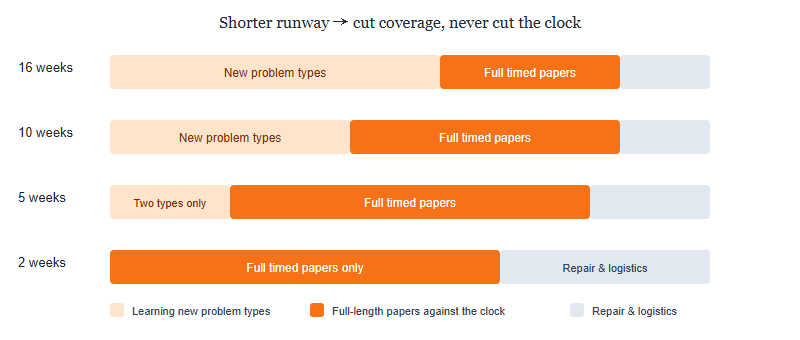
Most readers find this page in the wrong month. That is normal and mostly survivable, provided you compress the right thing. There is a strong instinct to cut the full timed papers first, because they are the most unpleasant item on the list and they eat a whole Saturday. That instinct is precisely backwards: at the sitting itself the binding constraint is almost never how many analytic techniques you know, it is how you spend the hours. Cut coverage. Keep the clock work.
| Time to the sitting | Keep | Cut | A realistic aim |
|---|---|---|---|
| 16 weeks | Full coverage, three timed papers, a written error log | Nothing yet | Compete on the merits of your preparation |
| 10 weeks | Four or five problem families, two timed papers, error log | The rarer problem types; any reading that is not problems | Most of the ground, none of the panic |
| 5 weeks | Two timed papers; the two families you score worst on | Breadth entirely. Do not tour the syllabus | A respectable paper and a real baseline for next cycle |
| 2 weeks | One full timed paper; the triage habit; sleep | Everything else, without guilt | Calibration — sit it to learn what the room feels like |
The two-week column deserves defending, because students often decide that if they cannot prepare properly they should not sit at all. That is the worst available choice. A first paper sat cold is the single most informative afternoon in this whole activity: it tells you what the format actually demands, which is information no amount of reading supplies. Sitting it as a calibration run, on purpose, with the next cycle already in mind, converts a rushed autumn into a genuine head start.
If the window has already closed for this cycle
Then you have a practice year, which is the ordinary path rather than a consolation prize. In our coaching experience, students who eventually do well at a national round usually sat something, or worked through something, the year before. Use the year concretely: work published past problems on a fixed weekly slot, keep a written log of every wrong analysis and what corrected it, and get two or three other students doing the same so you can compare readings of identical data. If you want the papers themselves, we keep our own compiled pack of past problems — scan the QR in the site footer to request it, and note that we have worked solutions for some years rather than every year.
One hard constraint should factor into this decision, because it is the one thing you cannot plan around. The IOL regulations state that contestants “must be less than 20 years old on the first day of the competition and must be pre-university students”. There is therefore a ceiling on how many cycles you get, and if you are already in your final pre-university year the arithmetic of a practice year changes completely. Work out how many cycles remain to you before you decide that this one does not matter. If you are still at the stage of deciding whether the competition is for you at all, our overview of what the IOL actually is is the better place to start than a calendar.
Finally, the fixed point on the horizon. ioling.org states that “Bangkok, Thailand has been selected to host the 24th International Linguistics Olympiad from July 21st to July 28th, 2027”. That is a real date, published by the organiser, and it is what the whole autumn chain eventually leads to for the small number of students who go all the way. Nothing about your national round is guaranteed by it — but it is a useful reminder that the January paper you are planning for sits inside a longer season, and that the students who handle January well are usually the ones who worked out the dependency chain in September.
Questions we get asked
Is registration really closing earlier this cycle?
Our operational information says so. The organiser’s own page is the authority, so check the real date and write it down.
Can I register for the IOL myself?
No. ioling.org states each country sends one or two teams of four, with contestants usually chosen from that country’s national olympiad.
Can a student at a mainland Chinese school enter NACLO?
Not unless they hold US or Canadian citizenship. Confirm on naclo.org. Its published past problems remain excellent practice either way.
How late is too late to start?
Five weeks still works if you keep the full timed papers. Under two weeks, sit it as a calibration run and plan properly for the next cycle.
This is an independent guide operated by Hanlin Education for China-based international-school students. We are not affiliated with, endorsed by, or sponsored by the IOL Board, and we are not affiliated with NACLO or any national organiser. Registration windows, eligibility rules and contest dates are set by those organisations and can change without notice; the earlier-closing report above is our own operational information and not an organiser announcement — confirm current details on ioling.org and on your national contest’s own site before acting. Errors reported to our editorial desk are corrected within 7 working days.
Keep reading.
From Three Hours to Six: What Actually Changes Between a National Round Paper and an IOL Paper
A national open round gives you roughly 25 minutes a problem; the IOL gives you over an hour. Four things that change…
How to Mark Your Own Linguistics Olympiad Practice Paper When There Is No Solution Sheet
Worked solutions do not exist for every past paper. A five-band self-marking rubric, the regeneration test, and the four ways students quietly…
How to Write About the Linguistics Olympiad in a University Application (2027 Entry)
Where the olympiad belongs in the three UCAS questions and a 150-character activity line, how to describe an award honestly, and four…