
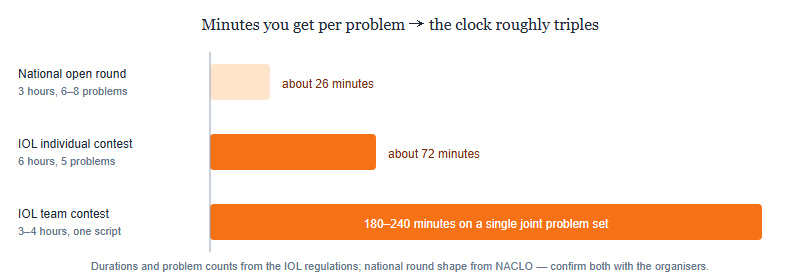
The step up is not that international problems are the same puzzles under more pressure. It is close to the reverse. A three-hour open round with six to eight problems gives you roughly twenty-five minutes each; the IOL regulations set five problems in six hours, which is over an hour each. The problems are built to need that hour, and that changes what you should be training.
The arithmetic of the step up
Start with the published numbers rather than with anyone’s impression of difficulty. The IOL regulations state that in the individual contest “a set of five problems is assigned; the duration is six hours”, and that “there is no break, although it is customary for refreshments to be provided”. Artificial aids such as pocket calculators and calendars are not permitted, and all phones, communication devices and devices with web access are strictly prohibited.
Against that, the shape of a national round. NACLO’s Open Round is sat in January over three hours with roughly six to eight problems at a registered site, and its Invitational Round follows in March over four hours consisting mostly of written reasoning — confirm the current format on naclo.org. Divide, and the difference stops being vague.
| National open round | National invitational round | IOL individual contest | IOL team contest | |
|---|---|---|---|---|
| Duration | 3 hours | 4 hours | 6 hours, no break | 3 or 4 hours, at the Problem Committee’s discretion |
| Problems | Roughly 6–8 | Mostly written reasoning | A set of five | One joint problem set |
| Time per problem | About 22–30 minutes | Confirm on naclo.org | About 72 minutes | The whole session, shared |
| Working with others | No | No | No | Yes — no more than four contestants |
| What is handed in | Answers with reasoning | Mostly written reasoning | Your written analysis, in your chosen language | A single team script |
What the extra hour is for
A problem you are expected to crack in twenty-five minutes has, in practice, one system to find. Spot the segmentation, apply it, write it up, move on. A problem written for seventy minutes almost always has two or three systems that interact, and — this is the part that catches strong students — the second system is usually invisible until the first one is solved.
Here is the shape of it, using an invented illustration rather than a real past problem. Suppose a numeral system where you work out, after fifteen minutes, that the base is twenty and that a numeral is built as multiplier-plus-unit. Everything fits. You have a rule that generates most of the data, and at a national round you would write it up and be right. Then you notice that three of the given numerals put the multiplier after the unit instead of before it, and that all three happen to be above a certain value. The first system was real; it was also only half the analysis. The second half was only discoverable from the residue the first one left behind.
That changes the failure mode completely, and this is the single most useful thing to internalise about the step up:
- At twenty-five minutes a problem, students lose marks by not spotting the pattern in time. The remedy is speed and pattern recognition.
- At seventy minutes a problem, students lose marks by spotting the first pattern, committing to it, and never going back to look at what it failed to explain. The remedy is a deliberate residue hunt.
So the trained behaviour is uncomfortable and slightly counter-intuitive: once your rule works, do not feel finished. Take the forms your rule does not cleanly generate, put them in a separate list, and treat that list as the actual problem. In a six-hour paper you have the time to do this, which means the examiners can assume you did, which means the problems are built on the assumption that you will. The other half of the same discipline is structured weekly practice that keeps returning to the types you avoid.
The second consequence of six hours is physical, and it is routinely underestimated. There is no break. Students who prepare in forty-five-minute sessions have never once experienced their own analytic quality at hour five, which is precisely when a paper is won or lost. You cannot discover that in a short session; you have to sit one long one.


The team contest is a different exam entirely
The IOL runs a second contest that has no equivalent in most national rounds, and students consistently arrive under-prepared for it because it is un-practisable alone. The regulations describe members working jointly on a single problem set, sharing the work and submitting one script, with “the time allowed for this… three or four hours, at the discretion of the Problem Committee”. A team is “no more than four contestants… accompanied by a team leader”.
Three or four hours, one problem set, four people, one piece of paper handed in. Nothing in solo practice trains any of the skills that decides: agreeing a notation in the first ten minutes so that four people’s working is mutually readable, splitting a problem without duplicating effort, and appointing one writer early rather than assembling four handwritings at the end.
It is also structurally scarce. Team medals are capped — at most one gold, two silver and three bronze across the entire contest — and the published results for IOL 2026 in Bucharest record exactly six team medals awarded. That is a different kind of scarcity from the individual medals, and it is worth knowing before you describe a team result to anyone, because almost no reader will realise how few exist.
The field changes shape too
The other half of the step up is who is in the room. A national open round is designed to be sat widely, at many registered sites, by students of very mixed preparation. The international field is the opposite: it is already a filtered population.
The IOL’s participation page states that “each participating country sends 1–2 teams of four contestants each”, and that “in most cases a country’s contestants are chosen from the winners of their national Linguistics Olympiad”. In North America the funnel runs from the Open Round through the Invitational Round to roughly the top four to eight in the US and the top four in Canada, who form the respective teams — confirm the current selection rules on naclo.org.
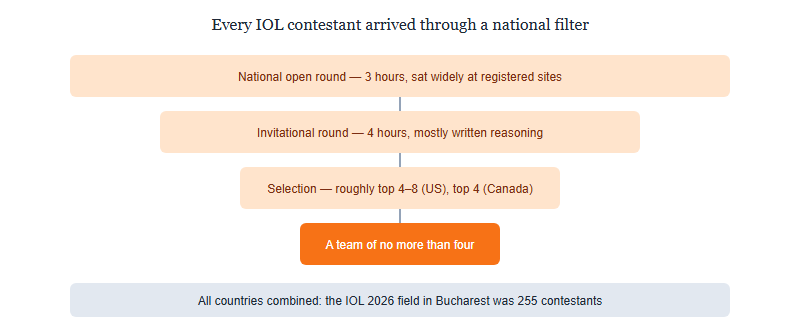
This matters for how you read an award. The regulations award gold, silver and bronze “approximately in the ratio 1:2:3”, with the total number of medals “between one quarter and one third of the number of contestants”, and contestants at or above the median who do not medal receive an Honourable Mention. Best solution prizes are awarded for individual problems. In Bucharest in 2026 that produced 84 medals from a field of 255, with 44 Honourable Mentions and nine best-solution awards; the medal count sat at the top of the published band.
Read that honestly and it cuts both ways. A third of contestants medalling sounds generous until you remember that the denominator is national team members. A bronze at the IOL is not “the top third of people interested in linguistics”; it is the top third of the students their countries selected. That is a genuinely strong result and it is also not a world ranking, and you should describe it as neither more nor less than it is.
Four things to train differently
None of this requires a different syllabus. It requires four adjustments to how the hours are spent.
| What changes | Why | What to actually do |
|---|---|---|
| Endurance | Six hours, no break, five problems — hour five is a skill | At least one full-length timed sitting per cycle, ideally two. Not four short sessions on the same day |
| The residue hunt | The second system only appears after the first is solved | Once your rule works, list every form it does not generate. Spend ten minutes there before writing up |
| Writing in your chosen language | The regulations say you receive problems “in a language of their choice” and “write the solutions in the same language” | Decide which language that is now, and practise writing full analyses in it. Do not discover in hour four that explaining a vowel alternation in a second language is slow |
| Working with other people | The team contest cannot be simulated alone | Practise in a group of three or four on one shared script, with an agreed notation and one appointed writer |
The third row deserves a sentence of its own, because it is specific to our readers and is almost never planned for. A student at an international school in China who thinks about grammar in Chinese but writes school essays in English has a real decision to make, and the sensible time to make it is in October, not in the room. Whichever you choose, the analyses you write in practice should be written in that language, at length, under time pressure. Availability of any particular language is a matter for the organisers — confirm on ioling.org.
One eligibility line to close on, because it determines whether any of this applies to you directly. NACLO is open to citizens of, or students enrolled at schools in, the United States or Canada; a student at a mainland Chinese school without US or Canadian citizenship cannot enter it, and no preparation changes that. Its published past problems remain excellent training material regardless, and your own route runs through your country’s national olympiad — ioling.org maintains the list. The IOL regulations also require contestants to be “less than 20 years old on the first day of the competition” and to be pre-university students, so the number of cycles available to you is finite and worth counting.
The horizon, meanwhile, is published: ioling.org states that Bangkok will host the 24th International Linguistics Olympiad from 21 to 28 July 2027. If you are working towards it, the useful thing to take from this article is not that it is harder — it is that it is longer per problem, and that long problems reward a habit most students never build. If you want papers to build that habit on, we keep our own compiled pack of past problems, with worked solutions for some years rather than every year; scan the QR in the site footer to request it. And if you are earlier than all of this, the overview of what the IOL is is the right first read.
Questions we get asked
How much harder is the IOL than a national round?
Mostly it is longer per problem. A three-hour open round allows about 25 minutes each; the IOL sets five problems in six hours.
How long is the IOL individual contest?
Six hours with no break for a set of five problems, per the IOL regulations. Calculators, phones and web-enabled devices are prohibited.
How many people compete at the IOL?
Each country sends one or two teams of four. The IOL 2026 field in Bucharest was 255 contestants; check ioling.org for each year.
Can I write my solutions in Chinese?
The regulations say contestants receive problems in a language of their choice and write solutions in that language. Confirm on ioling.org.
This is an independent guide operated by Hanlin Education for China-based international-school students. We are not affiliated with, endorsed by, or sponsored by the IOL Board, and we are not affiliated with NACLO or any national organiser. Contest durations, problem counts, award ratios, eligibility and selection rules are set by those organisations and can change — confirm current details on ioling.org and on your national contest’s own site. The numeral-system example is an invented illustration and is not taken from any past paper. Errors reported to our editorial desk are corrected within 7 working days.
How to Mark Your Own Linguistics Olympiad Practice Paper When There Is No Solution Sheet
You’re reading the earliest bulletin.
Keep reading.
How to Mark Your Own Linguistics Olympiad Practice Paper When There Is No Solution Sheet
Worked solutions do not exist for every past paper. A five-band self-marking rubric, the regeneration test, and the four ways students quietly…
The Deadline Before the Deadline: Planning a 2026-27 Linguistics Olympiad Autumn Backwards From the Sitting
Registration for the coming cycle is reported to close earlier than usual. An autumn planned backwards from the sitting, with compression options…
How to Write About the Linguistics Olympiad in a University Application (2027 Entry)
Where the olympiad belongs in the three UCAS questions and a 150-character activity line, how to describe an award honestly, and four…