
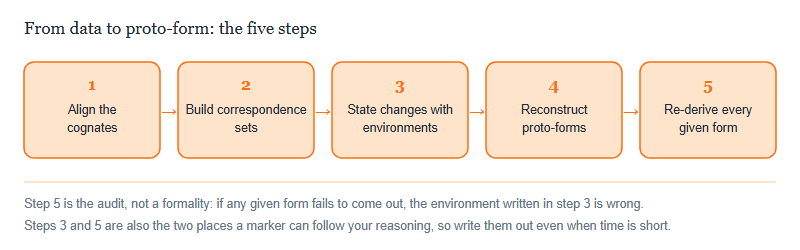
A reconstruction problem gives you the same handful of words in two or more related languages and asks what the ancestor looked like and what changed on the way to each descendant. You are not being tested on history you have memorised. Everything you need is in the data, and the method is mechanical once you see it: align the words, build correspondence sets, state each change with the environment that triggers it, then re-derive every form you were given.
What a reconstruction problem is actually asking
Most linguistics olympiad problems ask you to decode a system you have never met. A reconstruction problem narrows the target: the system you are decoding is change. You are given a table of related words, usually with English glosses, from two, three or four languages of one family. Three jobs follow from that table:
- Identify the correspondences. Which segment in Language A lines up with which segment in Language B, in which position, and how many times?
- State the changes. What was the older sound, what did it become, and in exactly which environment did it become that?
- Apply the changes. Predict unseen forms in one direction, and reconstruct unseen ancestors in the other. In our own walkthrough sessions this is the part that separates scripts most, though each problem carries its own mark scheme.
It helps to see where this genre sits next to the others. A phonology problem asks what a sound system is: which segments contrast, which are predictable variants. A reconstruction problem asks what a sound system was, and what happened to it. The machinery overlaps — natural classes, environments, complementary distribution — but the question is different, and so is the shape of a good answer. If you are new to the contest itself, our guide to what the International Linguistics Olympiad is covers the format and the route in; this article assumes you already solve problems and want this particular genre to stop feeling like guesswork.
One reassurance worth internalising: the problems are built so that no outside knowledge of the family is required. Recognising a language is a small comfort and nothing more. The marks are for the argument printed on your page.
Correspondence sets, not similar-looking words
The unit of evidence in this genre is not a word. It is a correspondence: a segment in Language A standing in the same position as a segment in Language B, across a set of words that mean the same thing. A single lookalike pair is a coincidence. A pairing that recurs three or four times, always in the same environment, is a fact you can build on.
Four working rules keep the evidence honest:
- Align by position, not by eye. Number the segments of each word and compare column by column. Whole-word resemblance is exactly the trap the setter is testing.
- Demand repeats. Treat any correspondence seen once as unproven until a second row supports it, and write the supporting rows down next to it.
- Keep positions separate at first. Word-initial, word-medial and word-final behaviour can differ. Merge the columns only after you have shown they behave alike — and then say in your answer that you checked.
- Vowels are correspondences too. Solvers hunt consonants and lose vowel marks. Build the vowel table before you decide you have finished.
From our own walkthrough sessions with China-based students, the most common way a strong solver loses a historical problem is not a hard analytical error. It is comparing whole words instead of columns: two words look alike, a rule gets written from that impression, and three rows later the rule collapses with no time left to rebuild it.


A worked mini-family: eight words, two languages
The data below is invented for this article — no past problem is reproduced — but it behaves the way a real set behaves. Two related languages, called simply A and B, with English glosses.
| Row | Gloss | Language A | Language B | Segment in question | Next vowel |
|---|---|---|---|---|---|
| 1 | fish | kimu | chimu | k : ch | i |
| 2 | to see | keri | cheri | k : ch | e |
| 3 | blood | naki | nachi | k : ch (word-medial) | i |
| 4 | stone | kata | kata | k : k | a |
| 5 | road | koto | koto | k : k | o |
| 6 | hand | paku | paku | k : k (word-medial) | u |
| 7 | moon | sila | chila | s : ch | i |
| 8 | salt | sona | sona | s : s | o |
Sort the rows by the segment rather than by meaning, and the pattern falls out. Rows 1, 2 and 3 show A k matching B ch, and in every one of those rows the following vowel is i or e. Rows 4, 5 and 6 show A k matching B k, and there the following vowel is a, o or u. Nothing overlaps: the two outcomes are in complementary distribution, decided by the vowel that follows.
Row 3 is the row our own walkthrough sessions show solvers skip most often. naki to nachi puts the change inside the word, not at its start, which tells you the rule is not restricted to word-initial position. Write that observation down explicitly. A marker cannot award you credit for a check you performed silently.
So the first statement is: in the history of Language B, *k became ch before front vowels, while Language A kept the older sound. In notation, *k > ch / __ {i, e}; elsewhere k is unchanged.
Which language is conservative is a conclusion, not an assumption. Language B has the conditioned distribution — ch only before i and e, k only elsewhere — which is exactly the residue a conditioned change leaves behind. Language A has one sound in all environments. Deriving B from an A-like ancestor takes one rule with one environment. Deriving A from a B-like ancestor would require ch to turn into k in some words and into s in others with nothing in the data to predict which, and the next section shows why that is fatal.
Mergers, and why direction matters
Rows 7 and 8 add the second layer. A s matches B ch before i, and matches B s before o. So *s also became ch before front vowels. That means B’s ch has two ancestors: it is a merger, and mergers destroy information.
The consequence is the whole point of the problem. Going from A to B is a function: every A form has exactly one B outcome. Going from B back to A is not, because a B form beginning chi- could descend from *ki- or from *si-, and nothing in B distinguishes them.
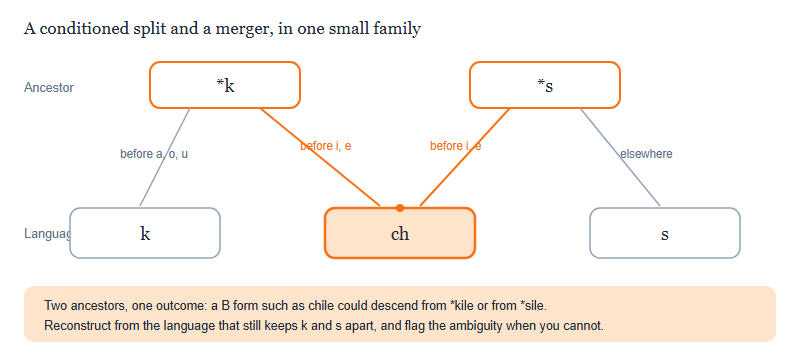
That asymmetry converts directly into answers. The table below shows what each direction can and cannot deliver on this invented family.
| Task | Given | Answer | Justification you should write |
|---|---|---|---|
| Predict B from A | kise | chiche | both k and s become ch before a front vowel (rows 1–3, 7) |
| Predict B from A | sopa | sopa | s is unchanged before a non-front vowel (row 8) |
| Reconstruct A from B | moche | moke or mose | ch before e has two sources; the data cannot decide |
| Reconstruct A from B | kanu | kanu | k survives before back vowels, so no change to undo |
Choosing one of the two candidates silently is the expensive mistake. You have a fifty per cent chance of the form and a zero per cent chance of the insight, when writing both plus one sentence of explanation costs you fifteen seconds.
Writing the answer so the marks land
A reconstruction answer is a short argument, and it has a predictable shape. Give the marker these five things, in this order, and almost nothing can be lost in transit:
- The rules, numbered. One line each, in the form X > Y / environment, followed by a plain sentence saying the same thing. Notation alone is risky if your symbols are unusual; a sentence alone is slow to check. Do both.
- The rows that support each rule. “R1: rows 1, 2, 3; no counterexamples in rows 4–6.” This is the cheapest credibility you can buy.
- Ordering, if the rules interact. If R1 must apply before R2, say so and cite the form that proves it. If they do not interact, say that too.
- Proto-forms with an asterisk, and one line explaining that the asterisk marks a reconstructed, unattested form.
- Explicit ambiguities. Where a merger makes two reconstructions possible, list both and say which merger is responsible.
Then run the audit. Take every form in the original data, apply your rules to the proto-forms you reconstructed, and check that the attested descendants come out. If one row fails, you do not have an exception — you have an environment you have not found yet. Two minutes of re-derivation catches more errors than twenty minutes of staring, and it is the habit that separates a solver who thinks they are right from one who knows.
Building the skill without a teacher
Historical problems reward drilling more than most genres, because the same three or four mechanisms — conditioned split, merger, loss, metathesis — recur across completely unrelated data. Three drills, in ascending difficulty:
- Cover a column. Take a set you have already solved, hide the second language entirely, and regenerate it from your own rules. Every mismatch is a missing environment. This is the single most efficient exercise in the genre.
- Rules first, answers second. Force yourself to write the rule statements before you write a single translation. If you cannot state the rule, you have not solved anything yet, you have pattern-matched.
- Set your own family. Invent five words, one conditioned change and one merger, then hand the table to a friend. Watching someone reason through data you designed teaches you what a setter is actually controlling — which rows are evidence and which rows are the test.
For material, work from our free past-problem practice pack, which our teachers have organised by problem type so you can do several historical sets in a row rather than meeting one every few weeks. On timing, a realistic cadence for a student in school is one historical problem per week: forty minutes solving as a deliberately compressed drill, tighter than IOL pacing, then twenty minutes writing the rules out cleanly as if they were being marked. If you are building a longer runway, our 12-week study plan shows where to slot that block alongside the other problem types so you are not revising phonology and reconstruction in the same fortnight and confusing the two.
One last note on expectations. Reconstruction problems look intimidating because the vocabulary around them — proto-form, cognate, merger — sounds like a university course. The analytical content is smaller than the vocabulary suggests. Anyone who can hold a table straight, compare columns rather than words, and write an environment precisely can score on them. The barrier is discipline, not background.
Questions students ask
Do I need to know language families to solve these?
No. The data is self-contained. Marks come from the correspondences you demonstrate, not from any family you happen to recognise.
Which language should I reconstruct from?
The one that keeps distinctions. A language that has merged two sounds has lost information, so it cannot predict its relatives uniquely.
What if two proto-forms both work?
Give both, name the merger that causes the ambiguity, and say what evidence would decide it. Silent guessing throws away the insight.
How long should the written rules be?
Short. One line per change with its environment, plus the rows supporting it. Follow any formatting instruction printed on the paper.
IOL Club is an independent guide operated by Hanlin Education for China-based international-school students. We are not affiliated with, endorsed by, or sponsored by the IOL Board, and this article is not an official statement of contest rules. Formats, timetables and regulations change between editions, so confirm current details on ioling.org before you rely on them. If you spot an error, tell us and we will correct it within 7 working days.
Keep reading.
IOLC Consonant Digraphs: Why bh, mb and ng Stay Single Units in Rongga-Style Data
In the 2026 IOLC Newcomer/Junior Division Rongga problem note, bh, mb and ng are recorded as consonants. Learn a data-first method for…
IOLC Team Average: How Each Participating Member Changes the Score
Understand how the IOLC team average is calculated from the individual scores of actual participating members, how adding or removing a member…
IOLC 2027 Level Test: Run a 3-Hour, 4-Problem Mock Before March 7
Prepare for the IOLC 2027 Level Test (March 7) by simulating the latest source-backed 2026 regional format: three hours, four independent puzzles….