
Most students choose an olympiad by prestige, then discover two years later that the binding constraint was never their ability. Every competition has two gates: a skill gate you can train through, and an access gate you often cannot. Choosing well means reading both honestly — and the linguistics olympiad has an unusually explicit access gate that students routinely fail to price in.
The wrong question and the right one
The wrong question is “which olympiad looks best?” It has no answer, because the comparison depends entirely on a student who does not exist in the abstract. The right question is narrower and much more useful:
Given my school, my year group, my citizenship and residence, and the roughly ten hours a week I can actually protect — which competition's bottleneck can I realistically clear, and what do I get if I clear it only partway?
That last clause matters most. Almost nobody reaches the international stage of any olympiad. So the real question is not what happens if you win, but whether the partial outcome — the national round, the training, the way of thinking — is worth the years by itself. For some competitions it clearly is. For others it clearly is not. That is the comparison worth making.
Two gates, and only one of them is about you
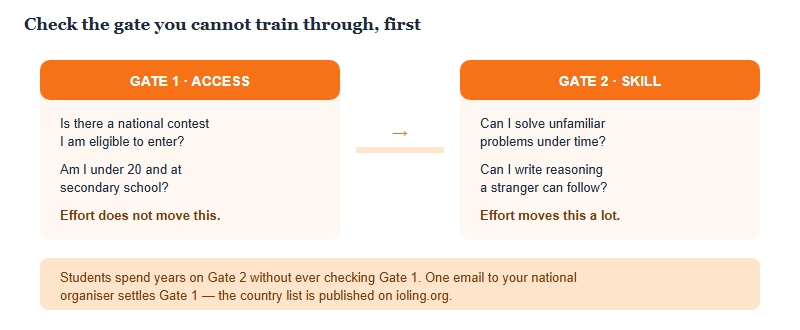
The linguistics olympiad is unusually transparent about its access gate, which is a good thing — it means you can check it in an afternoon rather than discovering it in year three. The published position on ioling.org is direct: “You can only participate in the IOL by qualifying through your national contest,” and “Students cannot participate on their own. No exceptions.” Where no national contest exists and no serious attempt is being made to start one, participation is not possible at all.
Alongside that, contestants must be under 20 on the opening day and must attend, or have only just finished attending, secondary school; and each accredited country is entitled to send one team of no more than four contestants, accompanied by a team leader.
Read those together and the shape becomes clear. The skill gate is trainable and the training is unusually self-serviceable. The access gate is administrative, is decided before you ever sit a paper, and is not responsive to effort. So you check it first.
Four axes worth scoring yourself on
Instead of comparing reputations, compare demand profiles. Score any competition you are considering — linguistics or otherwise — on these four axes, and check each competition's own official rules for its specifics rather than assuming they resemble each other. They frequently do not.
| Axis | Question to answer | Where the linguistics olympiad sits |
|---|---|---|
| Prior curriculum load | How much must I learn before I can attempt a real problem? | Unusually low. The official FAQ says specialist linguistic knowledge is “not technically” required, and that “the problems are constructed in such a way that all you need to solve the problem is found in the text given to you.” You can attempt a genuine problem this week, though the same FAQ adds that background knowledge is very useful and that the contest tests thinking linguistically, not logic alone. |
| Control over entry | Can I enter by choosing to, or does someone have to admit me? | Low control. Entry runs only through a national contest; there is no individual registration route. Verify your own eligibility before anything else. |
| Local training infrastructure | Are there teachers, teammates and materials near me — or am I alone? | Thin in most Chinese international schools. Compensated by published past problems and solutions, but you will likely need to build your own group. |
| Transfer value if I stop | If I quit after one year, what did I keep? | High. Data-pattern reasoning, hypothesis testing against counter-examples and writing an argument under time pressure transfer to almost everything. |
The pattern that emerges for linguistics is distinctive: a low barrier to starting, a high barrier to arriving, and unusually good consolation prizes. That combination suits a particular student — one who enjoys the puzzle for itself and would keep doing it whether or not a team seat materialised. It suits badly the student who is choosing an activity purely as a credential, because the credential is precisely the part that is hardest to guarantee.


The honest ceiling conversation
It is worth saying the numbers out loud rather than letting students discover them late. In 2026 the international contest in Bucharest involved 255 contestants from 65 teams representing 46 countries and territories. Each accredited country is entitled to one host-funded team of no more than four, and can send a second team only at its own expense if the local organisers allow it. Under the published rules, the total number of medals sits between roughly a quarter and a third of contestants, with gold, silver and bronze awarded in approximately a 1:2:3 ratio.
None of that should be read as discouragement, and it is not the right frame anyway. The correct conclusion is this: for the overwhelming majority of students, the national contest is not a qualifying step — it is the competition. Planning your year around doing genuinely well nationally is realistic, honest and worth doing. Planning it around a Bangkok team seat as the only acceptable outcome sets up a year that can only be judged a failure.
Students who need to understand what they would actually be signing up for should read the full overview of the competition before making a commitment decision.
A commitment ladder, not a yes-or-no
The most useful reframe we can offer: this is not a binary choice made once. It is a ladder, and you should climb one rung at a time, with an explicit exit review at each. Committing three years up front to something you have never tried is how students end up trapped in an activity they resent.
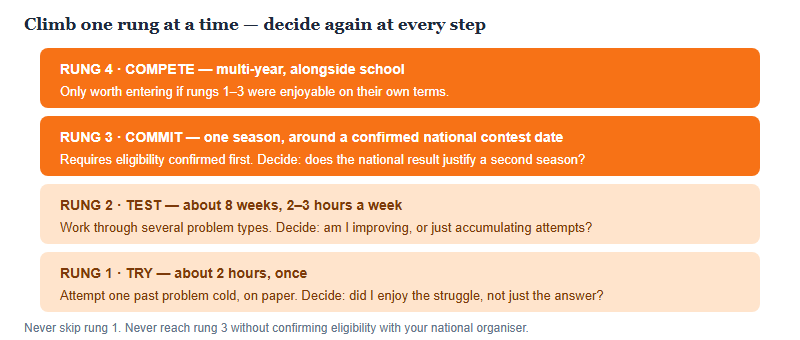
Rung one costs an afternoon and settles more than a month of deliberation. Take a real problem from the free past-problems pack, sit with it cold on paper, and pay attention to how the hour felt — not to whether you solved it. Students who find that hour absorbing tend to keep going. Students who find it merely difficult usually should not, and there is no shame in that finding. Rung two is where a structured twelve-week block starts earning its place.
Two ways students fall off this ladder are worth naming, because both are common and both are avoidable:
- Collecting olympiads. Entering five competitions shallowly produces five thin results and no real skill. Depth in one is more defensible in every direction — including in how you talk about it later — than breadth across many. Pick at most two that share underlying skills.
- Choosing on prestige rankings you read online. Nobody outside your own situation can tell you which competition suits your eligibility, your school and your temperament. A ranking that does not know whether you can legally enter is not advice.
The same decision looks different in Grade 8 and Grade 11
Year group does not change the framework, but it changes which axis dominates.
If you are in Grade 8 or 9, the deciding axis is transfer value. You have enough runway that a wrong choice is cheap and a right one compounds, so weight “would I enjoy this even if nothing came of it” heavily and worry about access later. The one thing worth doing early is checking the access gate anyway — not because it is urgent, but because discovering at 17 that you were never eligible is a genuinely bad way to find out.
If you are in Grade 11 or 12, the deciding axis is control over entry, and the arithmetic is harsher. With school assessment and applications competing for the same hours, committing to a competition whose entry route you have not yet confirmed is the highest-risk version of this decision. Confirm eligibility first — including whether the under-20 and “attending or only just finished attending secondary school” conditions still cover you in the year you would compete — and only then decide how many rungs of the ladder you can honestly climb. Rung two, done properly and enjoyed, is a defensible outcome for a senior. Rung four usually is not, started this late.
One caution on how you frame any of this: no competition, at any level, guarantees an admissions outcome, and nobody honest will tell you otherwise. Choose the one whose training you would defend as worthwhile even if the result went nowhere. If linguistics passes that test for you, the access gate is the very next thing to check — this week, by email, with your national organiser.
Frequently asked questions
Do I need to have studied linguistics first?
No. The official FAQ says specialist knowledge is not technically required and that everything needed to solve a problem is contained in the text you are given.
Can I do a linguistics olympiad alongside a maths or science olympiad?
Often yes at the trial stage, rarely well at the committed stage. Check each competition's own official calendar and rules before assuming they fit together.
What if my country has no national contest?
ioling.org states that where no contest exists and no attempt is being made to start one, you cannot take part. Check the published country list first.
Is it worth it if I never make the national team?
That is the right question to ask before starting. The reasoning, hypothesis-testing and timed-writing skills transfer widely — but decide that for yourself at rung one.
This is an independent guide operated by Hanlin Education for China-based international-school students. We are not affiliated with, endorsed by, or sponsored by the IOL Board, and this page is not an official source. Nothing here is a prediction or guarantee of any competition or admissions outcome. Rules, eligibility, dates and selection procedures are set by the organisers of each competition and change between editions — confirm current details on ioling.org and with your national organiser, and check other competitions against their own official sources. Factual errors reported to our editorial desk are corrected within 7 working days.
Keep reading.
From Three Hours to Six: What Actually Changes Between a National Round Paper and an IOL Paper
A national open round gives you roughly 25 minutes a problem; the IOL gives you over an hour. Four things that change…
How to Mark Your Own Linguistics Olympiad Practice Paper When There Is No Solution Sheet
Worked solutions do not exist for every past paper. A five-band self-marking rubric, the regeneration test, and the four ways students quietly…
The Deadline Before the Deadline: Planning a 2026-27 Linguistics Olympiad Autumn Backwards From the Sitting
Registration for the coming cycle is reported to close earlier than usual. An autumn planned backwards from the sitting, with compression options…