
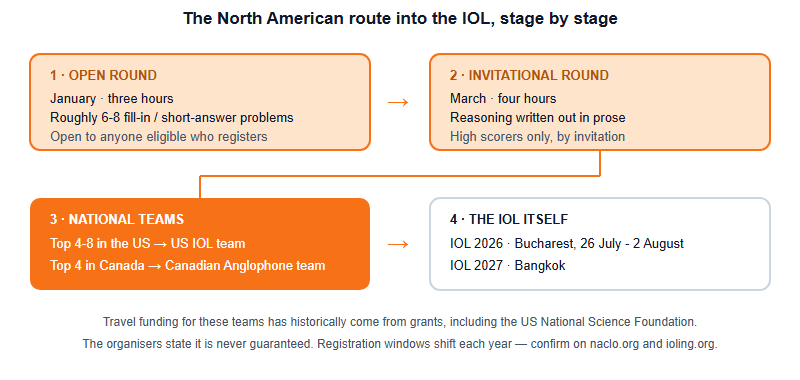
National IOL teams are not chosen by application. They fall out of a country’s own selection contest. In North America that contest is NACLO, which runs an Open Round in January and an Invitational Round in March; the top four to eight scorers in the United States and the top four in Canada become IOL team members. Crucially, NACLO is closed to students at schools in mainland China.
Why the word “NACLO” keeps appearing in IOL coverage
If you have read anything about the International Linguistics Olympiad in English, you have met the acronym NACLO — the North American Computational Linguistics Open Competition. It shows up in team announcements, in problem-archive links, and in almost every English-language explainer of how the IOL works, usually with no explanation of what it is or who it is for.
That is the gap this piece closes. NACLO is not a rival to the IOL and it is not a training programme. It is one country pair’s national selection contest — the mechanism by which the United States and Canada decide who represents them at the IOL. Every participating country has some equivalent, run by its own organisers. NACLO is simply the one whose materials are most visible in English, which is why students in Shanghai and Shenzhen keep running into it and quietly assuming it is the door they walk through.
It is not. Understanding why is genuinely useful, because once you see how a selection pipeline is built, you can read your own country’s route with much clearer eyes. If you are new to the competition itself, start with our guide to what the IOL actually is and come back here.
Two rounds, and what each one is really testing
NACLO runs in two stages. The distinction between them matters more than the dates, because the two rounds reward genuinely different skills — and only one of them resembles the way most students practise.
The Open Round is exactly what the name suggests: open to anyone eligible, no qualification needed. Registration opens each October and the round is sat the following January. The 2026 edition ran on 29 January, lasted three hours, and contained roughly six to eight problems in fill-in and short-answer format. The emphasis is on getting to the right answer inside a tight window across many problems.
The Invitational Round is for high scorers from the Open Round only. The 2026 edition ran on 19 March and lasted four hours. The format shifts: answers are mostly written, and you are expected to set out your reasoning in prose rather than simply produce the correct output. That shift — from “what is the answer” to “show me the system you found” — is the single most important thing a China-based student can learn from NACLO’s existence, and we will come back to it.
| Open Round | Invitational Round | |
|---|---|---|
| Who sits it | Anyone eligible who registers | High scorers from the Open Round, by invitation |
| When (2026 edition) | 29 January | 19 March |
| Length | Three hours | Four hours |
| Shape | Roughly six to eight problems, fill-in and short answer | Fewer, longer items; answers mostly written out |
| What it rewards | Speed, triage, clean pattern-spotting under pressure | Explaining the system you found, in prose a marker can follow |
| Registration | Opens each October for eligible entrants only — see the eligibility line below; dates change each year | No separate registration — invitation only |
The problems themselves will look familiar to anyone who has worked through our IOL past-problems pack: self-contained decipherment puzzles built on unfamiliar languages — Swahili, Inuktitut, Ancient Egyptian and the like — covering translation, numeral systems, writing systems, calendars, phonology and computational items. As with the IOL, no linguistics background, no second language and no programming knowledge is required. Everything you need is on the page.
From a score to a seat on the plane
Here is the part that is rarely spelled out. There is no separate team application to write. Places follow the Invitational Round scores, provided the students also meet the IOL’s own eligibility requirements: the top four to eight scorers in the United States form the US IOL team, and the top four in Canada form the Canadian Anglophone team.
That is worth sitting with. In a lot of competitions there is a soft layer — a shortlist, a panel, a portfolio — where a persuasive student can argue their way upward. Here there is not. The pipeline is narrow and score-driven, with the IOL’s own eligibility requirements as the remaining gate — confirm the current criteria on naclo.org.


The eligibility line, stated plainly
This is the section that matters most for our readers, so there will be no hedging in it.
NACLO is open to citizens of the United States or Canada, or to students enrolled at a school in the United States or Canada. A student attending a school in mainland China cannot enter NACLO. Not with a parent’s permission, not through an agency, not by paying a fee, not by sitting it remotely. The rule is about citizenship or school enrolment, and there is no side door.
We say this bluntly because the alternative is worse. Every year we speak with families who have spent weeks building a plan around NACLO after finding it in English-language IOL coverage, and who then discover the eligibility clause in October when registration opens. That is a wasted autumn attached to a real disappointment, and it is entirely avoidable.
Two secondary points, both worth knowing so you can judge related claims:
- Age framing. NACLO states it is aimed at students aged 13 to 18. Younger entrants are welcomed with parental permission, but are told plainly that the contest is pitched at older students. The IOL itself sets its own separate age and eligibility rules — confirm those on ioling.org rather than assuming NACLO’s framing carries across.
- Your own route. If you are at a school in mainland China, your path to the IOL runs through your own country’s selection process, not through North America’s. We are not going to describe that process here, because getting it half-right would be worse than not describing it: the countries section of ioling.org lists who organises each national olympiad, and that is the authoritative place to look.
Travel funding: the part nobody puts in the announcement
Making a national team and getting to the host city are two different problems, and the second one is invisible in almost all coverage.
For the North American teams, travel funding has historically been covered by grants, including support from the US National Science Foundation. But the organisers are explicit that this is never guaranteed, and selected students are told the funding position for their year. In other words: the money is real, it has usually been there, and it is not a promise.
Take the general lesson rather than the specific figure. Every national delegation solves the travel problem somehow — grants, a national body, a school, a family — and the arrangement varies by country and by year. If you are building a multi-year plan around reaching an IOL, the sensible move is to find out early how your own country’s team is funded, rather than discovering it in the week after selection. Ask the national organiser listed on ioling.org. It is an ordinary question and they are used to it.
What a China-based student should actually do with all this
Here is the practical turn. You cannot enter NACLO — but NACLO’s problems are published, and they are among the best training material that exists for this discipline. There is nothing awkward about using them. They are put out publicly, they are self-contained, and they share problem families with the IOL: translation, numeral systems, writing systems, calendars, phonology, computational items.
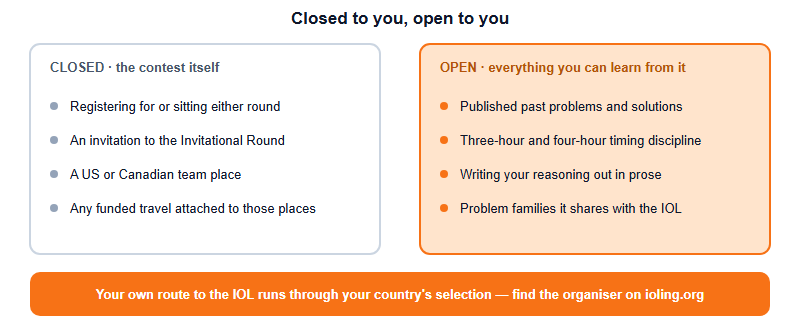
Three ways to use it well, drawn from what we see working in our own weekly sessions:
- Copy the clock, not just the content. A three-hour set of six to eight short-answer problems is a different animal from one long paper. Sitting a full timed set forces triage decisions you will never rehearse by solving one problem an evening.
- Use the Invitational format as a writing drill. This is the highest-value borrowing available to you. Take any problem you have already solved, then write out the system in prose as if a marker who cannot see your scratch work has to follow it. Most students who plateau are not failing to find patterns — they are failing to make the pattern visible on the page.
- Slot it into a structured block, not a random pile. Isolated problems produce isolated skills. Our twelve-week study plan gives you a frame to hang this material on, so that a NACLO set becomes a diagnostic rather than an evening’s entertainment.
One honest caveat, from our own cohorts and with the usual note that individual results vary: students who train exclusively on one national archive tend to develop a taste for that archive’s house style. Mix your sources. The IOL’s own past papers, other national olympiads’ published sets, and NACLO’s archive each have slightly different habits of presentation, and breadth is what stops you being surprised on the day.
Frequently asked questions
Can a student at an international school in Shanghai enter NACLO?
No. NACLO requires US or Canadian citizenship, or enrolment at a school in the US or Canada. Enter through your own national route instead.
Does NACLO require programming or linguistics knowledge?
No. Problems are self-contained decipherment puzzles. No linguistics background, no second language and no programming are needed.
How large is the US IOL team?
The top four to eight scorers in the US Invitational Round form the team; Canada’s Anglophone team is the top four. Confirm current numbers on naclo.org.
Is travel to the IOL paid for?
For North American teams it has historically come from grants including the US NSF, but organisers state it is never guaranteed. Arrangements differ by country.
IOL Club is an independent guide operated by Hanlin Education for China-based international-school students. We are not affiliated with, endorsed by, or sponsored by the IOL Board, and we do not administer NACLO or any national selection round. Registration windows, eligibility rules, round formats and funding arrangements change from year to year — confirm current details on ioling.org and with the relevant national organiser before acting on anything here. Errors reported to our editorial desk are corrected within 7 working days.
Keep reading.
From Three Hours to Six: What Actually Changes Between a National Round Paper and an IOL Paper
A national open round gives you roughly 25 minutes a problem; the IOL gives you over an hour. Four things that change…
How to Mark Your Own Linguistics Olympiad Practice Paper When There Is No Solution Sheet
Worked solutions do not exist for every past paper. A five-band self-marking rubric, the regeneration test, and the four ways students quietly…
The Deadline Before the Deadline: Planning a 2026-27 Linguistics Olympiad Autumn Backwards From the Sitting
Registration for the coming cycle is reported to close earlier than usual. An autumn planned backwards from the sitting, with compression options…