
Most students spend a year on the linguistics olympiad and then describe it in one flat sentence that could have been written by someone who never sat a paper. The competition is unusually good raw material for an application, because it produces a reasoning story rather than a credential. Getting that story onto the page takes about an hour of deliberate work.
The three sentences every reader has already seen
Admissions readers work through applications at speed, and by late autumn they have seen the same three constructions many times over: I have always been fascinated by language; I competed in the linguistics olympiad; this developed my analytical skills. None of them is false. All three are unusable, for the same reason: they are equally available to someone who did nothing.
What makes the olympiad worth writing about is not the participation and not the medal. It is that the format forces a very specific intellectual behaviour, and you can describe it concretely. You are given data in a language you have never encountered, no reference material, and a guarantee that a system is recoverable. The IOL regulations set five problems in six hours and prohibit calculators, phones and any device with web access. There is nowhere to look anything up. You form a hypothesis, and then the only useful move is to hunt for the row that would break it.
That last sentence is a claim about how you think, it is specific to this competition, and almost nobody writes it down. Everything below is about getting from the flat version to that one.
What the award ladder actually means — and how to say it honestly
Before you write anything, calibrate. Readers in linguistics and computer-science departments will not know this competition’s award bands, and the temptation to let a vague phrase do inflationary work is strong. Resist it; it reads as insecurity and it is easy to check.
The IOL regulations state that gold, silver and bronze are awarded “approximately in the ratio 1:2:3”, with medals totalling “between one quarter and one third of the number of contestants”, and that contestants at or above the median who did not win a medal receive an Honourable Mention. From those two published rules you can work out roughly what each award means as a share of the field:
| Award | Approximate band, derived from the published ratio | Honest one-line description | What it does not mean |
|---|---|---|---|
| Gold (individual) | Roughly the top 4–6% of contestants | “Placed in the top few per cent of the field” | Not a national ranking — the field is the contestants present |
| Silver (individual) | Cumulatively about the top 13–17% | “Placed in roughly the top sixth” | Not “narrowly missed gold” unless you know your score |
| Bronze (individual) | Cumulatively about the top 25–33% | “Finished in the medals” | Not “top ten”, not “distinction” |
| Honourable Mention | At or above the median, no medal — so within roughly the top half | “Finished above the median of the field” | Not a medal; say so plainly and move on |
| Team-contest medal | At most one gold, two silver and three bronze are awarded in total | “One of at most six teams to medal in the team contest” | Not an individual result — the team hands in a single script |
The percentage column is arithmetic on the published ratio, not an official IOL statistic, and the exact numbers vary by year — check the regulations on ioling.org rather than quoting this table as gospel. The point is the calibration: a bronze is a real achievement in a strong field and a mediocre one if you describe it as “top ten”. The team-contest row is the one worth knowing, because a team medal is genuinely scarce by regulation, and almost no reader will realise that unless you tell them in half a clause.
Two further honesty rules. If you did not qualify for a national team, do not write anything that could be read as implying you did — teams are capped at four contestants, and the phrase “represented my country” is checkable. If your school ran the sitting informally and you have no official result, say what you did rather than what you scored; effort described precisely reads better than an award described vaguely.


Where it belongs in a UK application
For 2026 entry onwards, UCAS replaced the open personal statement with three structured questions, and that structure carries into the 2027 cycle. The questions cover, in order, why you want to study the subject, how you have prepared for the course through your education, and what you have done outside education. Confirm the current wording and the character limits on ucas.com — UCAS owns those and they can change — but the division of labour is stable, and it matters for where the olympiad goes.
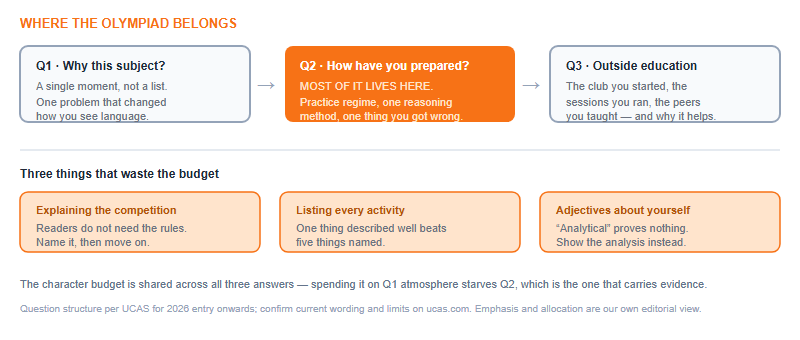
One practical consequence of the shared character budget: because every word in Question 1 is a word not spent on Question 2, the atmospheric opening that used to be conventional is now expensive. Say why the subject in a few concrete lines, then get to evidence.
Where it belongs in a US application
The Common Application handles this differently and far more brutally. The activities section gives you a very short description field — on the order of 150 characters, though you should check the current limit in the application itself — which is roughly one sentence. That is not enough room for a story, so do not attempt one.
Use the activity line for facts a reader cannot infer: what the competition is in three words, what you actually did, what the outcome was in plain terms. Something with the shape of “National linguistics olympiad; sat the open round, placed above the median; ran a fortnightly practice group for younger students” uses the space well, because every clause carries information. Words like passionate, prestigious and rigorous carry none and cost characters.
The reasoning story then belongs in a supplemental essay, and only where the prompt invites it — an intellectual-curiosity or “why this major” prompt, typically. A common error is to write the same paragraph in both places, which wastes the activity line and makes the supplement redundant.
Four rewrites, before and after
Below is the specificity ladder we use with students. Each rung proves strictly more than the one beneath it, and the top rung is the only one someone who did not do the work could not have written.
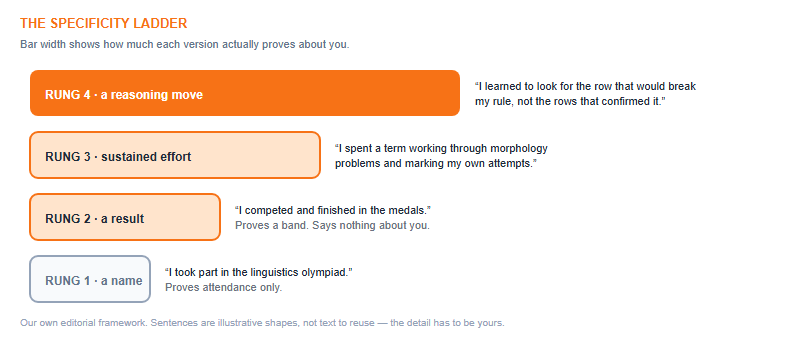
Applied to real sentences, the move is always the same: replace a claim about your qualities with a description of something you did.
| Where | The version readers have seen | The version that carries evidence |
|---|---|---|
| UK, Q1 | “I have always been fascinated by language.” | “I did not expect a language I had never seen to have a grammar I could recover from twenty lines of data in an afternoon.” |
| UK, Q2 | “The olympiad developed my analytical skills.” | “Working on segmentation problems taught me to hold two analyses open until a single form ruled one of them out.” |
| UK, Q2 | “I found the problems challenging but rewarding.” | “My recurring mistake was committing to the first pattern that fitted; I now check the data that would falsify it before writing anything down.” |
| UK, Q3 | “I founded the linguistics club at my school.” | “I set and marked the practice problems for our fortnightly group, which showed me how differently people read identical data.” |
| US, activities | “Passionate participant in prestigious linguistics competition.” | “National linguistics olympiad: sat the open round, placed above the median; ran fortnightly practice sessions for younger students.” |
Do not copy these. They are shapes, and a sentence lifted from a public page is worse than a flat sentence of your own — it is not yours, and it will not survive a conversation at interview. Write your version of the third row in particular: naming a mistake you fixed is the single most persuasive move available, and almost nobody makes it.
One caution on scope. Nothing here is a claim about outcomes. No competition result causes an admissions decision, and any adviser who tells you otherwise is selling something. What good writing does is make the work you genuinely did legible to a reader who has ninety seconds. If you are still deciding whether to commit a year to this at all, that is a different question — our overview of the competition is the better starting point, and our twelve-week study plan shows what the commitment actually looks like week by week.
Finally, a note on evidence. Rung 3 and Rung 4 sentences only exist if you kept some record. Log which problems you attempted, what you got wrong and what you changed — that log becomes your Question 2 material without any invention. If you need papers to work through, we keep our own compiled pack of past problems, with worked solutions for some years rather than every year; scan the QR in the site footer to request it.
Questions we get asked
Should I mention the olympiad if I did not win anything?
Yes, if you did real work. Describe the practice and one reasoning method. Effort described precisely beats an award described vaguely.
Where does it go in a UCAS application?
Mostly in question two, on how you prepared. Club leadership fits question three. Confirm the current question wording on ucas.com.
How do I describe an Honourable Mention?
Say you finished at or above the median of the field, which is what the regulations define it as, and then move on to what you learned.
Is a linguistics olympiad result useful for a computer science application?
It can evidence formal reasoning on unfamiliar data. Describe the reasoning, not the medal, and never claim a causal effect on admission.
This is an independent guide operated by Hanlin Education for China-based international-school students. We are not affiliated with, endorsed by, or sponsored by the IOL Board, and we are not affiliated with UCAS or the Common Application. Award ratios are set by the organisers and application formats by the admissions services; both can change — confirm current details on ioling.org, ucas.com and the relevant application platform. No competition result guarantees any admissions outcome. Errors reported to our editorial desk are corrected within 7 working days.
Keep reading.
From Three Hours to Six: What Actually Changes Between a National Round Paper and an IOL Paper
A national open round gives you roughly 25 minutes a problem; the IOL gives you over an hour. Four things that change…
How to Mark Your Own Linguistics Olympiad Practice Paper When There Is No Solution Sheet
Worked solutions do not exist for every past paper. A five-band self-marking rubric, the regeneration test, and the four ways students quietly…
The Deadline Before the Deadline: Planning a 2026-27 Linguistics Olympiad Autumn Backwards From the Sitting
Registration for the coming cycle is reported to close earlier than usual. An autumn planned backwards from the sitting, with compression options…