
A linguistics olympiad marker never sees the analysis in your head. They see a sheet of paper, alongside many others. Everything you worked out has to survive that trip. This article is not about how marks are allocated — it is about the physical artefact you hand in: how to gloss, how to state a rule so it can be checked in ten seconds, and how to lay out a page so nothing correct goes unread.
The marker sees the page, not your reasoning
Think of your script as a piece of evidence rather than a record. Two solvers can reach the same analysis and score differently, because one of them left the analysis implicit in a translation and the other wrote it down where it could be found. This is not unfair; it is the only thing a marker can act on.
Three consequences follow, and they shape everything below:
- An answer that requires interpretation is a risk you chose to take. If a marker has to decide whether the scribble in the margin is your final answer or an abandoned attempt, you have handed them a coin flip.
- A conclusion is worth less than a conclusion plus its rule. Six correct translations show you probably cracked it. Six translations plus a three-line statement of the morphology show you definitely did, and protect you if one translation is wrong.
- Legibility is content. A symbol a marker cannot read is a symbol you did not write.
None of this requires you to be a faster solver. It requires ten to fifteen minutes of the paper to be spent deliberately on presentation, and a handful of conventions rehearsed until they are automatic. If you are still choosing which contest to aim at, our introduction to the International Linguistics Olympiad sets out the route; if you already solve problems, the habits here are usually worth more than another problem type in your repertoire.
The three-line gloss, and when to use it
The standard way linguists present an example from an unfamiliar language is three aligned lines, often called Leipzig-style glossing. It exists because it makes a claim about structure visible instantly, which is exactly what you need from a marker who is scanning.
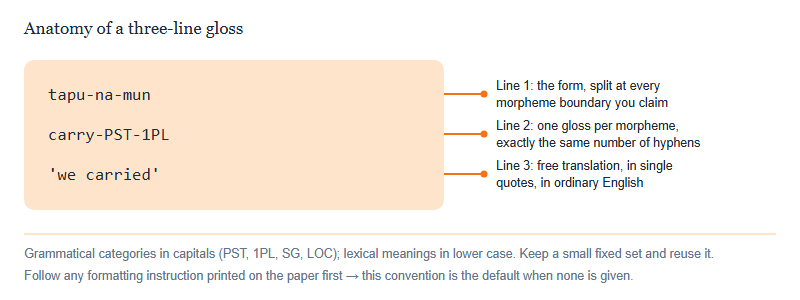
Two details do most of the work. First, the hyphens: if line 1 has two boundaries, line 2 must have two, and each piece must sit directly above or below its partner. A mismatch tells the marker that you have not decided how many morphemes there are. Second, the capitals: writing PST rather than “past” separates grammatical function from dictionary meaning at a glance, and stops you writing a shapeless string like “carry past we” that could mean several analyses.
Equally important is knowing when to skip it. Glossing every form on the paper is a classic time sink. Use a full three-line gloss when the question asks you to analyse structure, when you are introducing your segmentation for the first time, or when a form is your main evidence for a rule. For a plain translation question, a clean translation is the answer; add a one-line note only if your reading is unusual.


Rule statements a marker can check in ten seconds
A rule statement should be falsifiable on sight. That means it names what changes, what it changes into, the environment, the scope, and the rows that support it. Compare the two columns below; the left-hand versions are what tired solvers write at minute 150, and they are close to worthless.
| What a marker cannot use | What a marker can check immediately |
|---|---|
| “The vowel changes sometimes.” | “R1: u becomes i when the next syllable contains i (rows 2, 5, 7). No counterexamples in the data.” |
| “Plural is formed with a suffix.” | “R2: plural = stem + -ta; -ta appears as -da after a nasal (rows 3, 8). All other stems take -ta.” |
| “The word order is different from English.” | “R3: main clauses are Subject–Object–Verb (rows 1–6). The verb precedes the object only in questions (row 9).” |
| “Possession is marked on the noun.” | “R4: possessor prefix on the noun, agreeing in person and number (rows 4, 6, 11); no prefix in the 3rd person singular (row 10).” |
Add two further habits when rules interact. Number them (R1, R2) so you can refer back without rewriting, and if the order of application matters, say so explicitly — “R1 applies before R2; the form in row 7 proves it, since applying R2 first would give the wrong output.” Ordering is often the most sophisticated observation available in a problem, and it is invisible unless stated.
Finally, state your scope honestly. “This holds for all nouns in the data; I have no evidence about verbs” is a stronger answer than a sweeping rule that a marker can break with one row.
Paradigm tables: the shape that shows you understood the system
When a problem hands you an inflectional system, the fastest way to prove you have solved it is to build the grid the language implies and fill it. A table does three things at once: it displays the morpheme inventory, it shows the order of the pieces, and it exposes any gap you have not yet accounted for.
| Person / number | Present | Past | Segmentation of the past form |
|---|---|---|---|
| 1st singular | tapumi | tapunami | tapu-na-mi (carry-PST-1SG) |
| 2nd singular | tapusi | tapunasi | tapu-na-si (carry-PST-2SG) |
| 3rd singular | taputi | tapunati | tapu-na-ti (carry-PST-3SG) |
| 1st plural | tapumun | tapunamun | tapu-na-mun (carry-PST-1PL) |
| 2nd plural | tapusun | tapunasun | tapu-na-sun (carry-PST-2PL) |
| 3rd plural | taputun | tapunatun | tapu-na-tun (carry-PST-3PL) |
Notice what the table makes obvious without a sentence of prose: the person endings are identical in both tenses, the plural is built on the singular consonant plus -un, and the tense marker sits between root and person. A marker takes that in at a glance. Written as continuous prose, the same content takes a paragraph and is far easier to misread.
Three rules for tables under exam conditions. Label both axes, even when it feels obvious to you. Leave a cell blank rather than filling it with a guess, and mark predicted forms you were not given with a symbol you define — a question mark or a raised dot — so the marker can tell attested forms from your own extrapolations. And if the paper asks for specific forms, still copy them into the answer space next to the question number; a table is supporting evidence, not a substitute for answering where you were told to answer.
Working, crossings-out and the order of the page
Most avoidable losses we see when marking practice scripts in our own walkthrough sessions are not analytical at all. They come from the geography of the page: the right answer exists somewhere on the sheet, but not where it was asked for, or not distinguishable from three abandoned attempts around it.
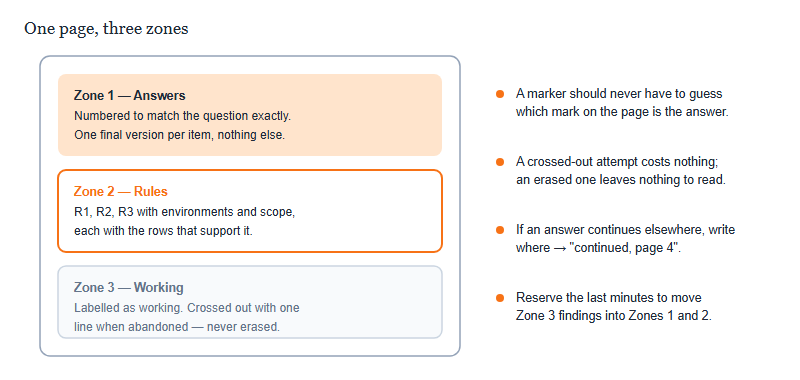
A few specifics that repeatedly matter:
- Never erase. Strike through with a single line. A partially correct abandoned attempt can still be readable evidence; an erased one is nothing.
- Mark the final version. If you have changed your mind twice, write the surviving answer clearly and label it. Boxing it is enough.
- Copy unfamiliar symbols exactly. If the data uses a diacritic or a letter you do not normally write, reproduce it as printed rather than substituting a familiar letter. Substitution can turn a correct answer into a different word.
- Watch ambiguous handwriting. Under time pressure, a and o, u and n, l and the digit 1 converge. Slow down for those four glyphs specifically; it costs seconds and protects whole items.
- Answer what was asked, in the quantity asked. If six translations are requested, count six on the page. If both directions are required, check both are present. This is the single cheapest audit available.
Budget for it. In practice, reserving roughly the last ten minutes of a long paper for transcription and checking, rather than for one more attempt at the hardest item, is the higher-expected-value choice for almost every solver. Scripts that under-score are rarely wrong throughout; they are right in the margin and blank in the answer box.
A two-minute sweep before you hand in
Run this list in order. It is designed so that each item takes seconds and catches a category of loss the others do not:
- Every question number on the paper has something written next to it — even a partial rule beats a blank.
- The number of items you produced matches the number requested, counted rather than assumed.
- Both directions are done wherever both were asked for.
- Every rule has an environment, a scope and the rows supporting it, and interacting rules have an order.
- Ambiguities are flagged as ambiguities, with the alternative given, rather than silently resolved.
- Hyphen counts match between your form lines and your gloss lines.
- Abandoned working is struck through and labelled; final answers are unambiguous.
- Unfamiliar symbols and diacritics are copied as printed, and your four risky glyphs are legible.
Rehearse the sweep during practice, not for the first time in the contest hall. The most effective way to build it is to mark someone else’s script — a club partner’s, or your own from three weeks ago — because the experience of failing to find an answer that is definitely somewhere on the page changes how you write forever. Our free past-problem practice pack is a convenient source of material to solve, swap and mark under something close to real conditions; the point is not the problems themselves but the scripts they generate.
None of this substitutes for solving ability. A beautifully presented wrong analysis is still a wrong analysis. But among students who can already crack the data, presentation is where the remaining variance lives, and it is the part of performance that improves fastest — usually within two or three practice papers rather than two or three months.
Questions students ask
Is there an official notation I have to use?
Follow the instructions printed on your own paper first. Where none are given, standard interlinear glossing is the convention markers read fastest.
Should I gloss every form I translate?
No. Gloss when the question asks about structure or when a form is your main evidence for a rule. Otherwise a clean translation is the answer.
What if I run out of space in the answer box?
Continue elsewhere and write exactly where, such as “continued, page 4”. Never leave the marker searching for it.
Do crossed-out attempts hurt me?
Not if the final answer is clearly marked. A struck-through attempt can still show partial understanding, so strike through rather than erase.
IOL Club is an independent guide operated by Hanlin Education for China-based international-school students. We are not affiliated with, endorsed by, or sponsored by the IOL Board, and nothing here overrides the instructions printed on a contest paper. Formats and answer-booklet requirements change between editions, so confirm current details on ioling.org. If you spot an error, tell us and we will correct it within 7 working days.
Keep reading.
IOLC Consonant Digraphs: Why bh, mb and ng Stay Single Units in Rongga-Style Data
In the 2026 IOLC Newcomer/Junior Division Rongga problem note, bh, mb and ng are recorded as consonants. Learn a data-first method for…
IOLC Team Average: How Each Participating Member Changes the Score
Understand how the IOLC team average is calculated from the individual scores of actual participating members, how adding or removing a member…
IOLC 2027 Level Test: Run a 3-Hour, 4-Problem Mock Before March 7
Prepare for the IOLC 2027 Level Test (March 7) by simulating the latest source-backed 2026 regional format: three hours, four independent puzzles….